


Wydawcy
Katalog tematyczny
- Archeologia (109)
- Ekonomia, finanse, business (13704)
- Filozofia (1445)
- Historia (3040)
- Języki i językoznawstwo (2356)
- Lifestyle, hobby i rozrywka (475)
- Medycyna (9704)
- Nauki humanistyczne (4)
- Nauki o Ziemi i środowisku (2638)
- Nauki ścisłe (20412)
- Astronomia (294)
- Biologia (5119)
- Chemia (6540)
- Chemia analityczna (361)
- Chemia fizyczna (346)
- Chemia nieorganiczna (137)
- Chemia organiczna (535)
- Krystalografia (27)
- Minerologia (46)
- Fizyka (3309)
- Matematyka (4574)
- Nauki ścisłe, ogólnie (503)
- Nauki społeczne (8486)
- Nauki techniczne (13450)
- Prawo (1696)
- Publikacje informacyjne i interdyscyplinarne (1288)
- Religia i wierzenia (917)
- Technika komputerowa (4067)
- Zdrowie, relacje międzyludzkie i rozwój osobisty (657)





Informacje szczegółowe o książce
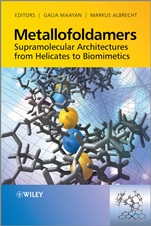
Metallofoldamers: Supramolecular Architectures from Helicates to Biomimetics
ISBN 9780470973233
Autor: Galia Maayan, Markus Albrecht
Wydawca: Wiley
Dostępność: 3-6 tygodni
Cena: 622,65 zł
Przed złożeniem zamówienia prosimy o kontakt mailowy celem potwierdzenia ceny.
ISBN13: |
9780470973233 |
ISBN10: |
0470973234 |
Autor: |
Galia Maayan, Markus Albrecht |
Oprawa: |
Hardback |
Rok Wydania: |
2013-03-08 |
Ilość stron: |
462 |
Wymiary: |
251x176 |
Tematy: |
PN |
Metallofoldamers are oligomers that fold into three–dimensionalstructures upon coordination with metal ions, and show an abilityto form helical structures and other three–dimensionalarchitectures. Several metallofoldamers have been applied assensors due to their selective folding when binding to a specificmetal ion, while others show promise for applications as responsivematerials on the basis of their ability to fold and unfold uponchanges in the oxidation state of the coordinated metal ion.
Metallofoldamers: Supramolecular Architectures from Helicatesto Biomimetics describes thevariety of interactions betweenoligomers and metal species, with a focus on non–natural syntheticmolecules. Topics coveredinclude:
Extract from Foreword by Nobel Prize Laureate Jean–MarieLehn
The editors have to be congratulated for assembling aremarkable roster of active players in the field, who deserve ourwarmest thanks for their expert contributions.
metalloproteins and metallopeptides introduction to un–natural foldamers helicates: self–assembly, structure and applications metallo–PNA and DNA interactions of biomimetic oligomers with metal ions applications of metallofoldamersList of Contributors xi
Foreword xiii
Preface xv
1 Metalloproteins and Metallopeptides NaturalMetallofoldamers 1
Vasiliki Lykourinou and Li–June Ming
1.1 Introduction 1
1.2 Metalloproteins 2
1.3 Metallopeptides 12
1.4 Conclusion and Perspectives 28
Acknowledgements 30
References 30
2 Introduction to Unnatural Foldamers 51
Claudia Tomasini and Nicola Castellucci
2.1 General Definition of Foldamers 51
2.2 Biotic Foldamers 53
2.3 Abiotic Foldamers 70
2.4 Organization Induced by External Agents 72
2.5 Applications 78
2.6 Conclusions and Outlook 81
References 81
3 Self–Assembly Principles of Helicates 91
Josef Hamacek
3.1 Introduction 91
3.2 Thermodynamic Considerations in Self–Assembly 93
3.3 Cooperativity in Self–Assembly 100
3.4 Kinetic Aspects of Multicomponent Organization 104
3.5 Understanding Self–Assembly Processes 108
3.6 Secondary Structure and Stabilizing Interactions 118
3.7 Conclusions 118
References 120
4 Structural Aspects of Helicates 125
Martin Berg and Arne Lützen
4.1 Introduction 125
4.2 Structural Dynamics 127
4.3 Template Effects 129
4.4 Sequence Selectivity 130
4.5 Self–Sorting Effects in Helicate Formation 135
4.6 Diastereoselectivity I Meso –Helicateversus Helicate Formation 138
4.7 Diastereoselectivity II Enantiomerically PureHelicates from Chiral Ligands 139
4.8 Summary and Outlook 150
References 151
5 Helical Structures Featuring Thiolato Donors 159
F. Ekkehardt Hahn and Dennis Lewing
5.1 Introduction 159
5.2 Coordination Chemistry of Bis– andTris(Benzene–o–Dithiolato) Ligands 162
5.3 Coordination Chemistry of MixedBis(Benzene–o–Dithiol)/Catechol Ligands 176
5.4 Subcomponent Self–Assembly Reactions 181
5.5 Summary and Outlook 186
References 186
6 Photophysical Properties and Applications of LanthanoidHelicates 193
Jean–Claude G. Bünzli
List of Acronyms and Abbreviations 193
6.1 Introduction 194
6.2 Homometallic Lanthanoid Helicates 197
6.3 Heterometallic d–f Helicates 223
6.4 Chiral Helicates 236
6.5 Extended Helical Structures 239
6.6 Perspectives 240
Acknowledgements 241
References 241
7 Design of Supramolecular Materials: Liquid–CrystallineHelicates 249
Raymond Ziessel
7.1 Introduction 249
7.2 Imino–Bipyridine and Imino–Phenanthroline Helicates 252
7.2.1 Liquid Crystals from Imino–Polypyridine Based Helicates257
7.3 Conclusions 266
7.4 Outlook and Perspectives 267
Acknowledgements 268
References 268
8 Helicates, Peptide–Helicates and Metal–AssistedStabilization of Peptide Microstructures 275
Markus Albrecht
8.1 Introduction 275
8.2 Selected Examples of Metal Peptide Conjugates 276
8.3 Helicates and Peptide–Helicates 279
8.4 Metal–Assisted Stabilization of Peptide Microstructures288
8.5 Conclusion 298
References 300
9 Artificial DNA Directed toward Synthetic Metallofoldamers303
Guido H. Clever and Mitsuhiko Shionoya
9.1 Introduction 303
9.2 The Quest for Alternative Base Pairing Systems 309
9.3 Design and Synthesis of Metal Base Pairs 311
9.4 Assembly and Analysis of Metal Base Pairs Inside the DNADouble Helix 315
9.5 Artificial DNA for Synthetic Metallofoldamers 318
9.6 Functions, Applications and Future Directions 324
References 327
10 Metal Complexes as Alternative Base Pairs or Triplets inNatural and Synthetic Nucleic Acid Structures 333
Arnie De Leon, Jing Kong, and Catalina Achim
10.1 Introduction 333
10.2 Brief Overview of Synthetic Analogues of DNA: PNA, LNA,UNA, and GNA 338
10.3 Metal–Containing, Ligand–Modified Nucleic Acid Duplexes340
10.4 Duplexes Containing Multiple Metal Complexes 361
10.5 Metal–Containing, Ligand–Modified Nucleic Acid Triplexes367
10.6 Summary and Outlook 367
Acknowledgement 369
Abbreviations 369
References 370
11 Interaction of Biomimetic Oligomers with Metal Ions379
Galia Maayan
11.1 Introduction 380
11.2 Single–Stranded Oligomers in Which Metal CoordinationTemplates, or Templates and Nucleates the Formation of an AbioticHelix 381
11.3 Folded Oligomers in Which Metal Coordination Nucleates theFormation of an Abiotic Single–Stranded Helix 384
11.4 Folded Oligomers in Which Metal Coordination EnhancesSecondary Structure and Leads to Higher–Order Architectures 393
11.5 Concluding Remarks 402
References 402
12 Applications of Metallofoldamers 407
Yan Zhao
12.1 Introduction 407
12.2 Metallofoldamers in Molecular Recognition 409
12.3 Metallofoldamers as Sensors for Metal Ions 414
12.4 Metallofoldamers as Dynamic Materials 419
12.5 Conclusions and Outlook 429
References 430
Index 433
Overall, the book is an interesting read and a useful reference for the chemistry of helicates and for those interested in metallosupramolecular chemistry more generally. (Applied Organometallic Chemistry, 31 October 2014)
Koszyk
Książek w koszyku: 0 szt.
Wartość zakupów: 0,00 zł
Informacje


Kontakt
Gambit
Centrum Oprogramowania
i Szkoleń Sp. z o.o.
Al. Pokoju 29b/22-24
31-564 Kraków
Siedziba Księgarni
ul. Kordylewskiego 1
31-542 Kraków
+48 12 410 5991
+48 12 410 5987
+48 12 410 5989
Subskrypcje
Administratorem danych osobowych jest firma Gambit COiS Sp. z o.o. Na podany adres będzie wysyłany wyłącznie biuletyn informacyjny.
Autoryzacja płatności

Informacje na temat autoryzacji płatności poprzez PayU.

© Copyright 2012: GAMBIT COiS Sp. z o.o. Wszelkie prawa zastrzeżone.
Projekt i wykonanie: Alchemia Studio Reklamy