


Wydawcy
Katalog tematyczny
- Archeologia (109)
- Ekonomia, finanse, business (13704)
- Filozofia (1445)
- Historia (3040)
- Języki i językoznawstwo (2356)
- Lifestyle, hobby i rozrywka (475)
- Medycyna (9704)
- Nauki humanistyczne (4)
- Nauki o Ziemi i środowisku (2638)
- Nauki ścisłe (20412)
- Nauki społeczne (8486)
- Edukacja (229)
- Kryminologia, opieka spełeczna (284)
- Obronność (10)
- Polityka (1389)
- Psychologia (777)
- Socjologia (410)
- Społeczeństwo i kultura (187)
- Nauki techniczne (13450)
- Prawo (1696)
- Publikacje informacyjne i interdyscyplinarne (1288)
- Religia i wierzenia (917)
- Technika komputerowa (4067)
- Zdrowie, relacje międzyludzkie i rozwój osobisty (657)





Informacje szczegółowe o książce
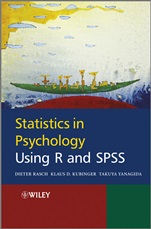
Statistics in Psychology Using R and SPSS
ISBN 9780470971246
Autor: Dieter Rasch, Klaus Kubinger, Takuya Yanagida
Wydawca: Wiley
Dostępność: 3-6 tygodni
Cena: 412,65 zł
Przed złożeniem zamówienia prosimy o kontakt mailowy celem potwierdzenia ceny.
ISBN13: |
9780470971246 |
ISBN10: |
047097124X |
Autor: |
Dieter Rasch, Klaus Kubinger, Takuya Yanagida |
Oprawa: |
Hardback |
Rok Wydania: |
2011-12-09 |
Ilość stron: |
564 |
Wymiary: |
261x188 |
Tematy: |
JC |
Statistics in Psychology presents the statistical methods needed for education and research in psychology. This book explores the process of empirical research in the following seven stages: formulation of the problem, stipulation of the precision requirements, selecting the statistical model for the planning and analysis, the (optimal) design of the experiment or survey, performing the experiment or the survey, statistical analysis and the interpretation of the observed results.
Key features:Explores solutions to real life problems by using software packages R and SPSS, whilst keeping formulae to a minimum.Addresses simple statistics along with univariate and multivariate methods and experimental design, such as accurate calculation of sample sizes.Discusses and uses results on characteristics of statistical test proceduresIs supported by an accompanying website featuring R and SPSS.
The authors address both basic and advanced levels. Students of psychology will find this book useful, as well as researchers and students in the social and behavioural sciences.
Spis treści:
Introduction.
1 Concept of the Book.
2 Measuring in Psychology.
2.1 Types of psychological measurements.
2.2 Measurement techniques in psychological assessment.
2.3 Quality criteria in psychometrics.
2.4 Additional psychological measurement techniques.
2.5 Statistical models of measurement with psychological roots.
3 Psychology: An Empirical Science.
3.1 Gain of insight in psychology.
3.2 Steps of empirical research.
4 Definition: Character, Chance, Experiment, and Survey.
4.1 Nominal scale.
4.2 Ordinal scale.
4.3 Interval scale.
4.4 Ratio scale.
4.5 Characters and factors.
II Descriptive Statistics.
5 Numerical and graphical Data Analysis.
5.1 Introduction to data analysis.
5.2 Frequencies and empirical distributions.
5.3 Statistics.
5.4 Frequency distribution for several characters.
III Inferential Statistics for one Character.
6 Probability and distribution.
6.1 Relative frequencies and probabilities.
6.2 Random variable and theoretical distributions.
6.3 Quantiles of theoretical distribution functions.
6.4 Mean and variance of theoretical distributions.
6.5 Estimation of unknown parameters.
7 Assumptions: Random Sampling and Randomization.
7.1 Simple random sampling in surveys.
7.2 Principles of random sampling and randomization.
8 One Sample from one Population.
8.1 Introduction.
8.2 The Parameter mof acharacter modeled by a normally distributed random variable.
8.3 Planning a study for hypothesis testing with respect to m.
8.4 Sequential tests for the unknown parameter m.
8.5 Estimation, hypothesis testing, planning the study, and sequential testing concerning other parameters.
9 Two Samples from two Populations.
9.1 Hypothesis testing, study planning and sequential testing regarding the unknown parameters m1 and m2.
9.2 Hypothesis testing, study planning and sequential testing for other parameters.
9.3 Equivalence testing.
10 Samples from more than two Populations.
10.1 The various problem situations.
10.2. Selection procedures.
10.3 Multiple comparisons of means.
10.4 Analysis of variance.
IV Descriptive and Inferential Statistics for two Characters.
11 Regression and Correlation.
11.1 Introduction.
11.2 Regression model.
11.3 Correlation coefficients and measures of association.
11.4 Hypothesis testing and planning the study concerning correlation coefficients.
11.5 Correlation analysis in two samples.
V Inferential Statistics for more than two Characters.
12 One Sample from one Population.
12.1 Association between three or more characters.
12.2 Hypothe
sis testing concerning a vector of means m.
12.3 Comparisons of means and "homological" methods for matched observations.
13 Samples from more than one Population.
13.1 General linear model.
13.2 Analysis of covariance.
13.3. Multivariate analysis of variance.
13.4 Discriminant analysis.
VI Model Generation and Theory–Generating Procedures.
14 Model Generation.
14.1 Theoretical basics of model generation.
14.2 Methods for determining the quality and excellence of a model.
14.2.1 Goodness of fit tests.
14.2.2 Coefficients of the goodness of fit.
14.2.3 Cross–validation.
14.4 Simulation: Non–analytical solutions to statistical problems.
15 Theory–Generating Procedures.
15.1 Descriptive statistics′ methods.
15.2 Methods of inferential statistics.
Okładka tylna:
Statistics in Psychology presents the statistical methods needed for education and research in psychology. This book explores the process of empirical research in the following seven stages: formulation of the problem, stipulation of the precision requirements, selecting the statistical model for the planning and analysis, the (optimal) design of the experiment or survey, performing the experiment or the survey, statistical analysis and the interpretation of the observed results.
Key features:Explores solutions to real life problems by using software packages R and SPSS, whilst keeping formulae to a minimum.Addresses simple statistics along with univariate and multivariate methods and experimental design, such as accurate calculation of sample sizes.Discusses and uses results on characteristics of statistical test proceduresIs supported by an accompanying website featuring R and SPSS.
The authors address both basic and advanced levels. Students of psychology will find this book useful, as well as researchers and students in the social and behavi
oural sciences.
Koszyk
Książek w koszyku: 0 szt.
Wartość zakupów: 0,00 zł
Informacje


Kontakt
Gambit
Centrum Oprogramowania
i Szkoleń Sp. z o.o.
Al. Pokoju 29b/22-24
31-564 Kraków
Siedziba Księgarni
ul. Kordylewskiego 1
31-542 Kraków
+48 12 410 5991
+48 12 410 5987
+48 12 410 5989
Subskrypcje
Administratorem danych osobowych jest firma Gambit COiS Sp. z o.o. Na podany adres będzie wysyłany wyłącznie biuletyn informacyjny.
Autoryzacja płatności

Informacje na temat autoryzacji płatności poprzez PayU.

© Copyright 2012: GAMBIT COiS Sp. z o.o. Wszelkie prawa zastrzeżone.
Projekt i wykonanie: Alchemia Studio Reklamy