


Wydawcy
Katalog tematyczny
- Archeologia (109)
- Ekonomia, finanse, business (13704)
- Filozofia (1445)
- Historia (3040)
- Języki i językoznawstwo (2356)
- Lifestyle, hobby i rozrywka (475)
- Medycyna (9704)
- Nauki humanistyczne (4)
- Nauki o Ziemi i środowisku (2638)
- Nauki ścisłe (20412)
- Astronomia (294)
- Biologia (5119)
- Chemia (6540)
- Chemia analityczna (361)
- Chemia fizyczna (346)
- Chemia nieorganiczna (137)
- Chemia organiczna (535)
- Krystalografia (27)
- Minerologia (46)
- Fizyka (3309)
- Matematyka (4574)
- Nauki ścisłe, ogólnie (503)
- Nauki społeczne (8486)
- Nauki techniczne (13450)
- Prawo (1696)
- Publikacje informacyjne i interdyscyplinarne (1288)
- Religia i wierzenia (917)
- Technika komputerowa (4067)
- Zdrowie, relacje międzyludzkie i rozwój osobisty (657)





Informacje szczegółowe o książce
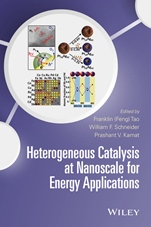
Heterogeneous Catalysis at Nanoscale for Energy Applications
ISBN 9780470952603
Autor: Franklin (Feng) Tao, William F. Schneider, Prashant V. Kamat
Wydawca: Wiley
Dostępność: 3-6 tygodni
Cena: 708,75 zł
Przed złożeniem zamówienia prosimy o kontakt mailowy celem potwierdzenia ceny.
ISBN13: |
9780470952603 |
ISBN10: |
0470952601 |
Autor: |
Franklin (Feng) Tao, William F. Schneider, Prashant V. Kamat |
Oprawa: |
Hardback |
Rok Wydania: |
2014-12-24 |
Ilość stron: |
344 |
Wymiary: |
243x158 |
Tematy: |
PN |
A comprehensive textbook and reference tool that provides state–of–the–art research and understanding of heterogeneous catalysis for efficient energy conversion One of the most crucial technologies at the forefront of materials chemistry, physical chemistry and chemical engineering topics is heterogeneous catalysis. The quality of our everyday lives owes much to the technology’s involvement in the efficient conversion of renewable energy with least environmental impact. Heterogeneous catalysis typically occurs on reactive sites of catalysts consisting of specific surface structures at the atomic scale. Both in–situ and ex–situ experimental techniques and theoretical approaches have been applied to study this mechanism used in energy conversion processes. Providing a foundation for the design and further development of new technical catalysts and technologies for energy economy, Heterogeneous Catalysis at Nanoscale for Energy Applications presents the fundamental concepts, latest achievements and promising solutions for global energy problems. The book features: Coverage of heterogeneous catalysis at the atomic– and nano– scales–––from synthesis, ex–situ and in–situ characterization, catalytic activity and selectivity, to mechanistic understanding based on experimental exploration and theoretical simulation Theoretical studies and experimental exploration on a range of energy conversion processes, providing an overview of modern catalysis and current trends in nanocatalysis research Discussion on the challenges that remain to overcome limitations imposed by oxygen reduction reaction at catalyst surface during the electrochemical operation, including electrochemical technologies Addressing heterogeneous catalysis, this comprehensive and authoritative text/reference is useful for graduate students, engineers and scientists in physical chemistry, materials chemistry, chemical engineering, nanoscience and nanotechnology, materials science, and environmental sciences. Franklin (Feng) Tao , PhD, is a tenured Miller associate professor of chemical engineering and chemistry at the University of Kansas. He leads a research group focusing on synthesis, evaluation of catalytic performance, and in–situ characterization of heterogeneous catalysts at nanoscale for chemical and energy transformations. He has published almost 100 papers and three books with Wiley and RSC. William F. Schneider , PhD, is a Professor of Chemical and Biomolecular Engineering at the University of Notre Dame. His research interests are in the application of theory and simulation to probe and predict the molecular details of surface chemical reactivity and catalysis. He has co–authored more than 130 papers and book chapters. Prashant V. Kamat , PhD, is Rev. John A. Zahm Professor of Science in the Department of Chemistry and Biochemistry, and Radiation Laboratory at the University of Notre Dame. For nearly three decades, he has worked to build bridges between physical chemistry and material science by developing semiconductor and metal nanostructure based hybrid assemblies for cleaner and efficient light energy conversion. He has co–authored more than 450 papers, reviews and book chapters.
Contents 1. Introduction Franklin (Feng) Tao, William F. Schneider, and Prashant Kamat 2. Chemical Synthesis of Nanoscale Heterogeneous Catalysts Jianbo Wu and Hong Yang 2.1 Introduction 2.2 Brief overview of heterogeneous catalysts 2.3 Chemical synthetic approaches 2.4 Core–shell nanoparticles and controls of surface compositions and surface atomic arrangements 2.5 Summary 3. Physical Fabrication of Nanostructured Heterogeneous Catalysts Chunrong Yin, Eric C. Tyo, and Stefan Vajda 3.1 Introduction 3.2 Cluster Sources 3.3 Mass Analyzers 3.4 Survey of Cluster Deposition Apparatuses in Catalysis Studies 4. Ex–situ Characterization Minghua Qiao, Songhai Xie, Yan Pei, and Kangnian Fan 4.1 Introduction 4.2 Ex–situ Characterization Techniques 4.3 Some Examples on Ex–situ Characterization of Nanocatalysts for Energy Applications 4.4 Conclusions 5. Applications of Soft X–ray Absorption Spectroscopy for in–situ Studies of Catalysts at Nanoscale Xingyi Deng, Xiaoli Gu, and Franklin (Feng) Tao 5.1 Introduction 5.2 In situ SXAS under reaction conditions 5.3 Examples of in situ SXAS studies under reaction conditions using reaction cells 5.4 Summary 6. First principles approaches to understanding heterogeneous catalysis Dorrell C. McCalman and William F. Schneider 6.1 Introduction 6.2 Computational models 6.3 NO x Reduction 6.4 Adsorption at Metal Surfaces 6.5 Elementary Surface Reactions Between Adsorbates 6.6 Coverage effects on reaction and activation energies at metal surfaces 6.7 Summary 7. Computational Screening for Improved Heterogeneous Catalysts and Electrocatalysts Jeffrey Greeley 7.1 Introduction 7.2 Trends–based studies in computational catalysis 7.3 Computational screening of heterogeneous catalysts and electrocatalysts 7.4 Challenges and new frontiers in computational catalyst screening 7.5 Conclusions 8. Catalytic Kinetics and Dynamics Rafael C. Catapan, Matthew A. Christiansen, Amir A. M. Oliveira, and Dionisios G. Vlachos 8.1 Introduction 8.2 Basics of Catalyst Functionality, Mechanisms, and Elementary Reactions on Surfaces 8.3 Transition State Theory, Collision Theory, and Rate Constants 8.4 Density Functional Theory (DFT) Calculations 8.5 Thermodynamic Consistency of the DFT–Predicted Energetics 8.6 State Properties from Statistical Thermodynamics 8.7 Semi–empirical Methods for Predicting Thermodynamic Properties and Kinetic Parameters 8.8 Analysis Tools for Microkinetic Modeling 8.9 Concluding Remarks 9. Catalysts for Biofuels Gregory T. Neumann and Jason C. Hicks 9.1 Introduction 9.2 Lignocellulosic biomass 9.3 Carbohydrate Upgrading 9.4 Lignin Conversion 9.5 Continued Efforts for the Development of Robust Catalysts 10. Development of New Gold Catalysts for Removing CO from H 2 Zhen Ma, Franklin (Feng) Tao, and Xiaoli Gu 10.1 Introduction 10.2 General description of catalyst development 10.3 Development of WGS catalysts 10.4 Development of new gold catalysts for PROX 10.5 Perspectives 11. Photocatalysis in Generation of Hydrogen from Water Kazuhiro Takanabe and Kazunari Domen 11.1 Solar energy conversion 11.2 Semiconductor particles: Optical and electronic nature 11.3 Photocatalyst materials for overall water splitting: UV to visible light response 11.4 Cocatalysts for photocatalytic overall water splitting 11.5 Concluding remarks 12. Photocatalysis in Conversion of Greenhouse Gases Kentaro Teramura and Tsunehiro Tanaka 12.1 Introduction 12.2 Outline of photocatalytic conversion of CO 2 12.3 Reaction mechanism for the photocatalytic conversion of CO 2 12.4 Summary 13. Electrocatalyst Design in Proton Exchange Membrane Fuel Cells for Automotive Application Anusorn Kongkanand, Wenbin Gu, and Frederick T. Wagner 13.1 Introduction 13.2 Advanced Electrocatalysts 13.3 Electrode Designs 13.4 Concluding Remarks
Franklin (Feng) Tao , PhD, is a tenured Miller associate professor of chemical engineering and chemistry at the University of Kansas. He leads a research group focusing on synthesis, evaluation of catalytic performance, and in–situ characterization of heterogeneous catalysts at nanoscale for chemical and energy transformations. He has published almost 100 papers and three books with Wiley and RSC. William F. Schneider , PhD, is a Professor of Chemical and Biomolecular Engineering at the University of Notre Dame. His research interests are in the application of theory and simulation to probe and predict the molecular details of surface chemical reactivity and catalysis. He has co–authored more than 130 papers and book chapters. Prashant V. Kamat , PhD, is Rev. John A. Zahm Professor of Science in the Department of Chemistry and Biochemistry, and Radiation Laboratory at the University of Notre Dame. For nearly three decades, he has worked to build bridges between physical chemistry and material science by developing semiconductor and metal nanostructure based hybrid assemblies for cleaner and efficient light energy conversion. He has co–authored more than 450 papers, reviews and book chapters.
Koszyk
Książek w koszyku: 0 szt.
Wartość zakupów: 0,00 zł
Informacje


Kontakt
Gambit
Centrum Oprogramowania
i Szkoleń Sp. z o.o.
Al. Pokoju 29b/22-24
31-564 Kraków
Siedziba Księgarni
ul. Kordylewskiego 1
31-542 Kraków
+48 12 410 5991
+48 12 410 5987
+48 12 410 5989
Subskrypcje
Administratorem danych osobowych jest firma Gambit COiS Sp. z o.o. Na podany adres będzie wysyłany wyłącznie biuletyn informacyjny.
Autoryzacja płatności

Informacje na temat autoryzacji płatności poprzez PayU.

© Copyright 2012: GAMBIT COiS Sp. z o.o. Wszelkie prawa zastrzeżone.
Projekt i wykonanie: Alchemia Studio Reklamy