


Wydawcy
Katalog tematyczny
- Archeologia (109)
- Ekonomia, finanse, business (13704)
- Filozofia (1445)
- Historia (3040)
- Języki i językoznawstwo (2356)
- Lifestyle, hobby i rozrywka (475)
- Medycyna (9704)
- Nauki humanistyczne (4)
- Nauki o Ziemi i środowisku (2638)
- Nauki ścisłe (20412)
- Nauki społeczne (8486)
- Nauki techniczne (13450)
- Budownictwo lądowe (1045)
- Chemia przemysłowa (2258)
- Elektronika i telekomunikacja (3287)
- Energetyka (1122)
- Inne nauki stosowane (363)
- Inżynieria biochemiczna (507)
- Inżynieria transportu (232)
- Mechanika i materiały (3316)
- Nauka o środowisku (321)
- Rolnictwo (507)
- Technika, ogólnie (475)
- Prawo (1696)
- Publikacje informacyjne i interdyscyplinarne (1288)
- Religia i wierzenia (917)
- Technika komputerowa (4067)
- Zdrowie, relacje międzyludzkie i rozwój osobisty (657)



Informacje szczegółowe o książce
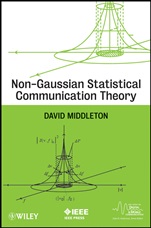
Non–Gaussian Statistical Communication Theory
ISBN 9780470948477
Autor: David Middleton
Wydawca: Wiley
Dostępność: 3-6 tygodni
Cena: 687,75 zł
Przed złożeniem zamówienia prosimy o kontakt mailowy celem potwierdzenia ceny.
ISBN13: |
9780470948477 |
ISBN10: |
0470948477 |
Autor: |
David Middleton |
Oprawa: |
Hardback |
Rok Wydania: |
2012-09-07 |
Ilość stron: |
664 |
Wymiary: |
259x179 |
Tematy: |
TJ |
Non–Gaussian Statistical Communication Theory
Since its inception in the late 1930s, Statistical CommunicationTheory (SCT) has grown into a major field of study, applicable tomany branches of science. This authoritative and provocative textis a legacy left behind by the late Dr. David Middleton apioneer of SCT. He works from a vision?of communication as thecentral operation of discovery in all the sciences. His applicationof Non–Gaussian Space–Time methodology to SCT clarifies manyunresolved signal and noise problems, especially those?prevalent insonar and radar signal processing.?These and other SCT problemsare?approached as cases of a larger space–time?signal processingproblem.
In addition to a review of the traditional theory, readers willfind fascinating chapters on:
Reception as a Statistical Decision Problem
Space–Time Processing and Space–Time Matched Filters
Wave–Number Frequency Analysis
Optimum Detection with Scattering, Arrays, and Beam Forming
Multiple Alternative Detection
Bayes Extraction Systems
Joint Detection and Estimation and Estimation When Signals MayNot Be Present
Canonical Channels
Non–Gaussian Detection and Estimation
Non–Gaussian and Inhomogeneous Wiener–Khintchine Problems
At his death in 2008, Dr. Middleton had completed 10 of 24planned chapters. Nine of these have been exhaustively edited bySeries Editor John Anderson and are presented here, together withMiddleton′s original plan for the entire book. Forewords byMiddleton′s colleague Vincent Poor and by the Editor show how thismassive project was brought to completion.
Foreword xv
Visualizing the Invisible xvii
Acknowledgments xxi
About the Author xxiii
Editor′s Note xxv
Introduction 1
1 Reception as a Statistical Decision Problem 15
1.1 Signal Detection and Estimation, 15
1.2 Signal Detection and Estimation, 17
1.3 The Reception Situation in General Terms, 22
1.4 System Evaluation, 27
1.5 A Summary of Basic Definitions and Principal Theorems,35
1.6 Preliminaries: Binary Bayes Detection, 40
1.7 Optimum Detection: On Off Optimum ProcessingAlgorithms, 46
1.8 Special On Off Optimum Binary Systems, 50
1.9 Optimum Detection: On Off Performance Measures andSystem Comparisons, 57
1.10 Binary Two–Signal Detection: Disjoint and OverlappingHypothesis Classes, 69
2 Space–Time Covariances and Wave Number Frequency Spectra:I. Noise and Signals with Continuous and Discrete Sampling77
2.1 Inhomogeneous and Nonstationary Signal and Noise Fields I:Waveforms, Beam Theory, Covariances, and Intensity Spectra, 78
2.2 Continuous Space–Time Wiener–Khintchine Relations, 91
2.3 The W Kh Relations for Discrete Samples in theNon–Hom–Stat Situation, 102
2.4 The Wiener Khintchine Relations for Discretely SampledRandom Fields, 108
2.5 Aperture and Arrays–I: An Introduction, 115
2.6 Concluding Remarks, 138
3 Optimum Detection, Space–Time Matched Filters, and BeamForming in Gaussian Noise Fields 141
3.1 Optimum Detection I: Selected Gaussian Prototypes–CoherentReception, 142
3.2 Optimum Detection II: Selected GaussianPrototypes–Incoherent Reception, 154
3.3 Optimal Detection III: Slowly Fluctuating Noise Backgrounds,176
3.4 Bayes Matched Filters and Their Associated Bilinear andQuadratic Forms, I, 188
3.5 Bayes Matched Filters in the Wave Number FrequencyDomain, 219
3.6 Concluding Remarks, 235
4 Multiple Alternative Detection 239
4.1 Multiple–Alternative Detection: The Disjoint Cases, 239
4.2 Overlapping Hypothesis Classes, 254
4.3 Detection with Decisions Rejection: Nonoverlapping SignalClasses, 262
5 Bayes Extraction Systems: Signal Estimation and Analysis,p(H1) = 1 271
5.1 Decision Theory Formulation, 272
5.2 Coherent Estimation of Amplitude (Deterministic Signals andNormal Noise, p(H1) = 1), 287
5.3 Incoherent Estimation of Signal Amplitude (DeterministicSignals and Normal Noise, p(H1) = 1), 294
5.4 Waveform Estimation (Random Fields), 300
5.5 Summary Remarks, 304
6 Joint Detection and Estimation, p(H1) 1: I.Foundations 307
6.1 Joint Detection and Estimation under Prior Uncertainty[p(H1) 1]: Formulation, 309
6.2 Optimal Estimation [ p(H1) 1]: No Coupling, 315
6.3 Simultaneous Joint Detection and Estimation: General Theory,326
6.4 Joint D and E: Examples Estimation of SignalAmplitudes [p(H1) 1], 350
6.5 Summary Remarks, p(H)1 1: I–Foundations, 378
7 Joint Detection and Estimation under Uncertainty, pk(H1)< 1.
II. Multiple Hypotheses and Sequential Observations 381
7.1 Jointly Optimum Detection and Estimation under MultipleHypotheses, p(H1) 1, 382
7.2 Uncoupled Optimum Detection and Estimation, MultipleHypotheses, and Overlapping Parameter Spaces, 400
7.3 Simultaneous Detection and Estimation: Sequences ofObservations and Decisions, 407
7.4 Concluding Remarks, 428
8 The Canonical Channel I: Scalar Field Propagation in aDeterministic Medium 435
8.1 The Generic Deterministic Channel: Homogeneous UnboundedMedia, 437
8.2 The Engineering Approach: I–The Medium and Channel asTime–Varying Linear Filters (Deterministic Media), 465
8.3 Inhomogeneous Media and Channels–Deterministic Scatter andOperational Solutions, 473
8.4 The Deterministic Scattered Field in Wave Number–FrequencySpace: Innovations, 494
8.5 Extensions and Innovations, Multimedia Interactions, 499
8.6 Energy Considerations, 509
8.7 Summary: Results and Conclusions, 535
9 The Canonical Channel II: Scattering in Random Media;"Classical" Operator Solutions 539
9.1 Random Media: Operational Solutions–First– and Second–OrderMoments, 541
9.2 Higher Order Moments Operational Solutions for The LangevinEquation, 565
9.3 Equivalent Representations: Elementary Feynman Diagrams,580
9.4 Summary Remarks, 598
References, 599
Appendix A1 601
Index 617
David Middleton, PhD, graduated from Harvard Universitywhere he began his career at the institution′s Radio ResearchLaboratory working on radar countermeasures as well aspassive and active jamming during World War II beforeteaching there. A recipient of numerous prizes and awards relatedto his work on communication theory, Dr. Middleton was a fellow ofthe IEEE, the American Physical Society, the Acoustical Society ofAmerica, and the American Association for the Advancement ofScience.
Koszyk
Książek w koszyku: 0 szt.
Wartość zakupów: 0,00 zł
Informacje


Kontakt
Gambit
Centrum Oprogramowania
i Szkoleń Sp. z o.o.
Al. Pokoju 29b/22-24
31-564 Kraków
Siedziba Księgarni
ul. Kordylewskiego 1
31-542 Kraków
+48 12 410 5991
+48 12 410 5987
+48 12 410 5989
Subskrypcje
Administratorem danych osobowych jest firma Gambit COiS Sp. z o.o. Na podany adres będzie wysyłany wyłącznie biuletyn informacyjny.
Autoryzacja płatności

Informacje na temat autoryzacji płatności poprzez PayU.

© Copyright 2012: GAMBIT COiS Sp. z o.o. Wszelkie prawa zastrzeżone.
Projekt i wykonanie: Alchemia Studio Reklamy