


Wydawcy
Katalog tematyczny
- Archeologia (109)
- Ekonomia, finanse, business (13704)
- Filozofia (1445)
- Historia (3040)
- Języki i językoznawstwo (2356)
- Lifestyle, hobby i rozrywka (475)
- Medycyna (9704)
- Nauki humanistyczne (4)
- Nauki o Ziemi i środowisku (2638)
- Nauki ścisłe (20412)
- Nauki społeczne (8486)
- Nauki techniczne (13450)
- Prawo (1696)
- Publikacje informacyjne i interdyscyplinarne (1288)
- Religia i wierzenia (917)
- Technika komputerowa (4067)
- Zdrowie, relacje międzyludzkie i rozwój osobisty (657)





Informacje szczegółowe o książce
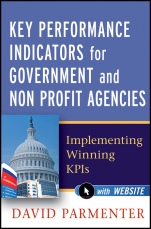
Key Performance Indicators for Government and Non Profit Agencies: Implementing Winning KPIs
ISBN 9780470944547
Autor: David Parmenter
Wydawca: Wiley
Dostępność: 3-6 tygodni
Cena: 248,85 zł
Przed złożeniem zamówienia prosimy o kontakt mailowy celem potwierdzenia ceny.
ISBN13: |
9780470944547 |
ISBN10: |
0470944544 |
Autor: |
David Parmenter |
Oprawa: |
Hardback |
Rok Wydania: |
2012-05-15 |
Ilość stron: |
336 |
Wymiary: |
237x153 |
Tematy: |
KM |
Praise for Key Performance Indicators for Government and Non profit Agencies "David Parmenter is a leading thinker on performance measurement. I admire his work very much. This application of David′s seminal thinking on KPIs to the public and non profit sectors is a major contribution to the field. Any practitioner or manager who is serious about improving measurement in their organizations should read this book." Dean R. Spitzer, PhD, author of Transforming Performance Measurement "Government and non profit agencies are both completely different and at the same time exactly the same as private sector organizations. David has done a brilliant job of presenting the best practices and lessons (hard) learned from the private sector, as applied in the mission–driven sector. This powerful and unique view should help prevent society from ′re–learning′ what has been learned, and leverage those best practices forward to benefit all. This work surpasses all previous works in capturing what society has learned and applying it where it is needed most." Brett Knowles, Executive Partner, pm2 Performance Measurement and Management "It′s about time someone raised the questions that David Parmenter does in his new book Key Performance Indicators for Government and Non Profit Agencies. For too long, managers and strategy and performance professionals have blindly followed assumptions about what performance measurement is about, wasting vast amounts of time and effort measuring the wrong things in the wrong ways. David reminds us, in his usual practical fashion, how to return to a more meaningful way of measuring performance." Stacey Barr, author, presenter, and facilitator, PuMP Performance Measure Blueprint Workshops and Online Programs "In his new book, David Parmenter brings a breath of fresh air to the art of crafting and implementing performance metrics. With a keen eye for how measurement works in the crucible of business operations, David once again provides page after page of practical, no–nonsense advice about how to measure business performance. And with his relentless focus on results, he′s not afraid to poke holes at sacred methodologies and complex approaches. This book is chock–full of practical nuggets of advice. It′s a manual for performance management success." Wayne Eckerson, Principal, BI Leader Consulting
Preface xiii Acknowledgments xxi PART I SETTING THE SCENE CHAPTER 1 Background 3 Are Agencies Really Non Profit Agencies? 3 Measurement in Government and Non Profit Agencies 3 Unintended Behavior: The Dark Side of Measures 4 Balanced Scorecards within Government and Non Profit Agencies 6 Checklist: Where Are You in Your Journey with Performance Measures? 6 Major Benefits of Performance Measures 8 Notes 10 CHAPTER 2 Myths of Performance Measurement 13 Myth 1: Measuring Performance Is Relatively Simple and the Appropriate Measures Are Very Obvious 13 Myth 2: You Can Delegate a Performance Management Project to a Consulting Firm 14 Myth 3: Your In–House Project Team Can Achieve Success while Continuing with Their Other Duties 14 Myth 4: By Tying KPIs to Pay You Will Increase Performance 14 Myth 5: Most Measures Lead to Better Performance 15 Myth 6: Performance Measures Are Mainly Used to Help Manage Implementation of Strategic Initiatives 16 Myth 7: The Balanced Scorecard Was First Off the Blocks 17 Myth 8: Measures Fit Neatly into One Balanced–Scorecard Perspective 18 Myth 9: The Balanced Scorecard Can Report Progress to Both Management and the Board 18 Myth 10: There Are Only Four Balanced–Scorecard Perspectives 18 Myth 11: Strategy Mapping Is a Vital Requirement 20 Myth 12: All Performance Measures Are KPIs 22 Myth 13: Monitoring Monthly Performance Measures Will Improve Performance 23 Myth 14: KPIs Are Financial and Nonfinancial Indicators 23 Myth 15: The More Measures the Better 23 Myth 16: Indicators Are Either Lead (Performance Driver) or Lag (Outcome) Indicators 24 Myth 17: We Know What Good Performance Will Look Like Before the Year Starts and, thus, Can Set Relevant Year–End Targets 24 Notes 25 CHAPTER 3 Revitalizing Performance Management 27 Foundation Stone 1: Understanding Human Behavior 27 Foundation Stone 2: Knowledge of the Paradigm Shifters (Drucker, Collins, Welch, Hamel, Peters, Waterman, and Others) 29 Foundation Stone 3: Using an Appropriate Strategy 44 Foundation Stone 4: Critical Success Factors Known by All Staff 45 Foundation Stone 5: Abandon Processes That Do Not Work 45 Rejuvenating Human Resources 46 Performance–Related Pay: Correcting the Errors 47 Reviewing an Individual’s Performance 48 Getting the Right People on the Bus 48 Jack Welch’s 20/70/10 Differentiation Rule 49 Secrets from High–Performing Teams 49 Toyota’s 14 Principles 50 Role of Performance Measures: Implementing Winning KPIs 51 Quarterly Rolling Planning: The Setting of Targets 51 Reporting Performance 52 Outside–In View 53 Adopting Kaizen 53 Working Smarter Not Harder 54 Getting Technology to Deliver 54 Moving from Management to Leadership 55 Notes 55 CHAPTER 4 Measurement Leadership Has to Come from the Chief Executive Officer 57 Barriers to Measurement Leadership 57 The Way Forward for the Chief Executive Officer 58 Appoint a Chief Measurement Officer 60 Notes 60 CHAPTER 5 Strategy and Its Relevance to Performance Measures 61 Define Your Organization’s Mission, Vision, Values 61 Create a Strategy That Is Understood by Staff 63 Ensure That Your Strategy Is Balanced 64 Monitor Implementation of Your Strategy 66 Creating the Future 66 Replace the Annual Planning Process with Rolling Planning 67 Notes 67 PART II WINNING KPIs METHODOLOGY CHAPTER 6 The Great KPI Misunderstanding 71 Key Result Indicators 71 Performance and Result Indicators 73 Key Performance Indicators 74 Seven Characteristics of KPIs 76 Difference between Key Results Indicators and KPIs 78 Lead and Lag Confusion 79 10/80/10 Rule 81 Importance of Timely Measurement 82 Note 83 CHAPTER 7 Finding Your Organization’s Critical Success Factors 85 The Missing Link 85 Importance of Knowing Your Organization’s Critical Success Factors 86 Four Tasks For Identifying Organization–Wide Critical Success Factors 91 Strategy Mapping 100 Notes 103 CHAPTER 8 Foundation Stones for Implementing Key Performance Indicators 105 “Partnership with the Staff, Unions, and Third Parties” Foundation Stone 105 “Transfer of Power to the Front Line” Foundation Stone 107 “Measure and Report Only What Matters” Foundation Stone 108 “Source KPIs from the Critical Success Factors” Foundation Stone 110 “Abandon Processes That Do Not Deliver” Foundation Stone 111 “Understand Human Behavior” Foundation Stone 112 “Organization–Wide Understanding of Winning KPIs Definition” Foundation Stone 113 Notes 113 CHAPTER 9 Implementing the 12–Step Process 115 How the 12–Step Model and the Seven Foundation Stones Fit Together 115 Step One: Senior Management Team Commitment 115 Step Two: Establish a Winning KPI Team Working Full Time on the Project 120 Step Three: Establish a Just–Do–It Culture and Process 124 Step Four: Set Up a Holistic KPI Development Strategy 127 Step Five: Market the KPI System to All Employees 131 Step Six: Identify Organization–Wide Critical Success Factors 134 Step Seven: Record Performance Measures in a Database 134 Step Eight: Select Team–Level Performance Measures 137 Step Nine: Select Organizational Winning KPIs 143 Step Ten: Develop the Reporting Framework at All Levels 145 Step Eleven: Facilitate the Use of Winning KPIs 148 Step Twelve: Refine KPIs to Maintain Their Relevance 151 Notes 152 CHAPTER 10 Determining the Measures 155 How to Derive Measures 156 Brainstorming Measures 156 Stacey Barr’s PuMP 157 Checking KPIs for Behavioral Alignment 159 CHAPTER 11 Case Studies 161 Golf Club (Non Profit Membership Organization) 161 Surf Life Saving (Non Profit Membership Organization) 166 Government Department 169 Professional Accounting Body 170 CHAPTER 12 Selling Change 173 Selling by Emotional Drivers 173 Selling the Move to Winning KPIs 174 CHAPTER 13 Common Critical Success Factors and Their Likely Measures for Government and Non Profit Agencies 177 CHAPTER 14 Reporting Performance Measures 185 The Work of Stephen Few in Data Visualization 185 Reporting the KPIs to Management and Staff 186 Reporting Performance Measures to Management 191 Reporting Performance Measures to Staff 195 Reporting Performance Measures to the Board 195 Reporting Team Performance Measures 201 How the Reporting of Performance Measures Fits Together 204 Notes 204 Epilogue: Resources 205 Appendix A: Foundation Stones of Performance–Related Pay Schemes 211 Appendix B: Effective Recruiting—Getting the Right People on the Bus 223 Appendix C: The Public Sector Can Abandon the Flawed Budget Process 229 Appendix D: Jack Welch’s Strategy Slides 241 Appendix E: Suggested Success Factors for Government and Non Profit Agencies 243 Appendix F: List of Performance Measures Suitable for Government and Non Profit Agencies 273 Appendix G: Presenting the Critical Success Factors to the Board/Government Official 293 Appendix H: Main Differences between the Balanced–Scorecard and Winning–KPIs Methodologies 301 Index 305
David Parmenter is an international presenter who is known for his entertaining and thought–provoking sessions, which have led to substantial change in many organizations. He is a leading expert in the development of winning KPIs, replacing the annual planning process with quarterly rolling planning and management practices that will get you to the top. David has delivered workshops to thousands of attendees in many cities around the world, including Sydney, Melbourne, Hong Kong, Kuala Lumpur, Singapore, Tehran, Jeddah, Muscat, Johannesburg, Prague, Rome, Dublin, London, Manchester, Edinburgh, and Toronto. He has worked for Ernst & Young, BP Oil Ltd, and Arthur Andersen, and is a Fellow of the Institute of Chartered Accountants in England and Wales. David is a regular writer for professional and business journals. He is also the author of Winning CFOs: Implementing and Applying Better Practices and The Leading–Edge Manager′s Guide to Success (both from Wiley). David can be contacted via parmenter@waymark.co.nz or +64 4 499 0007. His website, davidparmenter.com, contains many white papers, articles, and freeware that will be useful to readers.
Koszyk
Książek w koszyku: 0 szt.
Wartość zakupów: 0,00 zł
Informacje


Kontakt
Gambit
Centrum Oprogramowania
i Szkoleń Sp. z o.o.
Al. Pokoju 29b/22-24
31-564 Kraków
Siedziba Księgarni
ul. Kordylewskiego 1
31-542 Kraków
+48 12 410 5991
+48 12 410 5987
+48 12 410 5989
Subskrypcje
Administratorem danych osobowych jest firma Gambit COiS Sp. z o.o. Na podany adres będzie wysyłany wyłącznie biuletyn informacyjny.
Autoryzacja płatności

Informacje na temat autoryzacji płatności poprzez PayU.

© Copyright 2012: GAMBIT COiS Sp. z o.o. Wszelkie prawa zastrzeżone.
Projekt i wykonanie: Alchemia Studio Reklamy