


Wydawcy
Katalog tematyczny
- Archeologia (109)
- Ekonomia, finanse, business (13704)
- Filozofia (1445)
- Historia (3040)
- Języki i językoznawstwo (2356)
- Lifestyle, hobby i rozrywka (475)
- Medycyna (9704)
- Nauki humanistyczne (4)
- Nauki o Ziemi i środowisku (2638)
- Nauki ścisłe (20412)
- Astronomia (294)
- Biologia (5119)
- Chemia (6540)
- Chemia analityczna (361)
- Chemia fizyczna (346)
- Chemia nieorganiczna (137)
- Chemia organiczna (535)
- Krystalografia (27)
- Minerologia (46)
- Fizyka (3309)
- Matematyka (4574)
- Nauki ścisłe, ogólnie (503)
- Nauki społeczne (8486)
- Nauki techniczne (13450)
- Prawo (1696)
- Publikacje informacyjne i interdyscyplinarne (1288)
- Religia i wierzenia (917)
- Technika komputerowa (4067)
- Zdrowie, relacje międzyludzkie i rozwój osobisty (657)





Informacje szczegółowe o książce
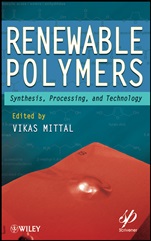
Renewable Polymers: Synthesis, Processing, and Technology
ISBN 9780470938775
Autor: Vikas Mittal
Wydawca: Wiley
Dostępność: 3-6 tygodni
Cena: 876,75 zł
Przed złożeniem zamówienia prosimy o kontakt mailowy celem potwierdzenia ceny.
ISBN13: |
9780470938775 |
ISBN10: |
0470938773 |
Autor: |
Vikas Mittal |
Oprawa: |
Hardback |
Rok Wydania: |
2011-12-02 |
Ilość stron: |
502 |
Wymiary: |
241x172 |
Tematy: |
PN |
Presents the synthesis, technology and processing details of a large range of polymers derived from renewable resources
It has been a long–term desire to replace polymers from fossil fuels with the more environmentally friendly polymers generated from renewable resources. Now, with the recent advancements in synthesis technologies and the finding of new functional monomers, research in this field has shown strong potential in generating better property polymers from renewable resources. A text describing these advances in synthesis, processing, and technology of such polymers not only provides the state–of–the–art information to researchers, but also acts to stimulate research in this direction. The contents are based on a wide range of functional monomers and the contributions are written by eminent researchers.
Specifically Renewable Polymers:
Demonstrates the design, synthesis, properties and applications of plant oil–based polymers
Presents an elaborate review of acid mediated polymerization techniques for the generation of green polymers
Details the production of polyhydroxyalkanoates (PHA) from olive oil based wastewater
Describes the use of atom transfer radical polymerization (ATRP) techniques
Reviews the renewable polymers derived from transgenic crop plants
Provides an overview of a range of biomass–based polymers
Concludes with the recent efforts and approaches exploiting the natural materials in developing drug delivery systems.
Spis treści:
Preface xii
List of Contributors xv
1. Polymers from renewable Resources 1
V. Mittal
1.1 Introduction 1
1.2 Naturally Renewable Methylene Butyrolactones 4
1.3 Renewable Rosin Acid–Degradable Caprolactone Block Copolymers 6
1.4 Plant Oils as Platform Chemicals for Polymer Synthesis 7
1.5 Biosourced Sterecontrolled
Polytriazoles 9
1.6 Polymers from Naturally Occurring Monoterpene 10
1.7 Polymerization of Biosourced 2– (Methacryloyloxy) ethyl Tiglate 11
1.8 Oxypropylation of Repeseed Cake Residue 12
1.9 Copolymerization of Naturally Occurring Limonene 13
1.10 Polymerization of Lactides 14
1.11 Nanocomposites Using Renewable Polymers 19
1.12 Castor Oil Based Thermosets 19
References 22
2. Design, Synthesis, Property, and Application of Plant Oil Polymers 23
Keshar Prassain and Duy H. Hua
2.1 Introduction 24
2.2 Triglyceride Polymers 25
2.3 Summary 65
Reference 65
3. Advances in Acid Mediated Polymerizations 69
Stewart P. Lewis and R. Mathers
3.1 Introduction 70
3.2 Problems Inherent to Cationic Ole. N Polymerization 72
3.3 Progress Toward Cleaner Cationic Polymerization 75
3.4 Environmental Bene. Ts via New Process Conditions 158
3.5 Cationic Polymerization of Monomers Derived from Renewable Resources 161
3.6 Sustainable Synthesis of Monomers for Cationic Polymerization 163
References 164
4. Olive Oil Wastewater as a Renewable Resource for Production of Polyhydroxyalkanoates 175
Francesco Valentino, Marianna Villano, Lorenzo Bertin, Mario Beccari, and Mauro Majone
4.1 Polyhydroxyalkanoates (PHAs): Structure, Properties, and Applications 175
4.2 PHA Production Processes Employing Pure Microbial Cultures 177
4.3 PHA Production Processes Employing Mixed Microbial Cultures 178
4.4 Olive Oil Mill Ef. Uents (OMEs) as a Possible Feedstock for PHA Production 197
4.5 OMEs as Feedstock for PHA Production 206
4.6 Concluding Remarks 211
References 212
5. Atom Transfer Radical Polymerization (ATRP) for Production of Polymers from Renewable Resources 221
Kattimuttathu I. Suresh
5.1 Introduction 221
5.2 Atom Transfer Radical Polymerization (ATRP) 222
5.3 Synthetic Strategies to Develop Functional Material Based on Renewab
le Resources – Composition, Topologies and Functionalities 227
5.4 Sustainable Sources for Monomers with a Potential for Making Novel Renewable Polymers 231
5.5 Conclusions and Outlook 241
References 242
6. Renewable Polymers in Transgenic Crop Plants 247
Tina Hausmann and Inge Broer
6.1 Natural Plant Polymers 248
6.2 De Novo Synthesis of Polymers in Plants 269
6.3 Conclusion 289
References 291
7. Polyesters, Polycarbonates and Polyamides Based on Renewable Resources 305
Bart A. J. Noordover
7.1 Introduction 306
7.2 Biomass–Based Monomers 307
7.3 Polyesters Based on Renewable Resources 308
7.4 Polycarbonates Based on Renewable Resources 332
7.5 Polyamides Based on Renewable Resources 344
7.6 Conclusions 349
References 350
8. Succinic Acid: Synthesis of Biobased Polymers from Renewable Resources 355
Stephen Kabasci and Inna Bretz
8.1 Introduction 355
8.2 Polymerization 359
8.3 Conclusions 371
References 372
9. 5–Hydroxymethylfurfural Based Polymers 381
Ananda S. Amarasekara
9.1 Introduction 381
9.2 5–Hydroxymethylfurfural 382
9.3 5–Hydroxymethylfurfural Derivatives 393
9.4 Polymers from 5–Hydroxymethylfurfural Derivatives 398
9.5 Conclusion 421
References 422
10. Natural Polymers–A Boon for Drug Delivery
Rajesh. N. Uma, and Valluru Ravi
10.1 Introduction 429
10.2 Acacia 429
10.3 Agar 431
10.4 Alginate 433
10.5 Carrageenan 436
10.6 Cellulose 438
10.7 Chitosan 440
10.8 Dextrin 444
10.9 Dextrin 445
10.10 Gellan Gum 447
10.11 Guar Gum 448
10.12 Inulin 451
10.13 Karaya Gum 454
10.14 Konjac Glucomannan 453
10.15 Locust Bean Gum 454
10.16 Locust Gum 455
10.17 Pectin 455
10.18 Psyllium Husk 457
10.19 Scleroglucan 457
10.20 Starch 460
10.21 Xanthan Gum 462
References 465
Index 473
Nota biograficzna:
Vikas Mittal is an Assistant Professor at the Chemical Engineering Department of The Petroleum Institute, Abu Dhabi. He obtained his PhD in 2006 in Polymer and Materials Engineering from the Swiss Federal Institute of Technology in Zurich. He then worked as a materials scientist in Active and Intelligent Coatings section of SunChemical in London, UK and as a polymer engineer at BASF Polymer Research in Ludwigshafen, Germany. His research interests include polymer nanocomposites, novel filler surface modifications, thermal stability enhancements, and polymer latexes with functionalized surfaces.
Okładka tylna:
Presents the synthesis, technology and processing details of a large range of polymers derived from renewable resources
It has been a long–term desire to replace polymers from fossil fuels with the more environmentally friendly polymers generated from renewable resources. Now, with the recent advancements in synthesis technologies and the finding of new functional monomers, research in this field has shown strong potential in generating better property polymers from renewable resources. A text describing these advances in synthesis, processing, and technology of such polymers not only provides the state–of–the–art information to researchers, but also acts to stimulate research in this direction. The contents are based on a wide range of functional monomers and the contributions are written by eminent researchers.
Specifically Renewable Polymers:
Demonstrates the design, synthesis, properties and applications of plant oil–based polymers
Presents an elaborate review of acid mediated polymerization techniques for the generation of green polymers
Details the production of polyhydroxyalkanoates (PHA) from olive oil based wastewater
Describes the use of atom transfer radical polymerization (ATRP) techniques
Reviews t
he renewable polymers derived from transgenic crop plants
Provides an overview of a range of biomass–based polymers
Concludes with the recent efforts and approaches exploiting the natural materials in developing drug delivery systems.
Koszyk
Książek w koszyku: 0 szt.
Wartość zakupów: 0,00 zł
Informacje


Kontakt
Gambit
Centrum Oprogramowania
i Szkoleń Sp. z o.o.
Al. Pokoju 29b/22-24
31-564 Kraków
Siedziba Księgarni
ul. Kordylewskiego 1
31-542 Kraków
+48 12 410 5991
+48 12 410 5987
+48 12 410 5989
Subskrypcje
Administratorem danych osobowych jest firma Gambit COiS Sp. z o.o. Na podany adres będzie wysyłany wyłącznie biuletyn informacyjny.
Autoryzacja płatności

Informacje na temat autoryzacji płatności poprzez PayU.

© Copyright 2012: GAMBIT COiS Sp. z o.o. Wszelkie prawa zastrzeżone.
Projekt i wykonanie: Alchemia Studio Reklamy