


Wydawcy
Katalog tematyczny
- Archeologia (109)
- Ekonomia, finanse, business (13704)
- Filozofia (1445)
- Historia (3040)
- Języki i językoznawstwo (2356)
- Lifestyle, hobby i rozrywka (475)
- Medycyna (9704)
- Nauki humanistyczne (4)
- Nauki o Ziemi i środowisku (2638)
- Nauki ścisłe (20412)
- Nauki społeczne (8486)
- Nauki techniczne (13450)
- Budownictwo lądowe (1045)
- Chemia przemysłowa (2258)
- Elektronika i telekomunikacja (3287)
- Energetyka (1122)
- Inne nauki stosowane (363)
- Inżynieria biochemiczna (507)
- Inżynieria transportu (232)
- Mechanika i materiały (3316)
- Nauka o środowisku (321)
- Rolnictwo (507)
- Technika, ogólnie (475)
- Prawo (1696)
- Publikacje informacyjne i interdyscyplinarne (1288)
- Religia i wierzenia (917)
- Technika komputerowa (4067)
- Zdrowie, relacje międzyludzkie i rozwój osobisty (657)





Informacje szczegółowe o książce
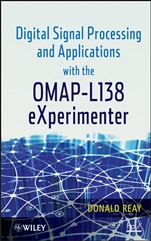
Digital Signal Processing and Applications with the OMAP – L138 eXperimenter
ISBN 9780470936863
Autor: Donald S. Reay
Wydawca: Wiley
Dostępność: 3-6 tygodni
Cena: 687,75 zł
Przed złożeniem zamówienia prosimy o kontakt mailowy celem potwierdzenia ceny.
ISBN13: |
9780470936863 |
ISBN10: |
047093686X |
Autor: |
Donald S. Reay |
Oprawa: |
Hardback |
Rok Wydania: |
2012-04-10 |
Ilość stron: |
360 |
Wymiary: |
247x159 |
Tematy: |
TJ |
Teaches digital signal processing concepts via hands–onexamples
The OMAP–L138 eXperimenter is the latest inexpensive DSPdevelopment system to be adopted by the Texas InstrumentsUniversity Program. The OMAP–L138 processor contains both ARM andDSP cores and is aimed at portable and mobile multimediaapplications. This book concentrates on the demonstration ofreal–time DSP algorithms implemented on its C6748 DSP core.
Digital Signal Processing and Applications with the OMAP–L138eXperimenter provides an extensive and comprehensive set ofprogram examples to aid instructors in teaching DSP in a laboratoryusing audio frequency signals making it an ideal text for DSPcourses at senior undergraduate and postgraduate levels.
Subjects covered include polling–based, interrupt–based, andDMA–based I/O methods, and how real–time programs may be run usingthe board support library (BSL), the DSP/BIOS real–time operatingsystem, or the DSP/BIOS Platform Support Package.
Chapters include:
Analog input and output with the OMAP–L138 eXperimenter
Finite impulse response filters
Infinite impulse response filters
Fast Fourier transform
Adaptive filters
DSP/BIOS and platform support package
Each chapter begins with a review of background theory and thenpresents a number of real–time program examples to reinforceunderstanding of that theory and to demonstrate the use of theOMAP–L138 eXperimenter and Texas Instruments Code Composer Studiointegrated development environment.
Preface xi
List of Examples xiii
1. OMAP–L138 Development System 1
1.1 Introduction 1
1.1.1 Digital Signal Processors 3
1.2 Hardware and Software Tools 4
1.2.1 Zoom OMAP–L138 eXperimenter Board 6
1.2.2 C6748 Processor 6
1.2.3 Code Composer Studio IDE 6
1.2.4 Installation of Code Composer Studio Software Version 4and Support Files 7
1.3 Initial Test of the Experimenter Using a Program Suppliedwith this Book 8
1.4 Programming Examples to Test the Experimenter 14
1.5 Support Files 31
1.5.1 Initialization and Configuration File(L138—aic3106—init.c) 31
1.5.2 Header File (L138—aic3106—init.h) 32
1.5.3 Vector Files (vectors—intr.asm and vectors—poll.asm)32
1.5.4 Linker Command File (linker—dsp.cmd) 34
Exercises 36
References 37
2. Analog Input and Output with the OMAP–L138eXperimenter 38
2.1 Introduction 38
2.1.1 Sampling, Reconstruction, and Aliasing 39
2.2 TLV320AIC3106 (AIC3106) On–Board Stereo Codec for AnalogInput and Output 39
2.3 Programming Examples Using C Code 41
2.3.1 Real–Time Input and Output Using Polling, Interrupts, andDirect Memory Access 41
2.3.2 Real–Time Sine Wave Generation 64
References 102
3. Finite Impulse Response Filters 103
3.1 Introduction to Digital Filters 103
3.1.1 FIR Filter 103
3.1.2 Introduction to the z–Transform 105
3.1.3 Properties of the z–Transform 107
3.1.4 z–Transfer Functions 109
3.1.5 Mapping from the s–Plane to the z–Plane 109
3.1.6 Difference Equations 111
3.1.7 Frequency Response and the z–Transform 112
3.1.8 Ideal Filter Response Classifications: LP, HP, BP, and BS112
3.1.9 Window Method of Filter Design 113
3.1.10 Window Functions 114
3.1.11 Design of Band–Pass and High–Pass Filters Using FrequencyShifting 120
3.2 Programming Examples Using C And ASM Code 123
References 158
4. Infinite Impulse Response Filters 159
4.1 Introduction 159
4.2 IIR Filter Structures 160
4.2.1 Direct Form I Structure 160
4.2.2 Direct Form II Structure 161
4.2.3 Direct Form II Transpose 162
4.2.4 Cascade Structure 164
4.2.5 Parallel Form Structure 165
4.3 Impulse Invariance 166
4.4 Bilinear Transformation 167
4.4.1 Bilinear Transform Design Procedure 169
4.5 Programming Examples Using C and ASM Code 169
4.5.1 Design of a Simple IIR Low–Pass Filter 169
Reference 211
5. Fast Fourier Transform 212
5.1 Introduction 212
5.2 Development of the FFT Algorithm with Radix–2 213
5.3 Decimation–In–Frequency FFT Algorithm with Radix–2 214
5.4 Decimation–In–Time FFT Algorithm with RADIX–2 218
5.4.1 Reordered Sequences in the Radix–2 FFT and Bit–ReversedAddressing 220
5.5 Decimation–In–Frequency FFT Algorithm with Radix–4 221
5.6 Inverse Fast Fourier Transform 223
5.7 Programming Examples Using C Code 223
5.7.1 Frame– or Block–Based Processing 233
5.7.2 Fast Convolution 258
References 278
6. Adaptive Filters 279
6.1 Introduction 279
6.2 Adaptive Filter Configurations 280
6.2.1 Adaptive Prediction 280
6.2.2 System Identification or Direct Modeling 281
6.2.3 Noise Cancellation 281
6.2.4 Equalization 283
6.3 Performance Function 283
6.3.1 Visualizing the Performance Function 285
6.4 Searching for the Minimum 285
6.5 Least Mean Squares Algorithm 287
6.5.1 LMS Variants 288
6.6 Programming Examples 288
7. DSP/BIOS and Platform Support Package 307
7.1 Introduction to DSP/BIOS 307
7.1.1 DSP/BIOS Threads 307
7.1.2 DSP/BIOS Configuration Tool 308
7.1.3 DSP/BIOS Start–Up Sequence 309
7.1.4 Hardware Interrupts 310
7.1.5 Software Interrupts 320
7.1.6 Tasks and Idle Functions 322
7.1.7 Periodic Functions 327
7.1.8 Real–Time Analysis with DSP/BIOS 329
7.2 DSP/BIOS Platform Support Package 329
References 335
Index 337
Donald Reay is a Lecturer at Heriot–Watt University in Edinburgh, Scotland. He has also taught hands–on DSP, on a number of occasions, as a visiting lecturer at Zhejiang University in Hangzhou, China. He coauthored, with Rulph Chassaing, the Second Edition of Digital Signal Processing and Applications with the TMS320C6713 and TMS320C6416 DSK, also published by Wiley.
Koszyk
Książek w koszyku: 0 szt.
Wartość zakupów: 0,00 zł
Informacje


Kontakt
Gambit
Centrum Oprogramowania
i Szkoleń Sp. z o.o.
Al. Pokoju 29b/22-24
31-564 Kraków
Siedziba Księgarni
ul. Kordylewskiego 1
31-542 Kraków
+48 12 410 5991
+48 12 410 5987
+48 12 410 5989
Subskrypcje
Administratorem danych osobowych jest firma Gambit COiS Sp. z o.o. Na podany adres będzie wysyłany wyłącznie biuletyn informacyjny.
Autoryzacja płatności

Informacje na temat autoryzacji płatności poprzez PayU.

© Copyright 2012: GAMBIT COiS Sp. z o.o. Wszelkie prawa zastrzeżone.
Projekt i wykonanie: Alchemia Studio Reklamy