


Wydawcy
Katalog tematyczny
- Archeologia (109)
- Ekonomia, finanse, business (13704)
- Filozofia (1445)
- Historia (3040)
- Języki i językoznawstwo (2356)
- Lifestyle, hobby i rozrywka (475)
- Medycyna (9704)
- Chirurgia (272)
- Inne gałęzie medycyny (1871)
- Medycyna kliniczna (4187)
- Choroby wewnętrzne (514)
- Dermatologia (51)
- Diagnostyka medyczna (3)
- Endokrynologia (144)
- Gastroenterologia (27)
- Geriatria (50)
- Ginekologia i położnictwo (134)
- Hematologia (46)
- Hepatologia (10)
- Kardiologia (71)
- Laryngologia (12)
- Nefrologia (10)
- Neurologia (500)
- Oftalmologia (50)
- Pediatria (33)
- Pulmunologia (32)
- Reumatologia (14)
- Terapia genowa (1)
- Układ mięśniowo-szkieletowy (1)
- Urologia (14)
- Medycyna niekonwencjonalna (14)
- Medycyna przedkliniczna (269)
- Medycyna, ogólnie (1740)
- Medyczne służby pomocnicze (745)
- Studia medyczne (16)
- Weterynaria (548)
- Nauki humanistyczne (4)
- Nauki o Ziemi i środowisku (2638)
- Nauki ścisłe (20412)
- Nauki społeczne (8486)
- Nauki techniczne (13450)
- Prawo (1696)
- Publikacje informacyjne i interdyscyplinarne (1288)
- Religia i wierzenia (917)
- Technika komputerowa (4067)
- Zdrowie, relacje międzyludzkie i rozwój osobisty (657)





Informacje szczegółowe o książce
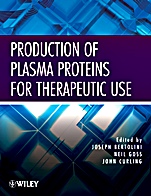
Production of Plasma Proteins for Therapeutic Use
ISBN 9780470924310
Autor: Joseph Bertolini, Neil Goss, John Curling
Wydawca: Wiley
Dostępność: 3-6 tygodni
Cena: 757,05 zł
Przed złożeniem zamówienia prosimy o kontakt mailowy celem potwierdzenia ceny.
ISBN13: |
9780470924310 |
ISBN10: |
0470924314 |
Autor: |
Joseph Bertolini, Neil Goss, John Curling |
Oprawa: |
Hardback |
Rok Wydania: |
2013-02-08 |
Ilość stron: |
512 |
Wymiary: |
288x219 |
Tematy: |
MJ |
Sets forth the state of the science and technology in plasmaprotein production
With contributions from an international team of eighty leadingexperts and pioneers in the field, Production of Plasma Proteinsfor Therapeutic Use presents a comprehensive overview of thecurrent state of knowledge about the function, use, and productionof blood plasma proteins. In addition to details of the operationalrequirements for the production of plasma derivatives, the bookdescribes the biology, development, research, manufacture, andclinical indications of essentially all plasma proteins withestablished clinical use or therapeutic potential.
Production of Plasma Proteins for Therapeutic Use coversthe key aspects of the plasma fractionation industry in fivesections:
Section 1: Introduction to Plasma Fractionationinitially describes the history of transfusion and then covers theemergence of plasma collection and fractionation from its earliestdays to the present time, with the commercial and not–for–profitsectors developing into a multi–billion dollar industry. Section 2: Plasma Proteins for Therapeutic Use contains24 chapters dedicated to specific plasma proteins, includingcoagulation factors, albumin, immunoglobulin, and a comprehensiverange of other plasma–derived proteins with therapeuticindications. Each chapter discusses the physiology, biochemistry,mechanism of action, and manufacture of each plasma proteinincluding viral safety issues and clinical uses. Section 3: Pathogen Safety of Plasma Products examinesissues and procedures for enhancing viral safety and reducing therisk of transmissible spongiform encephalopathy transmission. Section 4: The Pharmaceutical Environment Applied to PlasmaFractionation details the requirements and activitiesassociated with plasma collection, quality assurance, compliancewith regulatory requirements, provision of medical affairs support,and the manufacture of plasma products. Section 5: The Market for Plasma Products and the Economicsof Fractionation reviews the commercial environment andeconomics of the plasma fractionation industry including futuretrends, highlighting regions such as Asia, which have the potentialto exert a major influence on the plasma fractionation industry inthe twenty–first century.PREFACE ix
CONTRIBUTORS xi
SECTION 1 INTRODUCTION TO PLASMA FRACTIONATION
1 The History and Development of the Plasma ProteinFractionation Industry 3
John Curling, Neil Goss, and Joseph Bertolini
SECTION 2 PLASMA PROTEINS FOR THERAPEUTIC USE
2 Production and Clinical Profile of Human Plasma CoagulationFactor VIII 31
Sami Chtourou
3 Production and Clinical Profile of Human Plasma–Derived VonWillebrand Factor 41
Sami Chtourou and Michel Poulle
4 Factor Eight Inhibitor Bypassing Activity 49
Peter Turecek and Hans Peter Schwarz
5 Prothrombin Complex 65
Jürgen Römisch and Katharina Pock
6 Factor IX 81
Salvador Grancha, Steven Herring, Antonio Pa´ez, PereRistol, and Juan Ignacio Jorquera
7 Factor XI 93
Sami Chtourou and Michel Poulle
8 Factor XIII and Factor X 101
Peter Feldman
9 Fibrinogen: Science and Biotechnology 117
Gerard Marx
10 Fibrin Glues and Bandages 137
Hans Christian Hedrich and Heinz Gulle
11 Production and Clinical Use of Plasma Antithrombin III147
Andrea Morelli
12 Human Serum Albumin: A Multifunctional Plasma Protein159
John More and Mark Bulmer
13 IntravenousImmunoglobulinGfromHumanPlasma PurificationConcepts and Important QualityCriteria 185
Andrea Buchacher and Waltraud Kaar
14 Hyperimmune Immunoglobulin G 207
Hugh Price, Maurice Genereux, and Christopher Sinclair
15 Rh (D) Immunoglobulin 217
Maurice Genereux, Jodi Smith, William Bees, and ChristopherSinclair
16 Alpha1–Proteinase Inhibitor: The Disease, the Protein, andCommercial Production 227
Wytold Lebing
17 C1–Inhibitor 241
Jan Over, Christine Kramer, Anky Koenderman, Diana Wouters, andSacha Zeerleder
18 Acid–Stabilized Plasmin as a Novel Direct–Acting Thrombolytic259
Valery Novokhatny, James Rebbeor, Philip Scuderi, and StephenPetteway Jr.
19 Reconstituted, Plasma–Derived High–Density Lipoprotein273
Peter Lerch
20 Plant–Derived Manufacturing of Apolipoprotein AIMilano:Purification and Functional Characterization 283
Cory Nykiforuk, Yin Shen, Elizabeth Murray, Joseph Boothe, andMaurice Moloney
21 Transferrin 301
Leni von Bonsdorff, Hennie ter Hart, Ingrid Prins–de Nijs, AnkyKoenderman, Jan Over, and Jaakko Parkkinen
22 Plasminogen: Its Role in the Therapy of LigneousConjunctivitis 311
Claudia Nardini
23 Haptoglobin 321
Joan Dalton and Azubuike Okemefuna
24 Ceruloplasmin: Biology, Manufacture, and Clinical Use337
Aron Berkovsky and Vladimir Vaschenko
25 Solvent/Detergent Plasma 345
Tor–Einar Svae, Andrea Heger, Lothar Biesert, AndreaNeisser–Svae, and Wolfgang Frenzel
SECTION 3 PATHOGEN SAFETY OF PLASMA PRODUCTS
26 Ensuring Virus Safety of Plasma Products 361
Herbert Dichtelmu¨ller
27 Transmissible Spongiform Encephalopathies and Plasma Products369
Luisa Gregori, David Asher, and Dorothy Scott
SECTION 4 THE PHARMACEUTICAL ENVIRONMENT APPLIED TO PLASMAFRACTIONATION
28 Quality Assurance Requirements in Plasma Product Manufacture383
Jens Jesse
29 Regulatory Activities Associated with Production andCommercialization of Plasma Protein Therapeutics 403
Nancy Kirschbaum and Timothy Lee
30 The Emerging Role of Global Medical Affairs in theTwenty–First Century 413
Hartmut Ehrlich, David Perry, David Gelmont, and RaminFarhood
31 Plasma for Fractionation 423
Joseph Bertolini and Timothy Hayes
32 The Pharmaceutical Manufacturing Environment 437
Ernst Hetzl
SECTION 5 THE MARKET FOR PLASMA PRODUCTS AND THE ECONOMICS OFFRACTIONATION
33 The Economics of Plasma Fractionation 451
Neil Goss and John Curling
34 Future Trends in the Plasma Products Market 461
Paolo Marcucci
INDEX 471
JOSEPH BERTOLINI, BSc (HONS.), MSc, PhD, is R&DManager at CSL Bioplasma where he has been closely involved in thetechnical development and improvement of immunoglobulin and albuminproducts. He is active in national and international conferencesand industry organizations and is a strong advocate for theadvancement of bioprocessing.
NEIL GOSS, BSc (HONS.), PhD, is Executive Director atFurther Options Pty Ltd., a consulting company specializing inbiotechnology and the plasma fractionation industry. He waspreviously Director of R&D, CSL Bioplasma and is the foundingorganizer for both the Plasma Product Biotechnology Meeting seriesand the BioProcessing Network.
JOHN CURLING, BSc, is a consultant in bioseparations andprotein purification whose clients have included numerousbiopharmaceutical, biotechnology, and vendor companies. Hepioneered the development of chromatographic methods of plasmafractionation and was the President of the Process SeparationDivision of Pharmacia. He has acted as an advisor to the WorldHealth Organization.
Koszyk
Książek w koszyku: 0 szt.
Wartość zakupów: 0,00 zł
Informacje


Kontakt
Gambit
Centrum Oprogramowania
i Szkoleń Sp. z o.o.
Al. Pokoju 29b/22-24
31-564 Kraków
Siedziba Księgarni
ul. Kordylewskiego 1
31-542 Kraków
+48 12 410 5991
+48 12 410 5987
+48 12 410 5989
Subskrypcje
Administratorem danych osobowych jest firma Gambit COiS Sp. z o.o. Na podany adres będzie wysyłany wyłącznie biuletyn informacyjny.
Autoryzacja płatności

Informacje na temat autoryzacji płatności poprzez PayU.

© Copyright 2012: GAMBIT COiS Sp. z o.o. Wszelkie prawa zastrzeżone.
Projekt i wykonanie: Alchemia Studio Reklamy