


Wydawcy
Katalog tematyczny
- Archeologia (109)
- Ekonomia, finanse, business (13704)
- Filozofia (1445)
- Historia (3040)
- Języki i językoznawstwo (2356)
- Lifestyle, hobby i rozrywka (475)
- Medycyna (9704)
- Nauki humanistyczne (4)
- Nauki o Ziemi i środowisku (2638)
- Nauki ścisłe (20412)
- Astronomia (294)
- Biologia (5119)
- Chemia (6540)
- Fizyka (3309)
- Elektryczność i magnetyzm (90)
- Fizyka atomowa i molekularna (110)
- Fizyka cząstek elementarnych (36)
- Fizyka jądra atomowego (36)
- Fizyka kwantowa (210)
- Fizyka matematyczna (121)
- Fizyka relatywistyczna (36)
- Fizyka statystyczna (51)
- Fizyka stosowana (498)
- Mechanika klasyczna (186)
- Optyka i światło (133)
- Stany materii (202)
- Matematyka (4574)
- Nauki ścisłe, ogólnie (503)
- Nauki społeczne (8486)
- Nauki techniczne (13450)
- Prawo (1696)
- Publikacje informacyjne i interdyscyplinarne (1288)
- Religia i wierzenia (917)
- Technika komputerowa (4067)
- Zdrowie, relacje międzyludzkie i rozwój osobisty (657)





Informacje szczegółowe o książce
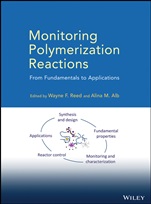
Monitoring Polymerization Reactions: From Fundamentals to Applications
ISBN 9780470917381
Autor: Wayne F. Reed, Alina M. Alb
Wydawca: Wiley
Dostępność: 3-6 tygodni
Cena: 730,80 zł
Przed złożeniem zamówienia prosimy o kontakt mailowy celem potwierdzenia ceny.
ISBN13: |
9780470917381 |
ISBN10: |
0470917385 |
Autor: |
Wayne F. Reed, Alina M. Alb |
Oprawa: |
Hardback |
Rok Wydania: |
2014-02-21 |
Ilość stron: |
488 |
Wymiary: |
288x221 |
Tematy: |
PH |
Offers new strategies to optimize polymer reactions With contributions from leading macromolecular scientists and engineers, this book provides a practical guide to polymerization monitoring. It enables laboratory researchers to optimize polymer reactions by providing them with a better understanding of the underlying reaction kinetics and mechanisms. Moreover, it opens the door to improved industrial-scale reactions, including enhanced product quality and reduced harmful emissions. Monitoring Polymerization Reactions begins with a review of the basic elements of polymer reactions and their kinetics, including an overview of stimuli-responsive polymers. Next, it explains why certain polymer and reaction characteristics need to be monitored. The book then explores a variety of practical topics, including: Principles and applications of important polymer characterization tools, such as light scattering, gel permeation chromatography, calorimetry, rheology, and spectroscopy Automatic continuous online monitoring of polymerization (ACOMP) reactions, a flexible platform that enables characterization tools to be employed simultaneously during reactions in order to obtain a complete record of multiple reaction features Modeling of polymerization reactions and numerical approaches Applications that optimize the manufacture of industrially important polymers Throughout the book, the authors provide step-by-step strategies for implementation. In addition, ample use of case studies helps readers understand the benefits of various monitoring strategies and approaches, enabling them to choose the best one to match their needs. As new stimuli-responsive and "intelligent" polymers continue to be developed, the ability to monitor reactions will become increasingly important. With this book as their guide, polymer scientists and engineers can take full advantage of the latest monitoring strategies to optimize reactions in both the lab and the manufacturing plant.
Preface Introduction Contributors Section 1 Overview of polymerization reactions and kinetics Chapter 1 Free Radical and Condensation Polymerizations Matthew Tirrell and Matthew Kade Chapter 2 Overview of Controlled/Living Polymerization Methods of Vinyl Monomers Robert T. Mathers, Andrew J. D. Magenau, Kristin Schröder and Krzysztof Matyjaszewski Chapter 3 Stimuli–Responsive Polymers via Controlled Radical Polymerization Joel D. Flores, Brooks A. Abel, DeeDee Smith, and Charles L. McCormick Chapter 4 Reactions in heterogeneous media: Emulsion, miniemulsion, microemulsion, suspension and dispersion polymerization Radmila Tomovska, José C. de la Cal, and José M. Asua Section 2 Polymerization Characterization and Monitoring Methods Chapter 5 Polymer Characteristics Wayne F. Reed Chapter 6 Infrared (MIR, NIR), Raman, and Other Spectroscopic Methods Alexandre F. Santos, Fabricio M. Silva, Marcelo K. Lenzi, José C. Pinto Chapter 7 Calorimetry, Conductivity, pH, Densimetry and Rheological measurements Jose R. Leiza and Timothy McKenna Chapter 8 Light Scattering Guy C. Berry Chapter 9 GPC/SEC as a key tool for assessment of polymer quality and determination of macromolecular properties Peter Kilz and Daniela Held Chapter 10 Mass Spectroscopy: ESR and NMR applications to polymer characterization and polymerization monitoring Zifu Zhu and Alina M. Alb Section 3 Automatic Continuous Online Monitoring of Polymerization Reactions (ACOMP) Chapter 11 Background and Principles of Automatic Continuous Online Monitoring of Polymerization Reactions, ACOMP Wayne F. Reed Chapter 12 Applications of ACOMP (I) Alina M. Alb Chapter 13 Applications of ACOMP (II) Wayne F. Reed Chapter 14 Cognate techniques to ACOMP Michael F. Drenski, Alina M. Alb, and Wayne F. Reed Chapter 15 Outlook for Industrial ACOMP Michael F. Drenski and Alex W. Reed Section 4 Reactor control and design. Batch, semi–batch, and continuous reactors Chapter 16 Mathematical Modeling of Polymerization Reactors Joseph F. Schork Chapter 17 Design and Operation of Polymerization Reactors Joseph F. Schork Chapter 18 Optimization of the Particle Size in Emulsion Polymerization Joseph Zeaiter and José A. Romagnoli Section 5 Industrial Applications Chapter 19 Water–Soluble Free Radical Addition Polymerizations Wesley L. Whipple and Hua Zheng Chapter 20 Protein Aggregation in Pharmaceutical Biotechnology Mark L. Brader Chapter 21 Rubbers and Elastomers Jorge Soto Chapter 22 Polymers from Natural Products Dimitrios Samios, Aline Nicolau, and Miriam B. Roza
WAYNE F. REED is Professor of Physics and Founding Director of the Tulane Center for Polymer Reaction Monitoring and Characterization. Dr. Reed has authored more than 100 scientific articles and holds several patents in the area of polymer reaction monitoring and characterization. ALINA M. ALB is Research Assistant Professor of Physics and Associate Director for Research at the Tulane Center for Polymer Reaction Monitoring and Characterization. Dr. Alb, author of numerous scientific articles and co-inventor of new instrumentation, has developed original methods to follow online synthesis of novel materials.
Koszyk
Książek w koszyku: 0 szt.
Wartość zakupów: 0,00 zł
Informacje


Kontakt
Gambit
Centrum Oprogramowania
i Szkoleń Sp. z o.o.
Al. Pokoju 29b/22-24
31-564 Kraków
Siedziba Księgarni
ul. Kordylewskiego 1
31-542 Kraków
+48 12 410 5991
+48 12 410 5987
+48 12 410 5989
Subskrypcje
Administratorem danych osobowych jest firma Gambit COiS Sp. z o.o. Na podany adres będzie wysyłany wyłącznie biuletyn informacyjny.
Autoryzacja płatności

Informacje na temat autoryzacji płatności poprzez PayU.

© Copyright 2012: GAMBIT COiS Sp. z o.o. Wszelkie prawa zastrzeżone.
Projekt i wykonanie: Alchemia Studio Reklamy