


Wydawcy
Katalog tematyczny
- Archeologia (109)
- Ekonomia, finanse, business (13704)
- Filozofia (1445)
- Historia (3040)
- Języki i językoznawstwo (2356)
- Lifestyle, hobby i rozrywka (475)
- Medycyna (9704)
- Nauki humanistyczne (4)
- Nauki o Ziemi i środowisku (2638)
- Nauki ścisłe (20412)
- Nauki społeczne (8486)
- Nauki techniczne (13450)
- Prawo (1696)
- Publikacje informacyjne i interdyscyplinarne (1288)
- Religia i wierzenia (917)
- Technika komputerowa (4067)
- Zdrowie, relacje międzyludzkie i rozwój osobisty (657)





Informacje szczegółowe o książce
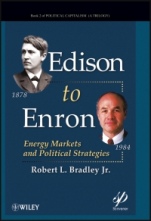
Edison to Enron: Energy Markets and Political Strategies
ISBN 9780470917367
Autor: Robert L. Bradley Jr.
Wydawca: Wiley
Dostępność: 3-6 tygodni
Cena: 265,65 zł
Przed złożeniem zamówienia prosimy o kontakt mailowy celem potwierdzenia ceny.
ISBN13: |
9780470917367 |
ISBN10: |
0470917369 |
Autor: |
Robert L. Bradley Jr. |
Oprawa: |
Hardback |
Rok Wydania: |
2011-11-07 |
Ilość stron: |
608 |
Wymiary: |
251x167 |
Tematy: |
KCP |
"This is a powerful story, brilliantly told." Forrest McDonald, Historian
"This scholarly work fills in much missing history about two of America′s most important industries, electricity and natural gas." Joseph A. Pratt, NEH–Cullen Professor of History and Business, University of Houston
"... a remarkable book on the political inner workings of the U.S. energy industry." Robert Peltier, Editor–in–Chief, POWER Magazine
Previously Published in the Political Capitalism Trilogy
Book I: Capitalism at Work: Business, Government, and EnergyPublished 2009 498 pp. ISBN 978–0–9764041–7–0
Capitalism took the blame for Enron although the company was anything but a free–market enterprise, and Ken Lay was hardly a principled capitalist. On the contrary, Enron was a politically dependent company and, in the end, a grotesque outcome of America′s mixed economy.
That is the central finding of Robert L. Bradley′s Capitalism at Work: The blame for Enron rests squarely with "political capitalism"––a system in which business firms routinely obtain government intervention to further their own interests at the expense of consumers, taxpayers, and competitors. Although Ken Lay professed allegiance to free markets, he was in fact a consumate politician. Only by manipulating the levers of government was he able to transform Enron from a $3 billion natural gas company to a $100 billion chimera, one that went in a matter of months from seventh place on Fortune′s 500 list to bankruptcy.
But Capitalism at Work goes beyond unmasking Enron′s sophisticated foray into political capitalism. Employing the timeless insights of Adam Smith, Samuel Smiles, and Ayn Rand, among others, Bradley shows how fashionable anti–capitalist doctrines set the stage for the ultimate business debacle.
"Bradley′s book is especially timely, and it raises fundamental questions about the b
usiness of competition. Given the author′s documentation, a wide audience might be served by reading Capitalism at Work." William A. Mogel, Energy Law Journal
"Fascinating, comprehensive ... far surpassing my own history of political capitalism done in the 1960s." Gabriel Kolko, Historian
"Recommended for public and academic library collections, lower–division undergraduate and up." CHOICE
Spis treści:
Preface.
Introduction.
Part I. The Chief: Samuel Insull.
Chapter 1. Building General Electric.
Chapter 2. Dynamo at Chicago Edition: 1892–1907.
Chapter 3. Expanding Horizons: 1907–1918.
Chapter 4. Peak and Peril: 1919–1929.
Chapter 5. Plummet and Ruin: 1930–38.
Part II. The Boss: Jack Bowen.
Chapter 6. Meadows to Murchison.
Chapter 7. A Monumental Mistake.
Chapter 8. Florida Gas Company.
Chapter 9. Transco Energy Company.
Part III. Houston Natural Gas Corporation.
Chapter 10. The Prince of Bankruptcy: John Henry Kirby.
Chapter 11. Robert Herring and Ray Fish.
Chapter 12. Formation of Maturation.
Chapter 13. Robert Herring and After.
Epilogue Market Order, Political Challenges.
Bibliography.
Illustration Credits.
Name Index.
Subject Index.
Nota biograficzna:
ROBERT L. BRADLEY JR., a 16–year Enron employee and Ken Lay confidant, is a noted free–market scholar and public–policy entrepreneur. The founder and CEO of the Institute for Energy Research, Bradley is the author of numerous books and essays on the history and political economy of energy. He is an adjunct scholar of the Cato Institute in Washington, D.C.; a visiting fellow of the Institute of Economic Affairs in London; and an honorary senior research fellow at the Center for Energy Economics at the University of Texas at Austin. In 2002, he received the Julian Simon Memorial Award for his work on energy and susta
inable development.
Bradley lives in Houston and likes to spend time in the beautiful Texas Hill Country.
Okładka tylna:
"This is a powerful story, brilliantly told." Forrest McDonald, Historian
"This scholarly work fills in much missing history about two of America′s most important industries, electricity and natural gas." Joseph A. Pratt, NEH–Cullen Professor of History and Business, University of Houston
"... a remarkable book on the political inner workings of the U.S. energy industry." Robert Peltier, Editor–in–Chief, POWER Magazine
Previously Published in the Political Capitalism Trilogy
Book I: Capitalism at Work: Business, Government, and EnergyPublished 2009 498 pp. ISBN 978–0–9764041–7–0
Capitalism took the blame for Enron although the company was anything but a free–market enterprise, and Ken Lay was hardly a principled capitalist. On the contrary, Enron was a politically dependent company and, in the end, a grotesque outcome of America′s mixed economy.
That is the central finding of Robert L. Bradley′s Capitalism at Work: The blame for Enron rests squarely with "political capitalism"––a system in which business firms routinely obtain government intervention to further their own interests at the expense of consumers, taxpayers, and competitors. Although Ken Lay professed allegiance to free markets, he was in fact a consumate politician. Only by manipulating the levers of government was he able to transform Enron from a $3 billion natural gas company to a $100 billion chimera, one that went in a matter of months from seventh place on Fortune′s 500 list to bankruptcy.
But Capitalism at Work goes beyond unmasking Enron′s sophisticated foray into political capitalism. Employing the timeless insights of Adam Smith, Samuel Smiles, and Ayn Rand, among others, Bradley shows how fashionable anti–capitalist doctrine
s set the stage for the ultimate business debacle.
"Bradley′s book is especially timely, and it raises fundamental questions about the business of competition. Given the author′s documentation, a wide audience might be served by reading Capitalism at Work." William A. Mogel, Energy Law Journal
"Fascinating, comprehensive ... far surpassing my own history of political capitalism done in the 1960s." Gabriel Kolko, Historian
"Recommended for public and academic library collections, lower–division undergraduate and up." CHOICE
Koszyk
Książek w koszyku: 0 szt.
Wartość zakupów: 0,00 zł
Informacje


Kontakt
Gambit
Centrum Oprogramowania
i Szkoleń Sp. z o.o.
Al. Pokoju 29b/22-24
31-564 Kraków
Siedziba Księgarni
ul. Kordylewskiego 1
31-542 Kraków
+48 12 410 5991
+48 12 410 5987
+48 12 410 5989
Subskrypcje
Administratorem danych osobowych jest firma Gambit COiS Sp. z o.o. Na podany adres będzie wysyłany wyłącznie biuletyn informacyjny.
Autoryzacja płatności

Informacje na temat autoryzacji płatności poprzez PayU.

© Copyright 2012: GAMBIT COiS Sp. z o.o. Wszelkie prawa zastrzeżone.
Projekt i wykonanie: Alchemia Studio Reklamy