


Wydawcy
Katalog tematyczny
- Archeologia (109)
- Ekonomia, finanse, business (13704)
- Filozofia (1445)
- Historia (3040)
- Języki i językoznawstwo (2356)
- Lifestyle, hobby i rozrywka (475)
- Medycyna (9704)
- Nauki humanistyczne (4)
- Nauki o Ziemi i środowisku (2638)
- Nauki ścisłe (20412)
- Astronomia (294)
- Biologia (5119)
- Chemia (6540)
- Fizyka (3309)
- Elektryczność i magnetyzm (90)
- Fizyka atomowa i molekularna (110)
- Fizyka cząstek elementarnych (36)
- Fizyka jądra atomowego (36)
- Fizyka kwantowa (210)
- Fizyka matematyczna (121)
- Fizyka relatywistyczna (36)
- Fizyka statystyczna (51)
- Fizyka stosowana (498)
- Mechanika klasyczna (186)
- Optyka i światło (133)
- Stany materii (202)
- Matematyka (4574)
- Nauki ścisłe, ogólnie (503)
- Nauki społeczne (8486)
- Nauki techniczne (13450)
- Prawo (1696)
- Publikacje informacyjne i interdyscyplinarne (1288)
- Religia i wierzenia (917)
- Technika komputerowa (4067)
- Zdrowie, relacje międzyludzkie i rozwój osobisty (657)





Informacje szczegółowe o książce
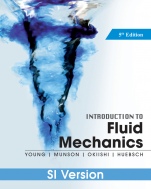
Introduction To Fluid Mechanics
ISBN 9780470902158
Autor: Donald F. Young, Bruce R. Munson, Theodore H. Okiishi, Wade W. Huebsch
Wydawca: Wiley
Dostępność: 3-6 tygodni
Cena: 307,65 zł
Przed złożeniem zamówienia prosimy o kontakt mailowy celem potwierdzenia ceny.
ISBN13: |
9780470902158 |
ISBN10: |
0470902159 |
Autor: |
Donald F. Young, Bruce R. Munson, Theodore H. Okiishi, Wade W. Huebsch |
Oprawa: |
Paperback |
Rok Wydania: |
2011-11-22 |
Numer Wydania: |
5th Edition SI Version |
Ilość stron: |
512 |
Wymiary: |
255x204 |
Tematy: |
PH |
A Brief Introduction to Fluid Mechanics, 5th Edition is designed to cover the standard topics in a basic fluid mechanics course in a streamlined manner that meets the learning needs of today’s student better than the dense, encyclopedic manner of traditional texts. This approach helps students connect the math and theory to the physical world and practical applications and apply these connections to solving problems. The text lucidly presents basic analysis techniques and addresses practical concerns and applications, such as pipe flow, open–channel flow, flow measurement, and drag and lift. It offers a strong visual approach with photos, illustrations, and videos included in the text, examples and homework problems to emphasize the practical application of fluid mechanics principles
Spis treści:
1. Introduction.
1.1 Some Characteristics of Fluids.
1.2 Dimensions, Dimensional Homogeneity, and Units.
1.3 Analysis of Fluid Behavior.
1.4 Measures of Fluid Mass and Weight.
1.5 Ideal Gas Law.
1.6 Viscosity.
1.7 Compressibility of Fluids.
1.8 Vapor Pressure.
1.9 Surface Tension.
1.10 A Brief Look Back in History.
1.11 Chapter Summary and Study Guide.
2. Fluid Statics.
2.1 Pressure at a Point.
2.2 Basic Equation for Pressure Field.
2.3 Pressure Variation in a Fluid at Rest.
2.4 Standard Atmosphere.
2.5 Measurement of Pressure.
2.6 Manometry.
2.7 Mechanical and Electronic Pressure–Measuring Devices.
2.8 Hydrostatic Force on a Plane Surface.
2.9 Pressure Prism.
2.10 Hydrostatic Force on a Curved Surface.
2.11 Buoyancy, Flotation, and Stability.
2.12 Pressure Variation on a Fluid with Rigid–Body Motion.
2.13 Chapter Summary and study Guide.
3. Elementary Fluid Dynamics–The Bernoulli Equation.
3.1 Newton’s Second Law.
3.2 F = ma Along a Streamline.
3.3 F = ma Normal to a Streamline.
3.4 Physical Interpretation.
3.5 Static, Stagnation, Dynamic, and Total Pressure.
3.6 Examples of Use of the Bernoulli Equation.
3.7 The Energy Line and the Hydraulic Grade Line.
3.8 Restrictions on the Use of the Bernoulli Equation.
3.9 Chapter Summary and Study Guide.
4. Fluid Kinematics.
4.1 The Velocity Field.
4.2 The Acceleration Field.
4.3 Control Volume and System Representations.
4.4 The Reynolds Transport Theorem.
4.5 Chapter Summary and Study Guide.
5. Finite Control Volume Analysis.
5.1 Conservation of Mass—The Continuity Equation.
5.2 Newton’s Second Law—The Linear Momentum and Moment–of–Momentum Equations.
5.3 First Law of Thermodynamics—The Energy Equation.
5.4 Chapter Summary and Study Guide.
6. Differential Analysis of Fluid Flow.
6.1 Fluid Element Kinematics.
6.2 Conservation of Mass.
6.3 Conservation of Linear Momentum.
6.4 Inviscid Flow.
6.5 Some Basic, Plane Potential Flows.
6.6 Superposition of Basic, Plane Potential Flows.
6.7 Other Aspects of Potential Flow Analysis.
6.8 Viscous Flow.
6.9 Some Simple Solutions for Laminar, Viscous, Incompressible Fluids.
6.10 Other Aspects of Differential Analysis.
6.11 Chapter Summary and Study Guide.
7. Similitude, Dimensional Analysis, and Modeling.
7.1 Dimensional Analysis.
7.2 Buckingham Pi Theorem.
7.3 Determination of Pi Terms.
7.4 Some Additional Comments about Dimensional Analysis.
7.5 Determination of Pi Terms by Inspection.
7.6 Common Dimensionless Groups in Fluid Mechanics.
7.7 Correlation of Experimental Data.
7.8 Modeling and Similitude.
7.9 Some Typical Model Studies.
7.10 Chapter Summary and Study Guide.
8. Viscous Flow in Pipes.
8.1 General Characteristics of Pipe Flow.
8.2 Fully Developed Laminar Flow.
8.3 Fully Developed Turbulent Flow.
8.4 Dimensional Analysis of Pipe Flow.
8.5 Pipe Flo
w Examples.
8.6 Pipe Flowrate Measurement.
8.7 Chapter Summary and Study Guide.
9. Flow Over Immersed Bodies.
9.1 General External Flow Characteristics.
9.2 Boundary Layer Characteristics.
9.3 Drag.
9.4 Lift.
9.5 Chapter Summary and Study Guide.
10. Open–Channel Flow.
10.1 General Characteristics of Open–Channel Flow.
10.2 Surface Waves.
10.3 Energy Considerations.
10.4 Uniform Depth Channel Flow.
10.5 Gradually Varied Flow.
10.6 Rapidly Varied Flow.
10.7 Chapter Summary and Study Guide.
11. Turbomachines.
11.1 Introduction.
11.2 Basic Energy Considerations.
11.3 Basic Angular Momentum Considerations.
11.4 The Centrifugal Pump.
11.5 Dimensionless Parameters and Similarity Laws.
11.6 Axial–Flow and Mixed–Flow Pumps.
11.7 Turbines.
11.8 Compressible Flow Turbomachines.
11.9 Chapter Summary and Study Guide.
A. Computational Fluid Dynamics and Flowlab.
B. Physical Properties of Fluids.
C. Properties of the U.S. Standard Atmosphere.
D. Reynolds Transport Theorem.
E. Comprehensive Table of Conversion Factors.
Online Appendix.
F. Video Library.
G. Review Problems.
H. Laboratory Problems.
I. CFD–Driven Cavity Example.
J. Flowlab Tutorial and User’s Guide.
K. Flowlab Problems.
L. Odd–Numbered Homework Problems.
Answers.
Index.
Index of Fluids Phenomena Videos.
Koszyk
Książek w koszyku: 0 szt.
Wartość zakupów: 0,00 zł
Informacje


Kontakt
Gambit
Centrum Oprogramowania
i Szkoleń Sp. z o.o.
Al. Pokoju 29b/22-24
31-564 Kraków
Siedziba Księgarni
ul. Kordylewskiego 1
31-542 Kraków
+48 12 410 5991
+48 12 410 5987
+48 12 410 5989
Subskrypcje
Administratorem danych osobowych jest firma Gambit COiS Sp. z o.o. Na podany adres będzie wysyłany wyłącznie biuletyn informacyjny.
Autoryzacja płatności

Informacje na temat autoryzacji płatności poprzez PayU.

© Copyright 2012: GAMBIT COiS Sp. z o.o. Wszelkie prawa zastrzeżone.
Projekt i wykonanie: Alchemia Studio Reklamy