


Wydawcy
Katalog tematyczny
- Archeologia (109)
- Ekonomia, finanse, business (13704)
- Filozofia (1445)
- Historia (3040)
- Języki i językoznawstwo (2356)
- Lifestyle, hobby i rozrywka (475)
- Medycyna (9704)
- Nauki humanistyczne (4)
- Nauki o Ziemi i środowisku (2638)
- Nauki ścisłe (20412)
- Nauki społeczne (8486)
- Nauki techniczne (13450)
- Budownictwo lądowe (1045)
- Chemia przemysłowa (2258)
- Elektronika i telekomunikacja (3287)
- Energetyka (1122)
- Inne nauki stosowane (363)
- Inżynieria biochemiczna (507)
- Inżynieria transportu (232)
- Mechanika i materiały (3316)
- Nauka o środowisku (321)
- Rolnictwo (507)
- Technika, ogólnie (475)
- Prawo (1696)
- Publikacje informacyjne i interdyscyplinarne (1288)
- Religia i wierzenia (917)
- Technika komputerowa (4067)
- Zdrowie, relacje międzyludzkie i rozwój osobisty (657)





Informacje szczegółowe o książce
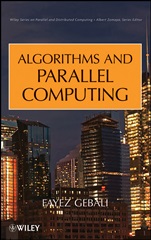
Algorithms and Parallel Computing
ISBN 9780470902103
Autor: Fayez Gebali
Wydawca: Wiley
Dostępność: 3-6 tygodni
Cena: 565,95 zł
Przed złożeniem zamówienia prosimy o kontakt mailowy celem potwierdzenia ceny.
ISBN13: |
9780470902103 |
ISBN10: |
0470902108 |
Autor: |
Fayez Gebali |
Oprawa: |
Hardback |
Rok Wydania: |
2011-03-18 |
Ilość stron: |
364 |
Wymiary: |
239x159 |
Tematy: |
TJ |
A balanced overview of the techniques used to design and program parallel computers There is a software gap between parallel computers and programmers′ abilities to program such computers. Programming a parallel computer requires closely studying the target algorithm or application, more so than in traditional sequential programming. Today′s programmer must be aware of the communication and data dependencies of the algorithm or application; yet, programmers do not have the tools to help them implement an algorithm on a parallel computer platform. This book provides the techniques necessary to explore parallelism in algorithms, serial as well as iterative. It shows how to systematically design special–purpose parallel processing structures to implement algorithms. The book begins by explaining how to classify an algorithm, and then identifying which technique would be appropriate to implement the application on a parallel platform. It provides techniques for studying and analyzing several types of algorithms—parallel, serial–parallel, non–serial–parallel, and regular iterative algorithms. New techniques for extracting parallelism and controlling thread workload are shown for the first time, such as z–transform, graphic, algebraic, and nonlinear workload specification for the threads. Also featured in the book: A review of algorithms and how to parallelize each algorithm category Ten case studies, detailed in separate chapters, that address implementing parallel algorithms on multithreaded parallel computers and developing special–purpose parallel machines A chapter dedicated to enhancing single processor performance End–of–chapter problems (solutions and lecture notes are available) Algorithms and Parallel Computing is intended for application developers, researchers, and graduate students and seniors in computer engineering, electrical engineering, and computer science. Software developers and major computer manufacturers will also find the material highly beneficial.
Preface. List of Acronyms. 1 Introduction. 1.1 Introduction. 1.2 Toward Automating Parallel Programming. 1.3 Algorithms. 1.4 Parallel Computing Design Considerations. 1.5 Parallel Algorithms and Parallel Architectures. 1.6 Relating Parallel Algorithm and Parallel Architecture. 1.7 Implementation of Algorithms: A Two–Sided Problem. 1.8 Measuring Benefi ts of Parallel Computing. 1.9 Amdahl’s Law for Multiprocessor Systems. 1.10 Gustafson–Barsis′s Law. 1.11 Applications of Parallel Computing. 2 Enhancing Uniprocessor Performance. 2.1 Introduction. 2.2 Increasing Processor Clock Frequency. 2.3 Parallelizing ALU Structure. 2.4 Using Memory Hierarchy. 2.5 Pipelining. 2.6 Very Long Instruction Word (VLIW) Processors. 2.7 Instruction–Level Parallelism (ILP) and Superscalar Processors. 2.8 Multithreaded Processor. 3 Parallel Computers. 3.1 Introduction. 3.2 Parallel Computing. 3.3 Shared–Memory Multiprocessors (Uniform Memory Access [UMA]). 3.4 Distributed–Memory Multiprocessor (Nonuniform Memory Access [NUMA]). 3.5 SIMD Processors. 3.6 Systolic Processors. 3.7 Cluster Computing. 3.8 Grid (Cloud) Computing. 3.9 Multicore Systems. 3.10 SM. 3.11 Communication Between Parallel Processors. 3.12 Summary of Parallel Architectures. 4 Shared–Memory Multiprocessors. 4.1 Introduction. 4.2 Cache Coherence and Memory Consistency. 4.3 Synchronization and Mutual Exclusion. 5 Interconnection Networks. 5.1 Introduction. 5.2 Classification of Interconnection Networks by Logical Topologies. 5.3 Interconnection Network Switch Architecture. 6 Concurrency Platforms. 6.1 Introduction. 6.2 Concurrency Platforms. 6.3 Cilk++. 6.4 OpenMP. 6.5 Compute Unifi ed Device Architecture (CUDA). 7 Ad Hoc Techniques for Parallel Algorithms. 7.1 Introduction. 7.2 Defining Algorithm Variables. 7.3 Independent Loop Scheduling. 7.4 Dependent Loops. 7.5 Loop Spreading for Simple Dependent Loops. 7.6 Loop Unrolling. 7.7 Problem Partitioning. 7.8 Divide–and–Conquer (Recursive Partitioning) Strategies. 7.9 Pipelining. 8 Nonserial–Parallel Algorithms. 8.1 Introduction. 8.2 Comparing DAG and DCG Algorithms. 8.3 Parallelizing NSPA Algorithms Represented by a DAG. 8.4 Formal Technique for Analyzing NSPAs. 8.5 Detecting Cycles in the Algorithm. 8.6 Extracting Serial and Parallel Algorithm Performance Parameters. 8.7 Useful Theorems. 8.8 Performance of Serial and Parallel Algorithms on Parallel Computers. 9 z –Transform Analysis. 9.1 Introduction. 9.2 Definition of z– Transform. 9.3 The 1–D FIR Digital Filter Algorithm. 9.4 Software and Hardware Implementations of the z– Transform. 9.5 Design 1: Using Horner’s Rule for Broadcast Input and Pipelined Output. 9.6 Design 2: Pipelined Input and Broadcast Output. 9.7 Design 3: Pipelined Input and Output. 10 Dependence Graph Analysis. 10.1 Introduction. 10.2 The 1–D FIR Digital Filter Algorithm. 10.3 The Dependence Graph of an Algorithm. 10.4 Deriving the Dependence Graph for an Algorithm. 10.5 The Scheduling Function for the 1–D FIR Filter. 10.6 Node Projection Operation. 10.7 Nonlinear Projection Operation. 10.8 Software and Hardware Implementations of the DAG Technique. 11 Computational Geometry Analysis. 11.1 Introduction. 11.2 Matrix Multiplication Algorithm. 11.3 The 3–D Dependence Graph and Computation Domain D. 11.4 The Facets and Vertices of D. 11.5 The Dependence Matrices of the Algorithm Variables. 11.6 Nullspace of Dependence Matrix: The Broadcast Subdomain B . 11.7 Design Space Exploration: Choice of Broadcasting versus Pipelining Variables. 11.8 Data Scheduling. 11.9 Projection Operation Using the Linear Projection Operator. 11.10 Effect of Projection Operation on Data. 11.11 The Resulting Multithreaded/Multiprocessor Architecture. 11.12 Summary of Work Done in this Chapter. 12 Case Study: One–Dimensional IIR Digital Filters. 12.1 Introduction. 12.2 The 1–D IIR Digital Filter Algorithm. 12.3 The IIR Filter Dependence Graph. 12.4 z–Domain Analysis of 1–D IIR Digital Filter Algorithm. 13 Case Study: Two– and Three–Dimensional Digital Filters. 13.1 Introduction. 13.2 Line and Frame Wraparound Problems. 13.3 2–D Recursive Filters. 13.4 3–D Digital Filters. 14 Case Study: Multirate Decimators and Interpolators. 14.1 Introduction. 14.2 Decimator Structures. 14.3 Decimator Dependence Graph. 14.4 Decimator Scheduling. 14.5 Decimator DAG for s1 = [1 0]. 14.6 Decimator DAG for s2 = [1 – 1]. 14.7 Decimator DAG for s3 = [1 1]. 14.8 Polyphase Decimator Implementations. 14.9 Interpolator Structures. 14.10 Interpolator Dependence Graph. 14.11 Interpolator Scheduling. 14.12 Interpolator DAG for s1 = [1 0]. 14.13 Interpolator DAG for s2 = [1 – 1]. 14.14 Interpolator DAG for s3 = [1 1]. 14.15 Polyphase Interpolator Implementations. 15 Case Study: Pattern Matching. 15.1 Introduction. 15.2 Expressing the Algorithm as a Regular Iterative Algorithm (RIA). 15.3 Obtaining the Algorithm Dependence Graph. 15.4 Data Scheduling. 15.5 DAG Node Projection. 15.6 DESIGN 1: Design Space Exploration When s = [1 1] t . 15.7 DESIGN 2: Design Space Exploration When s = [1 –1] t . 15.8 DESIGN 3: Design Space Exploration When s = [1 0] t . 16 Case Study: Motion Estimation for Video Compression. 16.1 Introduction. 16.2 FBMAs. 16.3 Data Buffering Requirements. 16.4 Formulation of the FBMA. 16.5 Hierarchical Formulation of Motion Estimation. 16.6 Hardware Design of the Hierarchy Blocks. 17 Case Study: Multiplication over GF(2 m ). 17.1 Introduction. 17.2 The Multiplication Algorithm in GF(2 m ). 17.3 Expressing Field Multiplication as an RIA. 17.4 Field Multiplication Dependence Graph. 17.5 Data Scheduling. 17.6 DAG Node Projection. 17.7 Design 1: Using d1 = [1 0] t . 17.8 Design 2: Using d2 = [1 1] t . 17.9 Design 3: Using d3 = [1 –1] t . 17.10 Applications of Finite Field Multipliers. 18 Case Study: Polynomial Division over GF(2). 18.1 Introduction. 18.2 The Polynomial Division Algorithm. 18.3 The LFSR Dependence Graph. 18.4 Data Scheduling. 18.5 DAG Node Projection. 18.6 Design 1: Design Space Exploration When s1 = [1 –1]. 18.7 Design 2: Design Space Exploration When s2 = [1 0]. 18.8 Design 3: Design Space Exploration When s3 = [1 –0.5]. 18.9 Comparing the Three Designs. 19 The Fast Fourier Transform. 19.1 Introduction. 19.2 Decimation–in–Time FFT. 19.3 Pipeline Radix–2 Decimation–in–Time FFT Processor. 19.4 Decimation–in–Frequency FFT. 19.5 Pipeline Radix–2 Decimation–in–Frequency FFT Processor. 20 Solving Systems of Linear Equations. 20.1 Introduction. 20.2 Special Matrix Structures. 20.3 Forward Substitution (Direct Technique). 20.4 Back Substitution. 20.5 Matrix Triangularization Algorithm. 20.6 Successive over Relaxation (SOR) (Iterative Technique). 20.7 Problems. 21 Solving Partial Differential Equations Using Finite Difference Method. 21.1 Introduction. 21.2 FDM for 1–D Systems. References. Index.
Fayez Gebali , PhD, has taught at the University of Victoria since 1984 and has served as the Associate Dean of Engineering for undergraduate programs since 2002. He has contributed to dozens of journals and technical reports and has completed four books. Dr. Gebali′s primary research interests include VLSI design, processor array design, algorithms for computer arithmetic, and communication system modeling.
Koszyk
Książek w koszyku: 0 szt.
Wartość zakupów: 0,00 zł
Informacje


Kontakt
Gambit
Centrum Oprogramowania
i Szkoleń Sp. z o.o.
Al. Pokoju 29b/22-24
31-564 Kraków
Siedziba Księgarni
ul. Kordylewskiego 1
31-542 Kraków
+48 12 410 5991
+48 12 410 5987
+48 12 410 5989
Subskrypcje
Administratorem danych osobowych jest firma Gambit COiS Sp. z o.o. Na podany adres będzie wysyłany wyłącznie biuletyn informacyjny.
Autoryzacja płatności

Informacje na temat autoryzacji płatności poprzez PayU.

© Copyright 2012: GAMBIT COiS Sp. z o.o. Wszelkie prawa zastrzeżone.
Projekt i wykonanie: Alchemia Studio Reklamy