


Wydawcy
Katalog tematyczny
- Archeologia (1)
- Ekonomia, finanse, business (698)
- Filozofia (20)
- Historia (57)
- Języki i językoznawstwo (4)
- Lifestyle, hobby i rozrywka (32)
- Medycyna (1025)
- Nauki humanistyczne (2)
- Nauki o Ziemi i środowisku (430)
- Nauki ścisłe (1681)
- Nauki społeczne (1297)
- Nauki techniczne (530)
- Prawo (1437)
- Publikacje informacyjne i interdyscyplinarne (32)
- Religia i wierzenia (15)
- Technika komputerowa (237)
- Zdrowie, relacje międzyludzkie i rozwój osobisty (4)





Informacje szczegółowe o książce
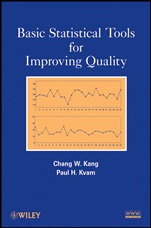
Basic Statistical Tools for Improving Quality
ISBN 9780470889497
Autor: Chang W. Kang, Paul H. Kvam
Wydawca: Wiley
Dostępność: 3-6 tygodni
Cena: 343,35 zł
Przed złożeniem zamówienia prosimy o kontakt mailowy celem potwierdzenia ceny.
ISBN13: |
9780470889497 |
ISBN10: |
0470889497 |
Autor: |
Chang W. Kang, Paul H. Kvam |
Oprawa: |
Paperback |
Rok Wydania: |
2011-05-20 |
Ilość stron: |
262 |
Wymiary: |
245x155 |
Tematy: |
KM |
A complete guide to the essential statistical process control techniques for understanding data and problem solving
Organizations across various areas of industry strive to improve the quality of their products, employees, and services, utilizing the technique of statistical process control (SPC) to measure variables in order to determine where improvements need to be made. Basic Statistical Tools for Improving Quality provides an introduction to improving the quality of a process or a system, primarily through SPC, while also showing how to implement continuous improvement into process control. The book analyzes quality management problems through cohesive explanations, real–world applications from different industries, and interpretations of results using software.
Promoting a ′learn by example′ approach, the authors introduce the basic tools of data analysis, control charts, and process improvement in a comprehensive style that does not rely heavily on mathematics. The book utilizes the author′s own user–friendly eZ SPC software to carry out key practices such as making tests and confidence intervals and using graphical statistics to communicate ideas. Basic control charts for means, variances, and proportions are featured along with advanced control charts and guidance on:
Generating a control chart to evaluate and monitor a process
Detecting the first moment when a process breaks down or goes out of control
Creating process improvement by investigating potential factors that affect the process and/or process output
Implementing correlation analysis, regression, analysis of variance, and factorial design using eZ SPC
Real–world examples illustrate the discussed methods, and every chapter contains a set of exercises. All presented data sets are available on the book′s related website along with the eZ SPC software, which readers can freely download to create the
ir own results and analyses.
Basic Statistical Tools for Improving Quality is an excellent reference for applied statisticians and practitioners working in the fields of engineering, business, and management science. It also serves as a supplemental book for courses on quality control at the upper–undergraduate and graduate levels.
Spis treści:
Preface.
1 The Importance of Quality Improvement.
1.1 Introduction.
1.2 What is Statistical Process Control?
1.3 The Birth of Quality Control.
1.4 What is a Process?
1.5 Examples of Processes from Daily Life.
1.6 Implementing the Tools and Techniques.
1.7 Continuous Process Improvement.
1.8 The Goal of Statistical Process Control.
1.9 The Eight Dimensions of Quality for Manufacturing & Service.
1.10 The Cost of (Poor) Quality).
1.11 What Did We Learn?
1.12 Test Your Knowledge.
2 Graphical Display of Data.
2.1 Introduction to eZ SPC.
2.2 Qualitative and Quantitative Data.
2.3 Bar Graph.
2.4 Pie Chart.
2.5 Pareto Chart.
2.6 Radar Chart.
2.7 Histogram.
2.8 Box Plot.
2.9 Scatter Plot.
2.10 Cause and E®ect Diagram.
2.11 What Did We Learn?
2.12 Test Your Knowledge.
Exercises.
3 Summarizing Data.
3.1 Central Tendency.
3.2 Variability.
3.3 Statistical Distributions.
3.4 Distributions in eZ SPC.
3.5 What Did We Learn?
3.6 Test Your Knowledge.
Exercises.
4 Analyzing Data.
4.1 Confidence Intervals.
4.2 Test of Hypothesis.
4.3 The p–value.
4.4 Probability Plots.
4.5 What Did We Learn?
4.6 Test Your Knowledge.
Exercises.
5 Shewhart Control Charts.
5.1 The Concepts of a Control Chart.
5.2 Managing the Process with Control Charts.
5.3 Variable Control Charts.
5.4 Attribute Control Charts.
5.5 Deciding Which Chart to Use.
5.6 What Did We Learn?
5.7 Test Your Knowledge.
Exercises.
6 Adv
anced Control Charts.
6.1 CUSUM Control Chart.
6.2 EWMA Control Charts.
6.3 CV Control Chart.
6.4 Nonparametric Control Charts.
6.5 Process Capability.
6.6 Gage R & R.
6.7 What Did We Learn?
6.8 Test Your Knowledge.
Exercises.
7 Process Improvement.
7.1 Correlation Analysis.
7.2 Regression Analysis.
7.3 Experimental Design.
7.4 Overview of Experimental Design.
7.5 Principles of Experimentation.
7.6 One–Way Analysis of Variance .
7.7 Two Way Analysis of Variance.
7.8 Two–level Factorial Design Analysis.
7.9 What Did We Learn?
7.10 Test Your Knowledge.
Exercises.
8 End Material.
8.1 Final Exam.
8.2 Final Exam Solutions.
8.3 Test Your Knowledge: Answers.
References.
Glossary.
Subject Index.
Nota biograficzna:
Chang W. Kang, PhD, is Professor in the Department of Industrial and Management Engineering at Hanyang University (South Korea). He has published extensively in the areas of engineering statistics, statistical quality control, and quality management. Former president of the Korea Society of Industrial and Systems Engineering, Dr. Kang is the recipient of both the President′s Award (2004) and the Medal of Service Merits (2007) by the Korean government.
Paul H. Kvam, PhD, is Professor of Industrial and Systems Engineering at the Georgia Institute of Technology. He has published numerous papers in the areas of statistical reliability with applications to engineering, nonparametric estimation, and analysis of complex and dependent systems. He is a Fellow of the American Statistical Association and the coauthor of Nonparametric Statistics for Science and Engineering (Wiley).
Okładka tylna:
A complete guide to the essential statistical process control techniques for understanding data and problem solving
Organizations across various areas of industry strive to improve the
quality of their products, employees, and services, utilizing the technique of statistical process control (SPC) to measure variables in order to determine where improvements need to be made. Basic Statistical Tools for Improving Quality provides an introduction to improving the quality of a process or a system, primarily through SPC, while also showing how to implement continuous improvement into process control. The book analyzes quality management problems through cohesive explanations, real–world applications from different industries, and interpretations of results using software.
Promoting a ′learn by example′ approach, the authors introduce the basic tools of data analysis, control charts, and process improvement in a comprehensive style that does not rely heavily on mathematics. The book utilizes the author′s own user–friendly eZ SPC software to carry out key practices such as making tests and confidence intervals and using graphical statistics to communicate ideas. Basic control charts for means, variances, and proportions are featured along with advanced control charts and guidance on:
Generating a control chart to evaluate and monitor a process
Detecting the first moment when a process breaks down or goes out of control
Creating process improvement by investigating potential factors that affect the process and/or process output
Implementing correlation analysis, regression, analysis of variance, and factorial design using eZ SPC
Real–world examples illustrate the discussed methods, and every chapter contains a set of exercises. All presented data sets are available on the book′s related website along with the eZ SPC software, which readers can freely download to create their own results and analyses.
Basic Statistical Tools for Improving Quality is an excellent reference for applied statisticians and practitioners working in the fields of engineering, b
usiness, and management science. It also serves as a supplemental book for courses on quality control at the upper–undergraduate and graduate levels.
Koszyk
Książek w koszyku: 0 szt.
Wartość zakupów: 0,00 zł
Informacje


Kontakt
Gambit
Centrum Oprogramowania
i Szkoleń Sp. z o.o.
Al. Pokoju 29b/22-24
31-564 Kraków
Siedziba Księgarni
ul. Kordylewskiego 1
31-542 Kraków
+48 12 410 5991
+48 12 410 5987
+48 12 410 5989
Subskrypcje
Administratorem danych osobowych jest firma Gambit COiS Sp. z o.o. Na podany adres będzie wysyłany wyłącznie biuletyn informacyjny.
Autoryzacja płatności

Informacje na temat autoryzacji płatności poprzez PayU.

© Copyright 2012: GAMBIT COiS Sp. z o.o. Wszelkie prawa zastrzeżone.
Projekt i wykonanie: Alchemia Studio Reklamy