


Wydawcy
Katalog tematyczny
- Archeologia (109)
- Ekonomia, finanse, business (13704)
- Filozofia (1445)
- Historia (3040)
- Języki i językoznawstwo (2356)
- Lifestyle, hobby i rozrywka (475)
- Medycyna (9704)
- Nauki humanistyczne (4)
- Nauki o Ziemi i środowisku (2638)
- Nauki ścisłe (20412)
- Nauki społeczne (8486)
- Nauki techniczne (13450)
- Prawo (1696)
- Publikacje informacyjne i interdyscyplinarne (1288)
- Religia i wierzenia (917)
- Technika komputerowa (4067)
- Zdrowie, relacje międzyludzkie i rozwój osobisty (657)





Informacje szczegółowe o książce
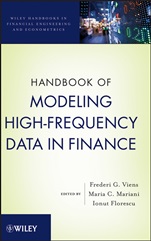
Handbook of Modeling High–Frequency Data in Finance
ISBN 9780470876886
Autor: Frederi G. Viens, Maria C. Mariani, Ionut Florescu
Wydawca: Wiley
Dostępność: 3-6 tygodni
Cena: 773,85 zł
Przed złożeniem zamówienia prosimy o kontakt mailowy celem potwierdzenia ceny.
ISBN13: |
9780470876886 |
ISBN10: |
0470876883 |
Autor: |
Frederi G. Viens, Maria C. Mariani, Ionut Florescu |
Oprawa: |
Hardback |
Rok Wydania: |
2012-01-06 |
Ilość stron: |
456 |
Wymiary: |
241x171 |
Tematy: |
KF |
CUTTING–EDGE DEVELOPMENTS IN HIGH–FREQUENCY FINANCIAL ECONOMETRICS
In recent years, the availability of high–frequency data and advances in computing have allowed financial practitioners to design systems that can handle and analyze this information. Handbook of Modeling High–Frequency Data in Finance addresses the many theoretical and practical questions raised by the nature and intrinsic properties of this data.
A one–stop compilation of empirical and analytical research, this handbook explores data sampled with high–frequency finance in financial engineering, statistics, and the modern financial business arena. Every chapter uses real–world examples to present new, original, and relevant topics that relate to newly evolving discoveries in high–frequency finance, such as:
Designing new methodology to discover elasticity and plasticity of price evolution
Constructing microstructure simulation models
Calculation of option prices in the presence of jumps and transaction costs
Using boosting for financial analysis and trading
The handbook motivates practitioners to apply high–frequency finance to real–world situations by including exclusive topics such as risk measurement and management, UHF data, microstructure, dynamic multi–period optimization, mortgage data models, hybrid Monte Carlo, retirement, trading systems and forecasting, pricing, and boosting. The diverse topics and viewpoints presented in each chapter ensure that readers are supplied with a wide treatment of practical methods.
Handbook of Modeling High–Frequency Data in Finance is an essential reference for academics and practitioners in finance, business, and econometrics who work with high–frequency data in their everyday work. It also serves as a supplement for risk management and high–frequency finance courses at the upper–undergraduate and graduate levels.
Preface xi
Contributors xiii
Part One Analysis of Empirical Data 1
1 Estimation of NIG and VG Models for High FrequencyFinancial Data 3
José E. Figueroa–López, Steven R. Lancette, KiseopLee, and Yanhui Mi
1.1 Introduction, 3
1.2 The Statistical Models, 6
1.3 Parametric Estimation Methods, 9
1.4 Finite–Sample Performance via Simulations, 14
1.5 Empirical Results, 18
1.6 Conclusion, 22
References, 24
2 A Study of Persistence of Price Movement using HighFrequency Financial Data 27
Dragos Bozdog, Ionut¸ Florescu, Khaldoun Khashanah, and JimWang
2.1 Introduction, 27
2.2 Methodology, 29
2.3 Results, 35
2.4 Rare Events Distribution, 41
2.5 Conclusions, 44
References, 45
3 Using Boosting for Financial Analysis and Trading47
Germán Creamer
3.1 Introduction, 47
3.2 Methods, 48
3.3 Performance Evaluation, 53
3.4 Earnings Prediction and Algorithmic Trading, 60
3.5 Final Comments and Conclusions, 66
References, 69
4 Impact of Correlation Fluctuations on Securitizedstructures 75
Eric Hillebrand, Ambar N. Sengupta, and Junyue Xu
4.1 Introduction, 75
4.2 Description of the Products and Models, 77
4.3 Impact of Dynamics of Default Correlation on
Low–Frequency Tranches, 79
4.4 Impact of Dynamics of Default Correlation on High–FrequencyTranches, 87
4.5 Conclusion, 92
References, 94
5 Construction of Volatility Indices Using A MultinomialTree Approximation Method 97
Dragos Bozdog, Ionut¸ Florescu, Khaldoun Khashanah, andHongwei Qiu
5.1 Introduction, 97
5.2 New Methodology, 99
5.3 Results and Discussions, 101
5.4 Summary and Conclusion, 110
References, 115
Part Two Long Range Dependence Models 117
6 Long Correlations Applied to the Study of Memory Effects inHigh Frequency (TICK) Data, the Dow Jones Index, and InternationalIndices 119
Ernest Barany and Maria Pia Beccar Varela
6.1 Introduction, 119
6.2 Methods Used for Data Analysis, 122
6.3 Data, 128
6.4 Results and Discussions, 132
6.5 Conclusion, 150
References, 160
7 Risk Forecasting with GARCH, Skewed t Distributions,and Multiple Timescales 163
Alec N. Kercheval and Yang Liu
7.1 Introduction, 163
7.2 The Skewed t Distributions, 165
7.3 Risk Forecasts on a Fixed Timescale, 176
7.4 Multiple Timescale Forecasts, 185
7.5 Backtesting, 188
7.6 Further Analysis: Long–Term GARCH and Comparisons usingSimulated Data, 203
7.7 Conclusion, 216
References, 217
8 Parameter Estimation and Calibration for Long–MemoryStochastic Volatility Models 219
Alexandra Chronopoulou
8.1 Introduction, 219
8.2 Statistical Inference Under the LMSV Model, 222
8.3 Simulation Results, 227
8.4 Application to the S&P Index, 228
8.5 Conclusion, 229
References, 230
Part Three Analytical Results 233
9 A Market Microstructure Model of Ultra High FrequencyTrading 235
Carlos A. Ulibarri and Peter C. Anselmo
9.1 Introduction, 235
9.2 Microstructural Model, 237
9.3 Static Comparisons, 239
9.4 Questions for Future Research, 241
References, 242
10 Multivariate Volatility Estimation with High FrequencyData Using Fourier Method 243
Maria Elvira Mancino and Simona Sanfelici
10.1 Introduction, 243
10.2 Fourier Estimator of Multivariate Spot Volatility, 246
10.3 Fourier Estimator of Integrated Volatility in the Presenceof Microstructure Noise, 252
10.4 Fourier Estimator of Integrated Covariance in the Presenceof Microstructure Noise, 263
10.5 Forecasting Properties of Fourier Estimator, 272
10.6 Application: Asset Allocation, 286
References, 290
11 The "Retirement" Problem 295
Cristian Pasarica
11.1 Introduction, 295
11.2 The Market Model, 296
11.3 Portfolio and Wealth Processes, 297
11.4 Utility Function, 299
11.5 The Optimization Problem in the Case (t,T] 0, 299
11.6 Duality Approach, 300
11.7 Infinite Horizon Case, 305
References, 324
12 Stochastic Differential Equations and Levy Models withApplications to High Frequency Data 327
Ernest Barany and Maria Pia Beccar Varela
12.1 Solutions to Stochastic Differential Equations, 327
12.2 Stable Distributions, 334
12.3 The Levy Flight Models, 336
12.4 Numerical Simulations and Levy Models: Applications toModels Arising in Financial Indices and High Frequency Data,340
12.5 Discussion and Conclusions, 345
References, 346
13 Solutions to Integro–Differential Parabolic ProblemArising on Financial Mathematics 347
Maria C. Mariani, Marc Salas, and Indranil SenGupta
13.1 Introduction, 347
13.2 Method of Upper and Lower Solutions, 351
13.3 Another Iterative Method, 364
13.4 Integro–Differential Equations in a Lévy Market,375
References, 380
14 Existence of Solutions for Financial Models withTransaction Costs and Stochastic Volatility 383
Maria C. Mariani, Emmanuel K. Ncheuguim, and IndranilSenGupta
14.1 Model with Transaction Costs, 383
14.2 Review of Functional Analysis, 386
14.3 Solution of the Problem (14.2) and (14.3) in SobolevSpaces, 391
14.4 Model with Transaction Costs and Stochastic Volatility,400
14.5 The Analysis of the Resulting Partial DifferentialEquation, 408
References, 418
Index 421
Frederi G. Viens, PhD, is Director and Coordinator of theComputational Finance Program at Purdue University, where he alsoserves as Professor of Statistics and Mathematics. He has publishedextensively in the areas of mathematical finance, probabilitytheory, and stochastic processes. Dr. Viens is co–organizer of theannual Conference on Modeling High–Frequency Data in Finance.
Maria C. Mariani, PhD, is Pro–fessor and Chair in theDepartment of Mathematical Sciences at The University of Texas atEl Paso. She currently focuses her research on mathematicalfinance, applied mathematics, and numerical methods. Dr. Mariani isco–organizer of the annual Conference on Modeling High–FrequencyData in Finance.
Ionut Florescu, PhD, is Assistant Professor ofMathematics at Stevens Institute of Technology. He has published inresearch areas including stochastic volatility, stochastic partialdifferential equations, Monte Carlo methods, and numerical methodsfor stochastic processes. Dr. Florescu is lead organizer of theannual Conference on Modeling High–Frequency Data in Finance.
Koszyk
Książek w koszyku: 0 szt.
Wartość zakupów: 0,00 zł
Informacje


Kontakt
Gambit
Centrum Oprogramowania
i Szkoleń Sp. z o.o.
Al. Pokoju 29b/22-24
31-564 Kraków
Siedziba Księgarni
ul. Kordylewskiego 1
31-542 Kraków
+48 12 410 5991
+48 12 410 5987
+48 12 410 5989
Subskrypcje
Administratorem danych osobowych jest firma Gambit COiS Sp. z o.o. Na podany adres będzie wysyłany wyłącznie biuletyn informacyjny.
Autoryzacja płatności

Informacje na temat autoryzacji płatności poprzez PayU.

© Copyright 2012: GAMBIT COiS Sp. z o.o. Wszelkie prawa zastrzeżone.
Projekt i wykonanie: Alchemia Studio Reklamy