


Wydawcy
Katalog tematyczny
- Archeologia (109)
- Ekonomia, finanse, business (13704)
- Filozofia (1445)
- Historia (3040)
- Języki i językoznawstwo (2356)
- Lifestyle, hobby i rozrywka (475)
- Medycyna (9704)
- Nauki humanistyczne (4)
- Nauki o Ziemi i środowisku (2638)
- Nauki ścisłe (20412)
- Nauki społeczne (8486)
- Nauki techniczne (13450)
- Budownictwo lądowe (1045)
- Chemia przemysłowa (2258)
- Elektronika i telekomunikacja (3287)
- Energetyka (1122)
- Inne nauki stosowane (363)
- Inżynieria biochemiczna (507)
- Inżynieria transportu (232)
- Mechanika i materiały (3316)
- Nauka o środowisku (321)
- Rolnictwo (507)
- Technika, ogólnie (475)
- Prawo (1696)
- Publikacje informacyjne i interdyscyplinarne (1288)
- Religia i wierzenia (917)
- Technika komputerowa (4067)
- Zdrowie, relacje międzyludzkie i rozwój osobisty (657)





Informacje szczegółowe o książce
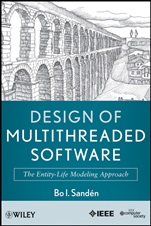
Design of Multithreaded Software: The Entity–Life Modeling Approach
ISBN 9780470876596
Autor: Bo I. Sanden
Wydawca: Wiley
Dostępność: 3-6 tygodni
Cena: 513,45 zł
Przed złożeniem zamówienia prosimy o kontakt mailowy celem potwierdzenia ceny.
ISBN13: |
9780470876596 |
ISBN10: |
047087659X |
Autor: |
Bo I. Sanden |
Oprawa: |
Hardback |
Rok Wydania: |
2011-02-15 |
Ilość stron: |
320 |
Wymiary: |
262x184 |
Tematy: |
TJ |
"Bo Sandén has written a splendid book that should be read by every developer of systems that interact with the real world. The multi–threading theme that gives the book its title treats the identification and design of individual threads—that is, of concurrent processes—and the synchronisation and control of their interactions at common entities. The book succeeds excellently in this difficult area, expounding patterns of thread interaction that clarify both the problems they address and the solutions they offer."
—Michael A. Jackson, from the Foreword
A novel approach to designing software for reactive systems
This book is the first available in–depth introduction to the cutting–edge entity–life modeling (ELM) approach for the design of multithreaded, reactive software, making it an instant authoritative reference. The text is divided into three parts:
Part I covers two fundamentals necessary for understanding ELM—program–language thread support in Ada and Java, and state modeling
Part II describes ELM′s unique approach
Part III positions ELM relative to other design approaches
Reactive software must respond to events in the world as they occur. To deal with this, ELM defines an event thread as a series of event occurrences that are separated in time. As the book reveals, event threads become the basis for software threads, leading to thread architectures that can be understood intuitively in problem–domain terms. Readers will discover how ELM captures the logic of event threads in terms of states, providing two patterns for designing software threads based on state diagrams and their activities.
Event threads in the domain can also form patterns. The text explains how ELM identifies the resource–user–thread pattern and the resource–guard–thread pattern, both addressing resource sharing by multiple domain entiti
es. It also covers the case where entities need simultaneous exclusive access to more than one resource, and shows how ELM deals with deadlock prevention.
Design of Multithreaded Software is intended for software designers, architects, and researchers as well as systems designers, programmers, and engineers interested in a practical account of this novel approach.
Spis treści:
Foreword.
Preface.
I Foundations.
1 Introduction.
1.1 Entity–Life Modeling.
1.2 Overview of This Book.
1.3 Multithreading.
1.4 Engineering the Intangible.
1.5 The Development Process.
1.6 Unifi ed Modeling Language.
1.7 Conclusion.
2 Support for Multithreading.
2.1 Introduction.
2.2 Concurrency in Java.
2.3 Concurrency in Ada.
2.4 Pthreads.
2.5 Conclusion.
3 State Modeling.
3.1 Introduction.
3.2 State–Modeling Terminology.
3.3 Basic State Modeling.
3.4 Superstates.
3.5 Examples.
3.6 State Modeling in Practice.
3.7 State Machine Implementation.
3.8 Conclusion.
II The ELM Way.
4 Entity–Life Modeling.
4.1 Introduction.
4.2 Modeling Software on Event Threads.
4.3 Discovering and Choosing Event–Thread Models.
4.4 Event–Thread Patterns for Resource Sharing.
∗4.5 Portraying the World in Software.
4.6 Conclusion.
5 Design Patterns Based on Event Threads.
5.1 Introduction.
5.2 State Machines without Software activities.
5.3 Sequential–Activities Design Pattern.
5.4 Concurrent–Activities Design Pattern.
5.5 Communicating State Machines.
5.6 Conclusion.
6 Event–Thread Patterns for Resource Sharing.
6.1 Introduction.
6.2 Resource–User–Thread Pattern.
6.3 The Resource–Guard–Thread Pattern.
6.4 Choosing and Combining Patterns.
6.5 Examples with Dual Solutions.
6.6 Data Stream Processing.
6.7 Repository Problems.
6.8 Conclusion.
7 Simultaneous Exclusive Access to Multiple Resources.
7.1 Introduction.
7.2 The Deadlock Problem.
7.3 Case Studies.
7.4 Heuristics.
7.5 More on Deadlock and Its Prevention.
7.6 Conclusion.
III Background and Discussion.
8 Real–Time Software Architectures and Data–Flow Design Approaches.
8.1 Introduction.
8.2 Real–Time Architectures.
8.3 Data–Flow Design Approaches.
8.4 Conclusion.
9 The Origins of Entity–Life Modeling.
9.1 Introduction.
9.2 Early Experiences with Software Development.
9.3 The Jackson Methods.
9.3.1.4 Structure Clashes.
∗9.4 Formal Models and Methods.
9.5 Software Patterns.
9.6 Conclusion.
Glossary.
References.
Index.
Nota biograficzna:
Bo I. Sandén, PhD, serves as Professor of Computer Science at Colorado Technical University. He has also taught at George Mason University in Fairfax, Virginia. Prior to his teaching career, Dr. Sandén worked at Phillips Elektronikindustrier in Stockholm, Sweden, and has significant professional experience as a systems analyst, project manager, programmer, and consultant. He devotes his research activities primarily to software design and has published extensively on Jackson system development, concurrency in Ada and Java, and entity–life modeling.
Okładka tylna:
"Bo Sandén has written a splendid book that should be read by every developer of systems that interact with the real world. The multi–threading theme that gives the book its title treats the identification and design of individual threads—that is, of concurrent processes—and the synchronisation and control of their interactions at common entities. The book succeeds excellently in this difficult area, expounding patterns of thread interaction that clarify both the problems they
address and the solutions they offer."
—Michael A. Jackson, from the Foreword
A novel approach to designing software for reactive systems
This book is the first available in–depth introduction to the cutting–edge entity–life modeling (ELM) approach for the design of multithreaded, reactive software, making it an instant authoritative reference. The text is divided into three parts:
Part I covers two fundamentals necessary for understanding ELM—program–language thread support in Ada and Java, and state modeling
Part II describes ELM′s unique approach
Part III positions ELM relative to other design approaches
Reactive software must respond to events in the world as they occur. To deal with this, ELM defines an event thread as a series of event occurrences that are separated in time. As the book reveals, event threads become the basis for software threads, leading to thread architectures that can be understood intuitively in problem–domain terms. Readers will discover how ELM captures the logic of event threads in terms of states, providing two patterns for designing software threads based on state diagrams and their activities.
Event threads in the domain can also form patterns. The text explains how ELM identifies the resource–user–thread pattern and the resource–guard–thread pattern, both addressing resource sharing by multiple domain entities. It also covers the case where entities need simultaneous exclusive access to more than one resource, and shows how ELM deals with deadlock prevention.
Design of Multithreaded Software is intended for software designers, architects, and researchers as well as systems designers, programmers, and engineers interested in a practical account of this novel approach.
Koszyk
Książek w koszyku: 0 szt.
Wartość zakupów: 0,00 zł
Informacje


Kontakt
Gambit
Centrum Oprogramowania
i Szkoleń Sp. z o.o.
Al. Pokoju 29b/22-24
31-564 Kraków
Siedziba Księgarni
ul. Kordylewskiego 1
31-542 Kraków
+48 12 410 5991
+48 12 410 5987
+48 12 410 5989
Subskrypcje
Administratorem danych osobowych jest firma Gambit COiS Sp. z o.o. Na podany adres będzie wysyłany wyłącznie biuletyn informacyjny.
Autoryzacja płatności

Informacje na temat autoryzacji płatności poprzez PayU.

© Copyright 2012: GAMBIT COiS Sp. z o.o. Wszelkie prawa zastrzeżone.
Projekt i wykonanie: Alchemia Studio Reklamy