


Wydawcy
Katalog tematyczny
- Archeologia (109)
- Ekonomia, finanse, business (13704)
- Filozofia (1445)
- Historia (3040)
- Języki i językoznawstwo (2356)
- Lifestyle, hobby i rozrywka (475)
- Medycyna (9704)
- Nauki humanistyczne (4)
- Nauki o Ziemi i środowisku (2638)
- Nauki ścisłe (20412)
- Nauki społeczne (8486)
- Nauki techniczne (13450)
- Budownictwo lądowe (1045)
- Chemia przemysłowa (2258)
- Elektronika i telekomunikacja (3287)
- Energetyka (1122)
- Inne nauki stosowane (363)
- Inżynieria biochemiczna (507)
- Inżynieria transportu (232)
- Mechanika i materiały (3316)
- Nauka o środowisku (321)
- Rolnictwo (507)
- Technika, ogólnie (475)
- Prawo (1696)
- Publikacje informacyjne i interdyscyplinarne (1288)
- Religia i wierzenia (917)
- Technika komputerowa (4067)
- Zdrowie, relacje międzyludzkie i rozwój osobisty (657)





Informacje szczegółowe o książce
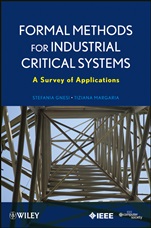
Formal Methods for Industrial Critical Systems: A Survey of Applications
ISBN 9780470876183
Autor: Stefania Gnesi, Tiziana Margaria
Wydawca: Wiley
Dostępność: 3-6 tygodni
Cena: 452,55 zł
Przed złożeniem zamówienia prosimy o kontakt mailowy celem potwierdzenia ceny.
ISBN13: |
9780470876183 |
ISBN10: |
0470876182 |
Autor: |
Stefania Gnesi, Tiziana Margaria |
Oprawa: |
Paperback |
Rok Wydania: |
2013-03-12 |
Ilość stron: |
292 |
Wymiary: |
232x156 |
Tematy: |
TJ |
Making the formal methods commonly used to test complex, safety–critical control systems easier to learn and integrate into the industries where they can do the most good
Formal methods are an essential step in the design process for industrial safety–critical systems. The term "formal methods" encompasses all notations having precise mathematical semantics, together with their associated analysis methods, that allow description and reasoning about the behavior of a system in a formal manner.
Based on more than a decade of award–winning collaborative work within the European Research Consortium for Informatics and Mathematics, Formal Methods for Industrial Critical Systems presents mainstream formal methods currently used for designing industrial critical systems, focusing on model checking. Its tri–fold purpose is to reduce the effort required to learn formal methods, to help designers to adopt the formal methods most appropriate for their systems, and to offer a panel of state–of–the–art techniques and tools for analyzing critical systems.
This powerful resource:
Balances leading–edge material, established practice, and reviews of historically important contributions Collects timely, current articles written by a truly international group of authors Describes case studies from many kinds of high–integrity systems development Emphasizes model checking, an important step in several types of formal methodsFormal Methods for Industrial Critical Systems is an ideal guide for students in advanced–undergraduate computer science courses and an excellent reference for industry professionals.
FOREWORD by Mike Hinchey xiii
FOREWORD by Alessandro Fantechi and Pedro Merino xv
PREFACE xvii
CONTRIBUTORS xix
PART I INTRODUCTION AND STATE OF THE ART 1
1 FORMAL METHODS: APPLYING {LOGICS IN, THEORETICAL} COMPUTERSCIENCE 3
Diego Latella
1.1 Introduction and State of the Art 3
1.2 Future Directions 9
PART II MODELING PARADIGMS 15
2 A SYNCHRONOUS LANGUAGE AT WORK: THE STORY OF LUSTRE 17
Nicolas Halbwachs
2.1 Introduction 17
2.2 A Flavor of the Language 18
2.3 The Design and Development of Lustre and Scade 20
2.4 Some Lessons from Industrial Use 25
2.5 And Now . . . 28
3 REQUIREMENTS OF AN INTEGRATED FORMAL METHOD FOR INTELLIGENTSWARMS 33
Mike Hinchey, James L. Rash, Christopher A. Rouff, Walt F.Truszkowski, and Amy K.C.S. Vanderbilt
3.1 Introduction 33
3.2 Swarm Technologies 35
3.3 NASA FAST Project 39
3.4 Integrated Swarm Formal Method 41
3.5 Conclusion 55
PART III TRANSPORTATION SYSTEMS 61
4 SOME TRENDS IN FORMAL METHODS APPLICATIONS TO RAILWAYSIGNALING 63
Alessandro Fantechi, Wan Fokkink, and Angelo Morzenti
4.1 Introduction 63
4.2 CENELEC Guidelines 65
4.3 Software Procurement in Railway Signaling 66
4.4 A Success Story: The B Method 70
4.5 Classes of Railway Signaling Equipment 71
4.6 Conclusions 80
5 SYMBOLIC MODEL CHECKING FOR AVIONICS 85
Radu I. Siminiceanu and Gianfranco Ciardo
5.1 Introduction 85
5.2 Application: The Runway Safety Monitor 87
5.3 A Discrete Model of RSM 95
5.4 Discussion 107
PART IV TELECOMMUNICATIONS 113
6 APPLYING FORMAL METHODS TO TELECOMMUNICATION SERVICES WITHACTIVE NETWORKS 115
María del Mar Gallardo, Jesús Martínez, and PedroMerino
6.1 Overview 115
6.2 Active Networks 116
6.3 The Capsule Approach 117
6.4 Previous Approaches on Analyzing Active Networks 118
6.5 Model Checking Active Networks with SPIN 122
6.6 Conclusions 129
7 PRACTICAL APPLICATIONS OF PROBABILISTIC MODEL CHECKING TOCOMMUNICATION PROTOCOLS 133
Marie Dufl ot, Marta Kwiatkowska, Gethin Norman, David Parker,Sylvain Peyronnet, Claudine Picaronny, and Jeremy Sproston
7.1 Introduction 133
7.2 PTAs 134
7.3 Probabilistic Model Checking 136
7.4 Case Study: CSMA/CD 139
7.5 Discussion and Conclusion 146
PART V INTERNET AND ONLINE SERVICES 151
8 DESIGN FOR VERIFIABILITY: THE OCS CASE STUDY 153
Johannes Neubauer, Tiziana Margaria, and BernhardSteffen
8.1 Introduction 153
8.2 The User Model 155
8.3 The Models and the Framework 158
8.4 Model Checking 159
8.5 Validating Emerging Global Behavior via Automata Learning161
8.6 Related Work 170
8.7 Conclusion and Perspectives 173
9 AN APPLICATION OF STOCHASTIC MODEL CHECKING IN THE INDUSTRY:USER–CENTERED MODELING AND ANALYSIS OF COLLABORATION IN THINKTEAM179
Maurice H. ter Beek, Stefania Gnesi, Diego Latella, MiekeMassink, Maurizio Sebastianis, and Gianluca Trentanni
9.1 Introduction 179
9.2 thinkteam 182
9.3 Analysis of the thinkteam Log File 184
9.4 thinkteam with Replicated Vaults 189
9.5 Lessons Learned 201
9.6 Conclusions 201
PART VI RUNTIME: TESTING AND MODEL LEARNING 205
10 THE TESTING AND TEST CONTROL NOTATION TTCN–3 AND ITS USE207
Ina Schieferdecker and Alain–Georges Vouffo–Feudjio
10.1 Introduction 207
10.2 The Concepts of TTCN–3 210
10.3 An Introductory Example 216
10.4 TTCN–3 Semantics and Its Application 219
10.5 A Distributed Test Platform for the TTCN–3 220
10.6 Case Study I: Testing of Open Service Architecture(OSA)/Parlay Services 223
10.7 Case Study II: Testing of IP Multimedia Subsystem (IMS)Equipment 225
10.8 Conclusion 230
11 PRACTICAL ASPECTS OF ACTIVE AUTOMATA LEARNING 235
Falk Howar, Maik Merten, Bernhard Steffen, and TizianaMargaria
11.1 Introduction 235
11.2 Regular Extrapolation 239
11.3 Challenges in Regular Extrapolation 244
11.4 Interacting with Real Systems 247
11.5 Membership Queries 250
11.6 Reset 253
11.7 Parameters and Value Domains 256
11.8 The NGLL 260
11.9 Conclusion and Perspectives 263
References 264
INDEX 269
STEFANIA GNESI is Director of Research and head of theFormal Methods and Tools Laboratory at ISTI–CNR (Istituto diScienza e Tecnologie dell′Informazione–Consiglio Nazionale delleRicerche) in Pisa, Italy. She was previously a lecturer in methodsand tools for the specification and analysis of software systems atthe University of Florence.
TIZIANA MARGARIA is Full Professor in the Faculty ofMathematics and Natural Sciences of the University of Potsdam,where she holds the Chair of Service and Software Engineering atthe Institute of Informatics. She has held positions atuniversities in Göttingen, Dortmund, and Passau, Germany, aswell as in Sweden and Italy.
Koszyk
Książek w koszyku: 0 szt.
Wartość zakupów: 0,00 zł
Informacje


Kontakt
Gambit
Centrum Oprogramowania
i Szkoleń Sp. z o.o.
Al. Pokoju 29b/22-24
31-564 Kraków
Siedziba Księgarni
ul. Kordylewskiego 1
31-542 Kraków
+48 12 410 5991
+48 12 410 5987
+48 12 410 5989
Subskrypcje
Administratorem danych osobowych jest firma Gambit COiS Sp. z o.o. Na podany adres będzie wysyłany wyłącznie biuletyn informacyjny.
Autoryzacja płatności

Informacje na temat autoryzacji płatności poprzez PayU.

© Copyright 2012: GAMBIT COiS Sp. z o.o. Wszelkie prawa zastrzeżone.
Projekt i wykonanie: Alchemia Studio Reklamy