


Wydawcy
Katalog tematyczny
- Archeologia (109)
- Ekonomia, finanse, business (13704)
- Filozofia (1445)
- Historia (3040)
- Języki i językoznawstwo (2356)
- Lifestyle, hobby i rozrywka (475)
- Medycyna (9704)
- Nauki humanistyczne (4)
- Nauki o Ziemi i środowisku (2638)
- Nauki ścisłe (20412)
- Astronomia (294)
- Biologia (5119)
- Chemia (6540)
- Fizyka (3309)
- Elektryczność i magnetyzm (90)
- Fizyka atomowa i molekularna (110)
- Fizyka cząstek elementarnych (36)
- Fizyka jądra atomowego (36)
- Fizyka kwantowa (210)
- Fizyka matematyczna (121)
- Fizyka relatywistyczna (36)
- Fizyka statystyczna (51)
- Fizyka stosowana (498)
- Mechanika klasyczna (186)
- Optyka i światło (133)
- Stany materii (202)
- Matematyka (4574)
- Nauki ścisłe, ogólnie (503)
- Nauki społeczne (8486)
- Nauki techniczne (13450)
- Prawo (1696)
- Publikacje informacyjne i interdyscyplinarne (1288)
- Religia i wierzenia (917)
- Technika komputerowa (4067)
- Zdrowie, relacje międzyludzkie i rozwój osobisty (657)





Informacje szczegółowe o książce
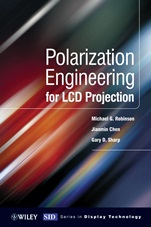
Polarization Engineering for LCD Projection
ISBN 9780470871058
Autor: Michael D. Robinson, Gary Sharp, Jianmin Chen
Wydawca: Wiley
Dostępność: 3-6 tygodni
Cena: 639,45 zł
Przed złożeniem zamówienia prosimy o kontakt mailowy celem potwierdzenia ceny.
ISBN13: |
9780470871058 |
ISBN10: |
0470871059 |
Autor: |
Michael D. Robinson, Gary Sharp, Jianmin Chen |
Oprawa: |
Hardback |
Rok Wydania: |
2005-05-20 |
Ilość stron: |
308 |
Wymiary: |
255x180 |
Tematy: |
PH |
Liquid Crystal Display (LCD) projection technology has, in recent years, led the way in large area displays because of its potential to deliver scalable, high–resolution images at a low cost. Since large displayed images demand high brightness and contrast, a full understanding of polarization, and how to manage its effects, is essential for the development of quality systems.
Using the example of LCD projection technology, this practical text provides a thorough coverage of polarization engineering problems, with appropriate solutions and mathematical tools for analysis.
Key features:A comprehensive introduction to the basics of polarization, LCDs, projection technologies and LCD projection system engineering.A detailed examination of optical system components, including polarizers and retarder stack filters.A full treatment of system contrast and color management issues.In–depth analyses of how to manage polarization in the major LCD projection systems.
Display engineers, scientists and technicians active in this field will find this a valuable resource, as will developers of large screen projection displays and microdisplays. Also useful for graduate students and researchers as an accessible introduction to the technology.
Spis treści:
Series Editor’s Foreword.
Preface.
1 Introduction.
1.1 The Case for Projection.
1.2 History and Projection Technology Overview.
1.3 Scope of the Book.
2 Liquid Crystal Projection System Basics.
2.1 Introduction.
2.2 Brightness and Color Sensitivity of the Human Eye.
2.3 Photometric Measurement.
2.4 Summary of What Constitutes a “Good” RPTV Display in the Current Marketplace.
2.5 System Engineering.
2.6 Étendue Considerations.
3 Polarization Basics.
3.1 Introduction.
3.2 Electromagnetic Wave Propagation.
3.3 Interaction with Media.
3.4 Index Ellipsoid Visualization
.
3.5 Modeling Techniques.
4 System Components.
4.1 Introduction.
4.2 Retarders.
4.3 Polarizers.
4.4 Interference Filters.
4.5 Polarizing Beam Splitters (PBSs).
4.6 Other Components.
5 Liquid Crystal Displays (LCDs).
5.1 Description and Brief History.
5.2 Anisotropic Properties of Liquid Crystals.
5.3 Frank Free Energy and Electromagnetic Field Contribution to Free Energy.
5.4 Alignment Layer and LC Pretilt Angle.
5.5 Rotational Viscosity.
5.6 Electro–optical Effect of LCs.
5.7 LC Modes for Projection.
5.8 FOV of LCDs.
6 Retarder Stack Filters.
6.1 Introduction.
6.2 Principle and Background of RSFs.
6.3 RSFs in LC Projection Systems.
6.4 Design of RSFs.
6.5 Properties of Retarder Stacks.
7 System Contrast.
7.1 Introduction.
7.2 On–axis Contrast.
7.3 Off–axis Effects.
7.4 PBS/LCOS Compensation.
7.5 ANSI Contrast Enhancement.
7.6 Skew Ray Compensated Retarder Stack Filters.
7.7 Alternative Projection Systems.
7.8 Overall System Contrast.
8 Color Management.
8.1 Introduction.
8.2 System Color Band Determination.
8.3 Color Management in Projection Systems.
9 Transmissive Three–panel Projection System.
9.1 Introduction.
9.2 Brief System Description.
9.3 System Throughput.
9.4 Contrast.
9.4.1 Negative c–plate Compensation.
10 Three–panel Reflective Systems.
10.1 Introduction.
10.2 3×PBS/X–cube System.
10.3 Polarization Color Filter Systems.
10.4 Three–panel LCOS System Comparison.
11 Single and Dual Panel LC Projection Systems.
11.1 Introduction.
11.2 Generic Color Sequential Single Panel Reflective LC System.
11.3 Example Single Panel Color Sequential Systems.
11.4 Two–panel Systems.
11.5 Commercialized Single Panel Projection Systems Based on Spatial Color Separation.
Appendix A.
Inde
x.
Okładka tylna:
Liquid Crystal Display (LCD) projection technology has, in recent years, led the way in large area displays because of its potential to deliver scalable, high–resolution images at a low cost. Since large displayed images demand high brightness and contrast, a full understanding of polarization, and how to manage its effects, is essential for the development of quality systems.
Using the example of LCD projection technology, this practical text provides a thorough coverage of polarization engineering problems, with appropriate solutions and mathematical tools for analysis.
Key features:A comprehensive introduction to the basics of polarization, LCDs, projection technologies and LCD projection system engineering.A detailed examination of optical system components, including polarizers and retarder stack filters.A full treatment of system contrast and color management issues.In–depth analyses of how to manage polarization in the major LCD projection systems.
Display engineers, scientists and technicians active in this field will find this a valuable resource, as will developers of large screen projection displays and microdisplays. Also useful for graduate students and researchers as an accessible introduction to the technology.
Koszyk
Książek w koszyku: 0 szt.
Wartość zakupów: 0,00 zł
Informacje


Kontakt
Gambit
Centrum Oprogramowania
i Szkoleń Sp. z o.o.
Al. Pokoju 29b/22-24
31-564 Kraków
Siedziba Księgarni
ul. Kordylewskiego 1
31-542 Kraków
+48 12 410 5991
+48 12 410 5987
+48 12 410 5989
Subskrypcje
Administratorem danych osobowych jest firma Gambit COiS Sp. z o.o. Na podany adres będzie wysyłany wyłącznie biuletyn informacyjny.
Autoryzacja płatności

Informacje na temat autoryzacji płatności poprzez PayU.

© Copyright 2012: GAMBIT COiS Sp. z o.o. Wszelkie prawa zastrzeżone.
Projekt i wykonanie: Alchemia Studio Reklamy