


Wydawcy
Katalog tematyczny
- Archeologia (1)
- Ekonomia, finanse, business (698)
- Filozofia (20)
- Historia (57)
- Języki i językoznawstwo (4)
- Lifestyle, hobby i rozrywka (32)
- Medycyna (1025)
- Nauki humanistyczne (2)
- Nauki o Ziemi i środowisku (430)
- Nauki ścisłe (1680)
- Nauki społeczne (1297)
- Nauki techniczne (530)
- Budownictwo lądowe (6)
- Chemia przemysłowa (27)
- Elektronika i telekomunikacja (163)
- Energetyka (25)
- Inne nauki stosowane (16)
- Inżynieria biochemiczna (11)
- Inżynieria transportu (17)
- Mechanika i materiały (176)
- Nauka o środowisku (27)
- Rolnictwo (8)
- Technika, ogólnie (46)
- Prawo (1437)
- Publikacje informacyjne i interdyscyplinarne (32)
- Religia i wierzenia (15)
- Technika komputerowa (237)
- Zdrowie, relacje międzyludzkie i rozwój osobisty (4)





Informacje szczegółowe o książce
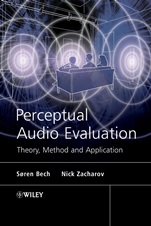
Perceptual Audio Evaluation – Theory, Method and Application
ISBN 9780470869239
Autor: Søren Bech, Nick Zacharov
Wydawca: Wiley
Dostępność: 3-6 tygodni
Cena: 622,65 zł
Przed złożeniem zamówienia prosimy o kontakt mailowy celem potwierdzenia ceny.
ISBN13: |
9780470869239 |
ISBN10: |
0470869232 |
Autor: |
Søren Bech, Nick Zacharov |
Oprawa: |
Hardback |
Rok Wydania: |
2006-04-21 |
Ilość stron: |
462 |
Wymiary: |
244x168 |
Tematy: |
TJ |
As audio and telecommunication technologies develop, there is an increasing need to evaluate the technical and perceptual performance of these innovations.
A growing number of new technologies (e.g. low bit–rate coding) are based on specific properties of the auditory system, which are often highly non–linear. This means that the auditory quality of such systems cannot be measured by traditional physical measures (such as distortion, frequency response etc.), but only by perceptual evaluations in the form of listening tests.
Perceptual Audio Evaluation provides a comprehensive guide to the many variables that need to be considered before, during and after experiments. Including the selection of the content of the programme material to be reproduced, technical aspects of the production of the programme material, the experimental set–up including calibration, and the statistical planning of the experiment and subsequent analysis of the data.
Perceptual Audio Evaluation:Provides a complete and accessible guide to the motives, theory and practical application of perceptual evaluation of reproduced sound.Discusses all the variables of perceptual evaluation, their control and their possible influence on the results.Covers in detail all international standards on the topic.Is illustrated throughout with tables, figures and worked solutions.
Perceptual Audio Evaluation will appeal to audio and speech engineers as well as researchers in audio and speech laboratories. Postgraduate students in engineering or acoustics and undergraduate students studying psychoacoustics, speech audio processing and signal processing will also find this an essential reference.
Spis treści:
Preface.
Organisation of the book.
Acknowledgments.
1. Introduction.
1.1 Listening tests – motivation for.
1.2 Role of standardization.
1.3 Role of predictive models.
I
. EXPERIMENTAL CONSIDERATIONS.
2. Definition of research question and hypothesis.
2.1 Principle of empiricism.
2.2 Principle of rationalism.
2.3 Other principles of scientific argumentation.
2.3.1 Probabilistic reasoning.
2.3.2 Argumentum ad hominem.
2.3.3 Conclusion by analogy.
2.4 Summary.
3. Fundamentals of experimentation.
4. Quantification of impression.
4.1 Response attribute.
4.1.1 Perceptual measurements.
4.1.2 Affective measurements.
4.2 Response format.
4.2.1 Direct scaling.
4.2.2 Indirect scaling.
4.2.3 Selection of appropriate scaling procedure.
4.2.4 Context and bias effects.
4.2.5 Other bias effects.
4.3 Overview of process.
5. Experimental variables.
5.1 Signal.
5.1.1 Signal category.
5.1.2 Recording technique, storage and encoding.
5.1.3 Time domain characteristics.
5.1.4 Spectral characteristics.
5.1.5 Spatial characteristics.
5.1.6 Reference signals.
5.2 Reproduction system.
5.3 Listening room.
5.4 Subject considerations.
5.4.1 Categorisation and applicability.
5.4.2 Listening panels.
5.4.3 Subject selection.
5.4.4 Training and monitoring.
6. Statistics.
6.1 Statistical experimental design.
6.2 Statistical analysis.
6.2.1 Classification of data type.
6.2.2 Levels of analysis.
6.2.3 Descriptive level.
6.2.4 Inferential level.
6.2.5 Statistical checklist.
II. TECHNICAL CONSIDERATIONS.
7. Electroacoustic considerations.
7.1 Listening rooms.
7.1.1 IEC 60268–13 listening rooms.
7.1.2 ITU–R BS.1116–1 listening rooms.
7.1.3 EBU 3276 listening rooms.
7.1.4 General characteristics.
7.2 Listening booths.
7.3 Other spaces.
7.4 Listener and loudspeaker positioning.
7.4.1 Monophonic reproduction.
7.4.2 Stereophonic reproduction.
7.4.3 Multichannel reproduction.
7.4.4 Separate bass loudspeakers.
7.4.5 Listener position.<
br>7.5 Accompanying picture.
7.6 Commonly encountered problems.
7.7 Electrical considerations.
8. Calibration.
8.1 Level calibration.
8.1.1 Level calibration methods.
8.1.2 Level metric selection.
8.1.3 Preferred listening levels.
8.1.4 Reference reproduction levels.
8.2 Loudspeaker calibration.
8.2.1 Level calibration.
8.3 Headphone calibration.
8.3.1 Headphone types.
8.3.2 Ear measurement points.
8.3.3 Headphone measurement.
8.3.4 Target frequency response.
8.3.5 Level calibration.
9. Test planning, administration and reporting.
9.1 Planning.
9.1.1 Experimental planning.
9.1.2 Logistic considerations.
9.1.3 Ethical considerations.
9.2 Administration.
9.2.1 Subject matters.
9.2.2 Subject familiarisation.
9.2.3 Listening test software.
9.3 Reporting.
III. APPLICATIONS.
10. Commonly encountered experimental paradigms.
10.1 Standards.
10.1.1 ITU–T P.800 methods.
10.1.2 ITU–R BS.1116–1.
10.1.3 ITU–R BS.1534–1.
IV. APPENDICES.
A: Standards and Recommendations.
A.1 Audio Engineering Society.
A.2 American National Standards Institute.
A.3 European Broadcasting Union.
A.4 International Electrotechnical Commission.
A.5 The International Telecommunications Union standards.
A.5.1 Telecommunications Standardisation Sector.
B: Attribute lists.
B.1 Speech quality.
B.2 Spatial sound quality.
B.2.1 Loudspeakers.
B.2.2 Headphones.
B.3 Other quality attributes.
C: Audio source and demonstration material.
D: A–, B–, C– and D– weighting curves.
E: DRP–ERP compensation curves.
F: Abbreviations.
Index.
Okładka tylna:
As audio and telecommunication technologies develop, there is an increasing need to evaluate the technical and perceptual performance of these innovations.
A growing number of new technologies (e.g
. low bit–rate coding) are based on specific properties of the auditory system, which are often highly non–linear. This means that the auditory quality of such systems cannot be measured by traditional physical measures (such as distortion, frequency response etc.), but only by perceptual evaluations in the form of listening tests.
Perceptual Audio Evaluation provides a comprehensive guide to the many variables that need to be considered before, during and after experiments. Including the selection of the content of the programme material to be reproduced, technical aspects of the production of the programme material, the experimental set–up including calibration, and the statistical planning of the experiment and subsequent analysis of the data.
Perceptual Audio Evaluation:Provides a complete and accessible guide to the motives, theory and practical application of perceptual evaluation of reproduced sound.Discusses all the variables of perceptual evaluation, their control and their possible influence on the results.Covers in detail all international standards on the topic.Is illustrated throughout with tables, figures and worked solutions.
Perceptual Audio Evaluation will appeal to audio and speech engineers as well as researchers in audio and speech laboratories. Postgraduate students in engineering or acoustics and undergraduate students studying psychoacoustics, speech audio processing and signal processing will also find this an essential reference.
Koszyk
Książek w koszyku: 0 szt.
Wartość zakupów: 0,00 zł
Informacje


Kontakt
Gambit
Centrum Oprogramowania
i Szkoleń Sp. z o.o.
Al. Pokoju 29b/22-24
31-564 Kraków
Siedziba Księgarni
ul. Kordylewskiego 1
31-542 Kraków
+48 12 410 5991
+48 12 410 5987
+48 12 410 5989
Subskrypcje
Administratorem danych osobowych jest firma Gambit COiS Sp. z o.o. Na podany adres będzie wysyłany wyłącznie biuletyn informacyjny.
Autoryzacja płatności

Informacje na temat autoryzacji płatności poprzez PayU.

© Copyright 2012: GAMBIT COiS Sp. z o.o. Wszelkie prawa zastrzeżone.
Projekt i wykonanie: Alchemia Studio Reklamy