


Wydawcy
Katalog tematyczny
- Archeologia (109)
- Ekonomia, finanse, business (13704)
- Filozofia (1445)
- Historia (3040)
- Języki i językoznawstwo (2356)
- Lifestyle, hobby i rozrywka (475)
- Medycyna (9704)
- Nauki humanistyczne (4)
- Nauki o Ziemi i środowisku (2638)
- Nauki ścisłe (20412)
- Astronomia (294)
- Biologia (5119)
- Chemia (6540)
- Chemia analityczna (361)
- Chemia fizyczna (346)
- Chemia nieorganiczna (137)
- Chemia organiczna (535)
- Krystalografia (27)
- Minerologia (46)
- Fizyka (3309)
- Matematyka (4574)
- Nauki ścisłe, ogólnie (503)
- Nauki społeczne (8486)
- Nauki techniczne (13450)
- Prawo (1696)
- Publikacje informacyjne i interdyscyplinarne (1288)
- Religia i wierzenia (917)
- Technika komputerowa (4067)
- Zdrowie, relacje międzyludzkie i rozwój osobisty (657)





Informacje szczegółowe o książce
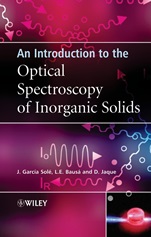
An Introduction to the Optical Spectroscopy of Inorganic Solids
ISBN 9780470868867
Autor: Jose Solé, Luisa Bausa, Daniel Jaque
Wydawca: Wiley
Dostępność: 3-6 tygodni
Cena: 432,60 zł
Przed złożeniem zamówienia prosimy o kontakt mailowy celem potwierdzenia ceny.
ISBN13: |
9780470868867 |
ISBN10: |
0470868864 |
Autor: |
Jose Solé, Luisa Bausa, Daniel Jaque |
Oprawa: |
Paperback |
Rok Wydania: |
2005-02-18 |
Ilość stron: |
304 |
Wymiary: |
233x163 |
Tematy: |
PN |
This book presents the basic aspects of the field of the optical spectroscopy of solids, allowing students with a background in quantum physics, optics and solid state physics, to interpret simple optical spectra (absorption, reflectivity, emission, scattering…) and obtain knowledge of the main instrumentation used in this field. Although most of the material treated in this book concerns the spectroscopy of centres embedded in inorganic materials, the principles described are also applicable to molecules and atoms in the gas and /or the liquid state.
This book is organized as follows:The opening chapter provides a short introduction of the fundamentals of optical spectroscopy, describing the basic standard equipment needed to measure optical spectra and the main optical magnitudes that can be measured.The next two chapters are devoted to describing the main characteristics and the basic working principles for the general instrumentation used in optical spectroscopy.Chapter 4 analyses the absorption and reflectivity spectra of pure crystals.The next two chapters deal with the spectra of "optically active centres", including a large variety of optical materials, such as phosphors, solid–state lasers and amplifiers.The final chapter presents a simple introduction to group theory and its usefulness in interpreting the optical spectra of active centres.
The book is suitable for undergraduate and postgraduate students in chemistry, physics and materials sciences, especially for those enrolled in courses in optics and laser spectroscopy, solid–state spectroscopy and introductory solid–state physics. It will also be of interest to researchers, teachers and libraries, with interests in the area of materials science, especially in the growing field of optical materials
Spis treści:
PREFACE.
ACKNOWLEDGEMENTS.
SOME PHYSICAL CONSTANTS OF INTEREST IN SPECTROSCOPY.
I FUNDAMENTALS.
I.1 Or
igin of the Spectroscopy.
I.2 Electromagnetic Spectrum. Optical Spectroscopy.
I.3 Absorption. The Spectrophotometer.
I.4 Luminescence. The Spectrofluorimeter. Time resolved luminescence.
I.5 Scattering. The Raman effect.
I.6 Advanced topic: The Fourier Transform Spectrophotometer.
Exercises.
II LIGHT SOURCES.
II.1 Introduction.
II.2 Lamps.
II.3 The Laser. Basic principles.
II.4 Types of Lasers.
II.5 Tunability of laser radiation. The Optical Parametric Oscillator.
II.6 Advanced Topic:1) Site Selective Spectroscopy. 2) Excited State Absorption.
Exercises.
III MONOCHROMATORS AND DETECTORS.
III.1 Introduction.
III.2 Monochromators.
III.3 Types of detectors. Basic parameters.
III.4 The Photomultiplier.
III.5 Signal/noise ratio optimisation.
III.6 Detection of pulses.
III.7 Advanced Topic: Detection of very fast pulses; The Streak Camera; The Correlator.
Exercises.
IV. OPTICAL TRANSPARENCY OF SOLIDS.
IV.1 Introduction.
IV.2 Optical magnitudes and the dielectric constant.
IV.3The Lorentz oscillator.
IV.4 Metals.
IV.5 Semiconductors and insulators.
IV.6 Spectral shape of the fundamental absorption edge.
IV.7 Excitons.
IV.8 Advanced topic: The colour of metals.
Exercises.
V. OPTICALLY ACTIVE CENTRES.
V.1 Introduction.
V.2 Static interaction. The crystalline field.
V.3 Band intensities. The oscillator strength.
V.4 Dynamic interaction. The coordinate configuration diagram.
V.5 Band shape. The Huang–Rhys factor.
V.6 Non radiative transitions. Energy transfer.
V.7 Advanced topic: Determination of quantum efficiencies.
Exercises.
VI. APPLICATIONS: RARE EARTH AND TRANSITION METAL IONS, COLOUR CENTERS.
VI.1 Introduction.
VI.2 Trivalent rare earth ions. Diagram of Dieke.
VI.3 Non radiative transitions in rare earth ions; The "energy gap" law.
VI.4 Transition metal ions. Tanabe– Sugano diagrams.
VI.5 Colour centres.
VI.6 Adv
anced topic: 1) The Judd and Ofelt method. 2) Optical cooling of solids.
Exercises.
VII. GROUP THEORY AND SPECTROSCOPY.
VII.1 Introduction.
VII.2 Symmetry operations and classes.
VII.3 Representations. The character table.
VII.4 Reduction in symmetry and splitting of energy levels.
VII.5 Selection rules for optical transitions.
VII.6 Illustrative examples.
VII.7 Advanced topic: Applications to optical transitions of Kramers ions.
Exercises.
APPENDICES.
APPENDIX A1.– The joint density of states.
APPENDIX A2.– Effect of an octahedral field on a valence electron d1.
APPENDIX A3.– Calculation of the spontaneous emission probability by the Einstein thermodynamic treatment.
APPENDIX A4.– Determination of the Smakula´s formula.
INDEX.
Okładka tylna:
This book presents the basic aspects of the field of the optical spectroscopy of solids, allowing students with a background in quantum physics, optics and solid state physics, to interpret simple optical spectra (absorption, reflectivity, emission, scattering…) and obtain knowledge of the main instrumentation used in this field. Although most of the material treated in this book concerns the spectroscopy of centres embedded in inorganic materials, the principles described are also applicable to molecules and atoms in the gas and /or the liquid state.
This book is organized as follows:The opening chapter provides a short introduction of the fundamentals of optical spectroscopy, describing the basic standard equipment needed to measure optical spectra and the main optical magnitudes that can be measured.The next two chapters are devoted to describing the main characteristics and the basic working principles for the general instrumentation used in optical spectroscopy.Chapter 4 analyses the absorption and reflectivity spectra of pure crystals.The next two chapters deal with the spectra
of "optically active centres", including a large variety of optical materials, such as phosphors, solid–state lasers and amplifiers.The final chapter presents a simple introduction to group theory and its usefulness in interpreting the optical spectra of active centres.
The book is suitable for undergraduate and postgraduate students in chemistry, physics and materials sciences, especially for those enrolled in courses in optics and laser spectroscopy, solid–state spectroscopy and introductory solid–state physics. It will also be of interest to researchers, teachers and libraries, with interests in the area of materials science, especially in the growing field of optical materials
Koszyk
Książek w koszyku: 0 szt.
Wartość zakupów: 0,00 zł
Informacje


Kontakt
Gambit
Centrum Oprogramowania
i Szkoleń Sp. z o.o.
Al. Pokoju 29b/22-24
31-564 Kraków
Siedziba Księgarni
ul. Kordylewskiego 1
31-542 Kraków
+48 12 410 5991
+48 12 410 5987
+48 12 410 5989
Subskrypcje
Administratorem danych osobowych jest firma Gambit COiS Sp. z o.o. Na podany adres będzie wysyłany wyłącznie biuletyn informacyjny.
Autoryzacja płatności

Informacje na temat autoryzacji płatności poprzez PayU.

© Copyright 2012: GAMBIT COiS Sp. z o.o. Wszelkie prawa zastrzeżone.
Projekt i wykonanie: Alchemia Studio Reklamy