


Wydawcy
Katalog tematyczny
- Archeologia (109)
- Ekonomia, finanse, business (13704)
- Filozofia (1445)
- Historia (3040)
- Języki i językoznawstwo (2356)
- Lifestyle, hobby i rozrywka (475)
- Medycyna (9704)
- Nauki humanistyczne (4)
- Nauki o Ziemi i środowisku (2638)
- Nauki ścisłe (20412)
- Astronomia (294)
- Biologia (5119)
- Chemia (6540)
- Chemia analityczna (361)
- Chemia fizyczna (346)
- Chemia nieorganiczna (137)
- Chemia organiczna (535)
- Krystalografia (27)
- Minerologia (46)
- Fizyka (3309)
- Matematyka (4574)
- Nauki ścisłe, ogólnie (503)
- Nauki społeczne (8486)
- Nauki techniczne (13450)
- Prawo (1696)
- Publikacje informacyjne i interdyscyplinarne (1288)
- Religia i wierzenia (917)
- Technika komputerowa (4067)
- Zdrowie, relacje międzyludzkie i rozwój osobisty (657)





Informacje szczegółowe o książce
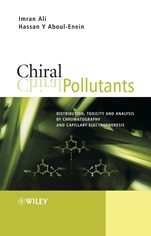
Chiral Pollutants: Distribution, Toxicity and Analysis by Chromatography and Capillary Electrophoresis
ISBN 9780470867808
Autor: Imran Ali, Hassan Y. Aboul–Enein
Wydawca: Wiley
Dostępność: 3-6 tygodni
Cena: 1 184,40 zł
Przed złożeniem zamówienia prosimy o kontakt mailowy celem potwierdzenia ceny.
ISBN13: |
9780470867808 |
ISBN10: |
0470867809 |
Autor: |
Imran Ali, Hassan Y. Aboul–Enein |
Oprawa: |
Hardback |
Rok Wydania: |
2004-03-30 |
Ilość stron: |
368 |
Wymiary: |
235x154 |
Tematy: |
PN |
The chiral analysis of environmental pollutants is a fairly recent development and attracts scientists needing to investigate the toxicity of enantiomers. For example, approximately 25% of agrochemicals are chiral in nature, including pesticides that are applied as their racemates in agricultural and forestry activities. To predict the exact toxicity of pollutants the determination of the concentration of both enantiomers in environmental matrices is essential. Various approaches to chiral resolution have been developed for the analysis of pharmaceuticals and drugs but this is the first text to present detailed metholodology on the chiral separation of pollutants.
This book is divided into 10 chapters: the first is an introduction to the principles of chirality; Chapters 2 to 9 discuss the sources, distribution, biotransformation, toxicity, sample preparation and chiral resolution of environmental pollutants by chromatography and capillary electrophoresis. In addition, the optimization of experimental parameters for chromatographic and capillary electrophoretic techniques is presented, making this book a useful ‘how to’ guide to chiral pollutants analysis. Coverage of the types, structures and properties of chiral stationary phases and their applications for the analysis of chiral pollutants is also presented. The concluding chapter reports on chiral legislation globally, and presents perspectives which could guide future research in this area.
This book will be of interest to researchers in biology, analytical chemistry and the environmental in industry, academia and governmental regulatory agencies.
Spis treści:
Preface.
Acknowledgements.
About the Book.
About the Authors.
1 Introduction.
1.1 The Importance of the Environment.
1.2 Environmental Pollutants.
1.3 Chirality and its Occurrence.
1.4 The Chemical Evolution of Chirality.
1.5 The Electronic Theory of Chir
ality.
1.6 The Importance of Chirality.
1.7 Nomenclature for Chiral Pollutants.
1.8 Chirality in Environmental Pollutants.
1.9 Chirality and its Consequences in the Environment.
1.10 The Enantiomeric Ratio and Fractions of Chiral Pollutants.
1.11 Methods for the Separation of Chiral Pollutants.
1.11.1 Chromatographic Methods.
1.11.2 The Capillary Electrophoretic Method.
1.12 Chiral Selectors in Chromatography and Capillary Electrophoresis.
1.13 Detection in Chromatography and Capillary Electrophoresis.
1.14 Other Methods of Separation of Chiral Pollutants.
References.
2 Chiral Pollutants: Sources and Distribution.
2.1 Introduction.
2.2 Sources of Contamination.
2.3 The Distribution of Chiral Pollutants.
2.3.1 Distribution in Water.
2.3.2 Distribution in Sediment.
2.3.3 Distribution in Soil.
2.3.4 Distribution in Air.
2.3.5 Distribution in Aquatic and Amphibian Biota.
2.3.6 Distribution in Terrestrial Biota.
2.3.7 Distribution in Food Products.
2.4 Conclusions.
References.
3 Chiral Pollutants: Biotransformation, Biodegradation and Metabolism.
3.1 Introduction.
3.2 The Mechanisms of the Interactions of Chiral Xenobiotics in Biological Systems.
3.3 The Fate of Chiral Pollutants in the Ecosystem.
3.3.1 Biotransformation.
3.4 Photochemical Conversion.
3.5 Metabolism.
3.6 Conclusions.
References.
4 The Enantioselective Toxicities of Chiral Pollutants.
4.1 Introduction.
4.2 The Enantioselective Toxicities of PCBs.
4.3 The Enantioselective Toxicities of HCH.
4.4 The Enantioselective Toxicities of Other Chlorinated Pesticides.
4.5 The Enantioselective Toxicities of Phosphorous Pesticides.
4.6 The Enantioselective Toxicities of Polyaromatic Hydrocarbons (PAHs).
4.7 The Enantioselective Toxicities of Other Xenobiotics.
4.8 The Enantioselective Toxicities of Drugs and Pharmaceuticals.
4.9 Conclusions.
References.
5 Sa
mple Preparation.
5.1 Introduction.
5.2 Sampling.
5.3 Filtration.
5.4 Homogenization.
5.5 Extraction.
5.5.1 The Extraction of Solid Samples.
5.5.2 The Extraction of Liquid Samples.
5.6 Membrane Methods in Sample Preparation.
5.7 Clean–up.
5.8 Pre–concentration.
5.9 Conclusions.
References.
6 The Analysis of Chiral Pollutants by Gas Chromatography.
6.1 Introduction.
6.2 Chiral Selectors.
6.2.1 Structures and Properties.
6.2.2 Preparation and Commercialization.
6.2.3 Other Chiral GC CSPs.
6.3 Applications.
6.4 The Optimization of GC Conditions.
6.4.1 Mobile Phases.
6.4.2 Temperature.
6.4.3 The Column Dimensions.
6.4.4 Structures and Types of Chiral Selectors.
6.4.5 The Structures of Chiral Pollutants.
6.4.6 Detection.
6.4.7 Other Parameters.
6.5 The Reverse Elution Order.
6.6 Errors and Problems in Enantioresolution.
6.7 The Derivatization of Chiral Environmental Pollutants.
6.8 Mechanisms of Chiral Resolution.
6.9 Conclusions.
References.
7 The Analysis of Chiral Pollutants by High Performance Liquid Chromatography.
7.1 Introduction.
7.2 Chiral Selectors.
7.3 Applications.
7.4 The Optimization of HPLC Conditions.
7.4.1 Polysaccharide CSPs.
7.4.2 Cyclodextrin CSPs.
7.4.3 Macrocyclic Glycopeptide Antibiotic CSPs.
7.4.4 Protein CSPs.
7.4.5 Chiral Crown Ether CSPs.
7.4.6 Ligand Exchange CSPs.
7.4.7 Pirkle–type CSPs.
7.5 Detection.
7.6 Chiral Recognition Mechanisms.
7.7 Conclusions.
References.
8 The Analysis of Chiral Pollutants byMicellar Electrokinetic, Capillary Electrochromatographic, Supercritical Fluid and Thin Layer Chromatographic Techniques.
8.1 Introduction.
8.2 Chiral Selectors.
8.3 Micellar Electrokinetic Chromatography (MEKC).
8.4 Capillary Electrochromatography (CEC).
8.5 Supercritical Fluid Chromatography (SFC).
8.6 Thin Layer Chromatography (TLC).
8.7 LC versus GC.
8.8 Conclusions.
References.
9 The Analysis of Chiral Environmental Pollutants by Capillary Electrophoresis.
9.1 Introduction.
9.2 Chiral Selectors.
9.3 Applications.
9.4 The Optimization of CE Conditions.
9.4.1 The Composition of the Background Electrolyte.
9.4.2 The pH of the Background Electrolyte.
9.4.3 The Ionic Strength of the Background Electrolyte.
9.4.4 Structures and Types of Chiral Selectors.
9.4.5 The Applied Voltage.
9.4.6 Temperature.
9.4.7 The Structures of Chiral Pollutants.
9.4.8 Organic Modifiers.
9.4.9 Other Parameters.
9.4.10 Optimization by Dependent Variables.
9.5 Detection.
9.6 Validation of Methods.
9.7 Mechanisms of Chiral Resolution.
9.8 CE versus HPLC.
9.9 Conclusions.
References.
10 Perspectives on the Analysis of Chiral Pollutants.
10.1 Introduction.
10.2 Regulations on Chirality in the USA.
10.3 Regulations on Chirality in Europe.
10.4 Regulations on Chirality in Japan.
10.5 Regulations on Chirality in Other Countries.
10.6 The Capabilities of Chiral Analysis Technologies.
10.7 The Large–scale Production of Pure Enantiomers.
10.8 The Impact of Chirality on Economic Growth.
10.9 Conclusions.
References.
Index.
Nota biograficzna:
Dr Imran Ali obtained his M.Sc. (1986) and Ph.D. (1990) degrees from the Indian Institute of Technology, Roorkee, India. At present, he is working as a Scientist in the National Institute of Hydrology, Roorkee, India. His research areas of interest are the chiral analysis of biologically and environmentally active chiral compounds, and metal ion speciation using chromatographic and capillary electrophoresis techniques. He also has expertise in water quality and wastewater treatment methodologies. Dr Ali is the author or co–author of more than 70 journal articles, book and encyclopedia chapters, and of a book entitled Chiral Sepa
Koszyk
Książek w koszyku: 0 szt.
Wartość zakupów: 0,00 zł
Informacje


Kontakt
Gambit
Centrum Oprogramowania
i Szkoleń Sp. z o.o.
Al. Pokoju 29b/22-24
31-564 Kraków
Siedziba Księgarni
ul. Kordylewskiego 1
31-542 Kraków
+48 12 410 5991
+48 12 410 5987
+48 12 410 5989
Subskrypcje
Administratorem danych osobowych jest firma Gambit COiS Sp. z o.o. Na podany adres będzie wysyłany wyłącznie biuletyn informacyjny.
Autoryzacja płatności

Informacje na temat autoryzacji płatności poprzez PayU.

© Copyright 2012: GAMBIT COiS Sp. z o.o. Wszelkie prawa zastrzeżone.
Projekt i wykonanie: Alchemia Studio Reklamy