


Wydawcy
Katalog tematyczny
- Archeologia (109)
- Ekonomia, finanse, business (13704)
- Filozofia (1445)
- Historia (3040)
- Języki i językoznawstwo (2356)
- Lifestyle, hobby i rozrywka (475)
- Medycyna (9704)
- Nauki humanistyczne (4)
- Nauki o Ziemi i środowisku (2638)
- Nauki ścisłe (20412)
- Nauki społeczne (8486)
- Nauki techniczne (13450)
- Budownictwo lądowe (1045)
- Chemia przemysłowa (2258)
- Elektronika i telekomunikacja (3287)
- Energetyka (1122)
- Inne nauki stosowane (363)
- Inżynieria biochemiczna (507)
- Inżynieria transportu (232)
- Mechanika i materiały (3316)
- Nauka o środowisku (321)
- Rolnictwo (507)
- Technika, ogólnie (475)
- Prawo (1696)
- Publikacje informacyjne i interdyscyplinarne (1288)
- Religia i wierzenia (917)
- Technika komputerowa (4067)
- Zdrowie, relacje międzyludzkie i rozwój osobisty (657)





Informacje szczegółowe o książce
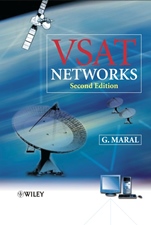
VSAT Networks
ISBN 9780470866849
Autor: Gerard Maral
Wydawca: Wiley
Dostępność: 3-6 tygodni
Cena: 702,45 zł
Przed złożeniem zamówienia prosimy o kontakt mailowy celem potwierdzenia ceny.
ISBN13: |
9780470866849 |
ISBN10: |
0470866845 |
Autor: |
Gerard Maral |
Oprawa: |
Hardback |
Rok Wydania: |
2003-12-16 |
Numer Wydania: |
2nd Edition |
Ilość stron: |
296 |
Wymiary: |
256x187 |
Tematy: |
TJ |
Now fully revised and updated, VSAT Networks continues to cover all of the essential issues involved with the installation and operation of networks of small earth stations called ‘Very Small Aperture Terminal’. VSATs are typically one to two meters in antenna reflector diameter and communicate with one another, or with a central earth station called a ‘hub’, via a relay satellite in space. This informative volume enables the reader to understand how services, economics and regulatory aspects condition the success of such networks.
Key features include:configuration and practical applications of VSAT networksradio frequency (RF) link analysis, focusing on basic formulae and the evaluation of the RF link performanceprotocols used, with emphasis on the necessary adaptation of protocols used in terrestrial networksprocedures for the dimensioning of the network according to the type and volume of generated traffic and to the expected quality of service
Written by a well–known, highly respected academic, this authoritative volume will appeal to students of telecommunications, electronics and computer science. Practising telecommunications engineers and technical managers involved in the planning, design and operation of networks and service provision will all find this book a valuable reference source.
This Second Edition has taken full advantage of the author’s experience gained from the success of the first edition. The theoretical background has been expanded and the operational contents have been updated in view of recent developments in the field.
Spis treści:
Preface.
Acronyms and Abbreviations.
Notation.
1. Introduction.
1.1 VSAT network definition.
1.2 VSAT network configurations.
1.3 User terminal connectivity.
1.4 VSAT network applications and types of traffic.
1.4.1 Civilian VSAT networks.
1.4.2 Military VSAT networks.
1.5 VS
AT networks: involved parties.
1.6 VSAT network options.
1.6.1 Star or mesh?
1.6.2 Data/voice/video.
1.6.3 Fixed/demand assignment.
1.6.4 Frequency bands.
1.6.5 Hub options.
1.7 VSAT network earth stations.
1.7.1 VSAT station.
1.7.2 Hub station.
1.8 Economic aspects.
1.9 Regulatory aspects.
1.9.1 Licensing.
1.9.2 Access to the space segment.
1.9.3 Local regulations.
1.10 Conclusions.
1.10.1 Advantages.
1.10.2 Drawbacks.
2. Use of satellites for VSAT networks.
2.1 Introduction.
2.1.1 The relay function.
2.1.2 Transparent and regenerative payload.
2.1.3 Coverage
2.1.4 Impact of coverage on satellite relay performance.
2.1.5 Frequency reuse.
2.2 Orbits.
2.2.1 Newton′s universal law of attraction.
2.2.2 Orbital parameters.
2.3 The geostationary satellite.
2.3.1 Orbit parameters.
2.3.2 Launching the satellite.
2.3.3 Distance to the satellite.
2.3.4 Propagation delay.
2.3.5 Conjunction of the sun and the satellite.
2.3.6 Orbit perturbations.
2.3.7 Apparent satellite movement.
2.3.8 Orbit corrections.
2.3.9 Doppler effect.
2.4 Satellites for VSAT services.
3. Operational aspects.
3.1 Installation.
3.1.1 Hub.
3.1.2 VSAT.
3.1.3 Antenna pointing.
3.2 The customer′s concerns.
3.2.1 Interfaces to end equipment.
3.2.2 Independence from vendor.
3.2.3 Set–up time.
3.2.4 Access to the service.
3.2.5 Flexibility.
3.2.6 Failure and disaster recovery.
3.2.7 Blocking probability.
3.2.8 Response time.
3.2.9 Link quality.
3.2.10 Availability.
3.2.11 Maintenance.
3.2.12 Hazards.
3.2.13 Cost.
4. Networking aspects.
4.1 Network functions.
4.2 Some definitions .
4.2.1 Links and connections.
4.2.2 Bit rate.
4.2.3 Protocols.
4.2.4 Delay.
4.2.5 Throughput.
4.2.6 Channel efficiency.
4.2.7 Channel utilization.
4.3 Traffic characterization.
4.3.1 Traffic forecasts.
4.3.2 T
raffic measurements.
4.3.3 Traffic source modeling.
4.4 The OSI reference model for data communications.
4.4.1 The physical layer.
4.4.2 The data link layer.
4.4.3 The network layer.
4.4.4 The transport layer.
4.4.5 The upper layers (5 to 7).
4.5 Application to VSAT networks.
4.5.1 Physical and protocol configurations of a VSAT network.
4.5.2 Protocol conversion (emulation).
4.5.3 Reasons for protocol conversion.
4.6 Multiple access.
4.6.1 Basic multiple access protocols.
4.6.2 Meshed networks.
4.6.3 Star–shaped networks.
4.6.4 Fixed assignment versus demand assignment.
4.6.5 Random time division multiple access.
4.6.6 Delay analysis.
4.6.7 Conclusion.
4.7 Network design.
4.7.1 Principles.
4.7.2 Guidelines for preliminary dimensioning.
4.7.3 Example.
4.8 Conclusion.
5. Radio frequency link analysis.
5.1 Principles.
5.1.1 Thermal noise.
5.1.2 Interference noise.
5.1.3 Intermodulation noise.
5.1.4 Carrier power to noise power spectral density ratio.
5.1.5 Total noise.
5.2 Uplink analysis.
5.2.1 Power flux density at satellite distance.
5.2.2 Effective isotropic radiated power of the earth station.
5.2.3 Uplink path loss.
5.2.4 Figure of merit of satellite receiving equipment.
5.3 Downlink analysis.
5.3.1 Effective isotropic radiated power of the satellite.
5.3.2 Flux density at earth surface.
5.3.3 Downlink path loss.
5.3.4 Figure of merit of earth station receiving equipment.
5.4 Intermodulation analysis.
5.5 Interference analysis.
5.5.1 Expressions for carrier–to–interference ratio.
5.5.2 Types of interference.
5.5.3 Self–interference.
5.5.4 External interference.
5.5.5 Conclusion.
5.6 Overall link performance.
5.7 Bit error rate determination.
5.8 Power versus bandwidth exchange.
5.9 Example.
Appendix 1: Traffic source models.
Appendix 2: Automatic repeat request (ARQ) protocols.Appendix 3: Interface protocols.
Appendix 4: Antenna parameters.
Appendix 5: Emitted and received power.
Appendix 6: Carrier amplification.
Appendix 7: VSAT products.
References.
Index.
Okładka tylna:
Now fully revised and updated, VSAT Networks continues to cover all of the essential issues involved with the installation and operation of networks of small earth stations called ‘Very Small Aperture Terminal’. VSATs are typically one to two meters in antenna reflector diameter and communicate with one another, or with a central earth station called a ‘hub’, via a relay satellite in space. This informative volume enables the reader to understand how services, economics and regulatory aspects condition the success of such networks.
Key features include:configuration and practical applications of VSAT networksradio frequency (RF) link analysis, focusing on basic formulae and the evaluation of the RF link performanceprotocols used, with emphasis on the necessary adaptation of protocols used in terrestrial networksprocedures for the dimensioning of the network according to the type and volume of generated traffic and to the expected quality of service
Written by a well–known, highly respected academic, this authoritative volume will appeal to students of telecommunications, electronics and computer science. Practising telecommunications engineers and technical managers involved in the planning, design and operation of networks and service provision will all find this book a valuable reference source.
This Second Edition has taken full advantage of the author’s experience gained from the success of the first edition. The theoretical background has been expanded and the operational contents have been updated in view of recent developments in the field.
Koszyk
Książek w koszyku: 0 szt.
Wartość zakupów: 0,00 zł
Informacje


Kontakt
Gambit
Centrum Oprogramowania
i Szkoleń Sp. z o.o.
Al. Pokoju 29b/22-24
31-564 Kraków
Siedziba Księgarni
ul. Kordylewskiego 1
31-542 Kraków
+48 12 410 5991
+48 12 410 5987
+48 12 410 5989
Subskrypcje
Administratorem danych osobowych jest firma Gambit COiS Sp. z o.o. Na podany adres będzie wysyłany wyłącznie biuletyn informacyjny.
Autoryzacja płatności

Informacje na temat autoryzacji płatności poprzez PayU.

© Copyright 2012: GAMBIT COiS Sp. z o.o. Wszelkie prawa zastrzeżone.
Projekt i wykonanie: Alchemia Studio Reklamy