


Wydawcy
Katalog tematyczny
- Archeologia (109)
- Ekonomia, finanse, business (13704)
- Filozofia (1445)
- Historia (3040)
- Języki i językoznawstwo (2356)
- Lifestyle, hobby i rozrywka (475)
- Medycyna (9704)
- Nauki humanistyczne (4)
- Nauki o Ziemi i środowisku (2638)
- Nauki ścisłe (20412)
- Nauki społeczne (8486)
- Nauki techniczne (13450)
- Budownictwo lądowe (1045)
- Chemia przemysłowa (2258)
- Elektronika i telekomunikacja (3287)
- Energetyka (1122)
- Inne nauki stosowane (363)
- Inżynieria biochemiczna (507)
- Inżynieria transportu (232)
- Mechanika i materiały (3316)
- Nauka o środowisku (321)
- Rolnictwo (507)
- Technika, ogólnie (475)
- Prawo (1696)
- Publikacje informacyjne i interdyscyplinarne (1288)
- Religia i wierzenia (917)
- Technika komputerowa (4067)
- Zdrowie, relacje międzyludzkie i rozwój osobisty (657)





Informacje szczegółowe o książce
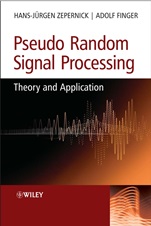
Pseudo Random Signal Processing: Theory and Application
ISBN 9780470866573
Autor: Hans–Jurgen Zepernick, Adolf Finger
Wydawca: Wiley
Dostępność: 3-6 tygodni
Cena: 605,85 zł
Przed złożeniem zamówienia prosimy o kontakt mailowy celem potwierdzenia ceny.
ISBN13: |
9780470866573 |
ISBN10: |
0470866578 |
Autor: |
Hans–Jurgen Zepernick, Adolf Finger |
Oprawa: |
Hardback |
Rok Wydania: |
2005-09-30 |
Ilość stron: |
436 |
Wymiary: |
252x178 |
Tematy: |
TJ |
In recent years, pseudo random signal processing has proven to be a critical enabler of modern communication, information, security and measurement systems. The signal’s pseudo random, noise–like properties make it vitally important as a tool for protecting against interference, alleviating multipath propagation and allowing the potential of sharing bandwidth with other users.
Taking a practical approach to the topic, this text provides a comprehensive and systematic guide to understanding and using pseudo random signals. Covering theoretical principles, design methodologies and applications, Pseudo Random Signal Processing: Theory and Application:sets out the mathematical foundations needed to implement powerful pseudo random signal processing techniques;presents information about binary and nonbinary pseudo random sequence generation and design objectives;examines the creation of system architectures, including those with microprocessors, digital signal processors, memory circuits and software suits;gives a detailed discussion of sophisticated applications such as spread spectrum communications, ranging and satellite navigation systems, scrambling, system verification, and sensor and optical fibre systems.
Pseudo Random Signal Processing: Theory and Applicationis an essential introduction to the subject for practising Electronics Engineers and researchers in the fields of mobile communications, satellite navigation, signal analysis, circuit testing, cryptology, watermarking, and measurement. It is also a useful reference for graduate students taking courses in Electronics, Communications and Computer Engineering.
Spis treści:
Preface.
List of abbreviations.
List of common symbols.
1. Introduction.
1.1 Prologue.
1.2 Elements of pseudo random signal processing.
1.3 Outline of the book.
2. Characterization of signals and
sequences.
2.1 Classification of signals and sequences.
2.2 Transformations of signals and sequences.
2.3 Correlation measures.
2.4 Power spectral density.
2.5 Pseudo random signals and sequences.
3. Mathematical foundations.
3.1 Algebraic structures.
3.2 Polynomials over finite fields.
4. Binary pseudo random sequences.
4.1 Classification.
4.2 Maximal–length sequences.
4.3 Binary sequences with good autocorrelation.
4.4 Binary sequences with special cross–correlation.
5. Nonbinary pseudo random sequences.
5.1 Classification.
5.2 Interference–free window sequences.
5.3 Complex–valued sequences.
5.4 Polyphase sequences with special correlations.
6. Generating pseudo random signals.
6.1 Linear autonomous automata.
6.2 Generating maximal–length sequences.
6.3 Transformations of maximal–length sequences.
6.4 Combinations of maximal–length sequences.
6.5 Pseudo random signal processing with microprocessors and memory circuits.
7. Applications of pseudo random signal processing.
7.1 Spread spectrum communications.
7.2 Ranging and navigation systems.
7.3 Scrambling.
7.4 Automatic testing and system verification.
7.5 Cryptology.
7.6 Other applications.
Bibliography.
Index.
Okładka tylna:
In recent years, pseudo random signal processing has proven to be a critical enabler of modern communication, information, security and measurement systems. The signal’s pseudo random, noise–like properties make it vitally important as a tool for protecting against interference, alleviating multipath propagation and allowing the potential of sharing bandwidth with other users.
Taking a practical approach to the topic, this text provides a comprehensive and systematic guide to understanding and using pseudo random signals. Covering theoretical principles, design m
ethodologies and applications, Pseudo Random Signal Processing: Theory and Application:sets out the mathematical foundations needed to implement powerful pseudo random signal processing techniques;presents information about binary and nonbinary pseudo random sequence generation and design objectives;examines the creation of system architectures, including those with microprocessors, digital signal processors, memory circuits and software suits;gives a detailed discussion of sophisticated applications such as spread spectrum communications, ranging and satellite navigation systems, scrambling, system verification, and sensor and optical fibre systems.
Pseudo Random Signal Processing: Theory and Applicationis an essential introduction to the subject for practising Electronics Engineers and researchers in the fields of mobile communications, satellite navigation, signal analysis, circuit testing, cryptology, watermarking, and measurement. It is also a useful reference for graduate students taking courses in Electronics, Communications and Computer Engineering.
Koszyk
Książek w koszyku: 0 szt.
Wartość zakupów: 0,00 zł
Informacje


Kontakt
Gambit
Centrum Oprogramowania
i Szkoleń Sp. z o.o.
Al. Pokoju 29b/22-24
31-564 Kraków
Siedziba Księgarni
ul. Kordylewskiego 1
31-542 Kraków
+48 12 410 5991
+48 12 410 5987
+48 12 410 5989
Subskrypcje
Administratorem danych osobowych jest firma Gambit COiS Sp. z o.o. Na podany adres będzie wysyłany wyłącznie biuletyn informacyjny.
Autoryzacja płatności

Informacje na temat autoryzacji płatności poprzez PayU.

© Copyright 2012: GAMBIT COiS Sp. z o.o. Wszelkie prawa zastrzeżone.
Projekt i wykonanie: Alchemia Studio Reklamy