


Wydawcy
Katalog tematyczny
- Archeologia (109)
- Ekonomia, finanse, business (13704)
- Filozofia (1445)
- Historia (3040)
- Języki i językoznawstwo (2356)
- Lifestyle, hobby i rozrywka (475)
- Medycyna (9704)
- Nauki humanistyczne (4)
- Nauki o Ziemi i środowisku (2638)
- Nauki ścisłe (20412)
- Nauki społeczne (8486)
- Nauki techniczne (13450)
- Prawo (1696)
- Publikacje informacyjne i interdyscyplinarne (1288)
- Religia i wierzenia (917)
- Technika komputerowa (4067)
- Zdrowie, relacje międzyludzkie i rozwój osobisty (657)





Informacje szczegółowe o książce
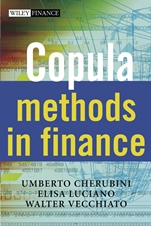
Copula Methods in Finance
ISBN 9780470863442
Autor: Umberto Cherubini, Elisa Luciano, Walter Vecchiato
Wydawca: Wiley
Dostępność: 3-6 tygodni
Cena: 564,90 zł
Przed złożeniem zamówienia prosimy o kontakt mailowy celem potwierdzenia ceny.
ISBN13: |
9780470863442 |
ISBN10: |
0470863447 |
Autor: |
Umberto Cherubini, Elisa Luciano, Walter Vecchiato |
Oprawa: |
Hardback |
Rok Wydania: |
2004-05-25 |
Ilość stron: |
310 |
Wymiary: |
252x171 |
Tematy: |
KF |
The evaluation and risk measurement of portfolios of complex non–linear positions and non–normal risk factors has become a major nightmare for people working in the structured finance business. Dealing with "fat tails" and "smile effects", as well as the typical asymmetric shape of default risk has rapidly made obsolete the traditional linear correlation tools. In this new environment, the copula functions methodology has become the most significant new technique to handle the co–movement between markets and risk factors in a flexible way. This is the first book addressing copula functions from the viewpoint of mathematical finance applications. The method is to explain copulas by means of applications to major topics in derivative pricing and credit risk analysis, with the target to make the reader able to device her own application, following the strategies illustrated throughout the book. Examples include pricing of the main exotic derivatives typically included in commonly traded structured finance products (barrier, basket, rainbow options), as well as risk management issues. Particular focus is given to the pricing of asset–backed securities and basket credit derivative products and the evaluation of counterparty risk in derivative transactions.
Copula Methods in Finance provides:Rigorous treatment of the mathematics of copula functions, illustrated with financial applicationsComplete analysis of estimation and simulation issues applied to market dataCredit–linked structured products applications: CDO and basket credit derivatives Equity–linked structured product applications: barrier, rainbow and basket derivativesCounterparty risk in derivative transactions: vulnerable option pricing
Spis treści:
Preface.
List of Common Symbols and Notations.
1 Derivatives Pricing, Hedging and Risk Management: The State of the Art.
1.1 Introduction.
1.2 Derivative pricing basics: the binomial model.
1.2.1 Replicating portfolios.
1.2.2 No–arbitrage and the risk–neutral probability measure.
1.2.3 No–arbitrage and the objective probability measure.
1.2.4 Discounting under different probability measures.
1.2.5 Multiple states of the world.
1.3 The Black–Scholes model.
1.3.1 Ito’s lemma.
1.3.2 Girsanov theorem.
1.3.3 The martingale property.
1.3.4 Digital options.
1.4 Interest rate derivatives.
1.4.1 Affine factor models.
1.4.2 Forward martingale measure.
1.4.3 LIBOR market model.
1.5 Smile and term structure effects of volatility.
1.5.1 Stochastic volatility models.
1.5.2 Local volatility models.
1.5.3 Implied probability.
1.6 Incomplete markets.
1.6.1 Back to utility theory.
1.6.2 Super–hedging strategies.
1.7 Credit risk.
1.7.1 Structural models.
1.7.2 Reduced form models.
1.7.3 Implied default probabilities.
1.7.4 Counterparty risk.
1.8 Copula methods in finance: a primer.
1.8.1 Joint probabilities, marginal probabilities and copula functions.
1.8.2 Copula functions duality.
1.8.3 Examples of copula functions.
1.8.4 Copula functions and market comovements.
1.8.5 Tail dependence.
1.8.6 Equity–linked products.
1.8.7 Credit–linked products.
2 Bivariate Copula Functions.
2.1 Definition and properties.
2.2 Fréchet bounds and concordance order.
2.3 Sklar’s theorem and the probabilistic interpretation of copulas.
2.3.1 Sklar’s theorem.
2.3.2 The subcopula in Sklar’s theorem.
2.3.3 Modeling consequences.
2.3.4 Sklar’s theorem in financial applications: toward a non–Black–Scholes world.
2.4 Copulas as dependence functions: basic facts.
2.4.1 Independence.
2.4.2 Comonotonicity.
2.4.3 Monotone transforms and copula invariance.
2.4.4 An application: VaR trade–off.
2.5
Survival copula and joint survival function.
2.5.1 An application: default probability with exogenous shocks.
2.6 Density and canonical representation.
2.7 Bounds for the distribution functions of sum of r.v.s.
2.7.1 An application: VaR bounds.
2.8 Appendix.
3 Market Comovements and Copula Families.
3.1 Measures of association.
3.1.1 Concordance.
3.1.2 Kendall’s τ.
3.1.3 Spearman’s ρS.
3.1.4 Linear correlation.
3.1.5 Tail dependence.
3.1.6 Positive quadrant dependency.
3.2 Parametric families of bivariate copula.
3.2.1 The bivariate Gaussian copula.
3.2.2 The bivariate Student’s t copula.
3.2.3 The Fr´echet family.
3.2.4 Archimedean copulas.
3.2.5 The Marshall–Olkin copula.
4 Multivariate Copulas.
4.1 Definition and basic properties.
4.2 Fréchet bounds and concordance order: the multidimensional case.
4.3 Sklar’s theorem and the basic probabilistic interpretation: the multidimensional case.
4.3.1 Modeling consequences.
4.4 Survival copula and joint survival function.
4.5 Density and canonical representation of a multidimensional copula.
4.6 Bounds for distribution functions of sums of n random variables.
4.7 Multivariate dependence.
4.8 Parametric families of n–dimensional copulas.
4.8.1 The multivariate Gaussian copula.
4.8.2 The multivariate Student’s t copula.
4.8.3 The multivariate dispersion copula.
4.8.4 Archimedean copulas.
5 Estimation and Calibration from Market Data.
5.1 Statistical inference for copulas.
5.2 Exact maximum likelihood method.
5.2.1 Examples.
5.3 IFM method.
5.3.1 Application: estimation of the parametric copula for market data.
5.4 CML method.
5.4.1 Application: estimation of the correlation matrix for a Gaussian copula.
5.5 Non–parametric estimation.
5.5.1 The empirical co
pula.
5.5.2 Kernel copula.
5.6 Calibration method by using sample dependence measures.
5.7 Application.
5.8 Evaluation criteria for copulas.
5.9 Conditional copula.
5.9.1 Application to an equity portfolio.
6 Simulation of Market Scenarios.
6.1 Monte Carlo application with copulas.
6.2 Simulation methods for elliptical copulas.
6.3 Conditional sampling.
6.3.1 Clayton n–copula.
6.3.2 Gumbel n–copula.
6.3.3 Frank n–copula.
6.4 Marshall and Olkin’s method.
6.5 Examples of simulations.
7 Credit Risk Applications.
7.1 Credit derivatives.
7.2 Overview of some credit derivatives products.
7.2.1 Credit default swap.
7.2.2 Basket default swap.
7.2.3 Other credit derivatives products.
7.2.4 Collateralized debt obligation (CDO).
7.3 Copula approach.
7.3.1 Review of single survival time modeling and calibration.
7.3.2 Multiple survival times: modeling.
7.3.3 Multiple defaults: calibration.
7.3.4 Loss distribution and the pricing of CDOs.
7.3.5 Loss distribution and the pricing of homogeneous basket default swaps.
7.4 Application: pricing and risk monitoring a CDO.
7.4.1 Dow Jones EuroStoxx50 CDO.
7.4.2 Application: basket default swap.
7.4.3 Empirical application for the EuroStoxx50 CDO.
7.4.4 EuroStoxx50 pricing and risk monitoring.
7.4.5 Pricing and risk monitoring of the basket default swaps.
7.5 Technical appendix.
7.5.1 Derivation of a multivariate Clayton copula density.
7.5.2 Derivation of a 4–variate Frank copula density.
7.5.3 Correlated default times.
7.5.4 Variance–covariance robust estimation.
7.5.5 Interest rates and foreign exchange rates in the analysis.
8 Option Pricing with Copulas.
8.1 Introduction.
8.2 Pricing bivariate options in complete markets.
8.2.1 Copula pricing kernels.
8.2.2 Alternative pricing techniques.
8.3 Pricing bivariate options i
Koszyk
Książek w koszyku: 0 szt.
Wartość zakupów: 0,00 zł
Informacje


Kontakt
Gambit
Centrum Oprogramowania
i Szkoleń Sp. z o.o.
Al. Pokoju 29b/22-24
31-564 Kraków
Siedziba Księgarni
ul. Kordylewskiego 1
31-542 Kraków
+48 12 410 5991
+48 12 410 5987
+48 12 410 5989
Subskrypcje
Administratorem danych osobowych jest firma Gambit COiS Sp. z o.o. Na podany adres będzie wysyłany wyłącznie biuletyn informacyjny.
Autoryzacja płatności

Informacje na temat autoryzacji płatności poprzez PayU.

© Copyright 2012: GAMBIT COiS Sp. z o.o. Wszelkie prawa zastrzeżone.
Projekt i wykonanie: Alchemia Studio Reklamy