


Wydawcy
Katalog tematyczny
- Archeologia (109)
- Ekonomia, finanse, business (13704)
- Filozofia (1445)
- Historia (3040)
- Języki i językoznawstwo (2356)
- Lifestyle, hobby i rozrywka (475)
- Medycyna (9704)
- Nauki humanistyczne (4)
- Nauki o Ziemi i środowisku (2638)
- Nauki ścisłe (20412)
- Astronomia (294)
- Biologia (5119)
- Chemia (6540)
- Chemia analityczna (361)
- Chemia fizyczna (346)
- Chemia nieorganiczna (137)
- Chemia organiczna (535)
- Krystalografia (27)
- Minerologia (46)
- Fizyka (3309)
- Matematyka (4574)
- Nauki ścisłe, ogólnie (503)
- Nauki społeczne (8486)
- Nauki techniczne (13450)
- Prawo (1696)
- Publikacje informacyjne i interdyscyplinarne (1288)
- Religia i wierzenia (917)
- Technika komputerowa (4067)
- Zdrowie, relacje międzyludzkie i rozwój osobisty (657)





Informacje szczegółowe o książce
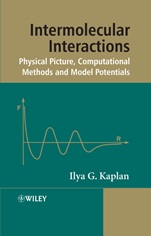
Intermolecular Interactions: Physical Picture, Computational Methods and Model Potentials
ISBN 9780470863329
Autor: Ilya G. Kaplan
Wydawca: Wiley
Dostępność: 3-6 tygodni
Cena: 926,10 zł
Przed złożeniem zamówienia prosimy o kontakt mailowy celem potwierdzenia ceny.
ISBN13: |
9780470863329 |
ISBN10: |
0470863323 |
Autor: |
Ilya G. Kaplan |
Oprawa: |
Hardback |
Rok Wydania: |
2006-04-07 |
Ilość stron: |
380 |
Wymiary: |
239x164 |
Tematy: |
PN |
The subject of this book—intermolecular interactions— is as important in physics as in chemistry and molecular biology. Intermolecular interactions are responsible for the existence of liquids and solids in nature. They determine the physical and chemical properties of gases, liquids, and crystals, the stability of chemical complexes and biological compounds.
In the first two chapters of this book, the detailed qualitative description of different types of intermolecular forces at large, intermediate and short–range distances is presented. For the first time in the literature, the temperature dependence of the dispersion forces is analyzed and it is shown that the famous Casimir–Polder formula for dispersion forces is incorrect at any finite temperature. The author has aimed to make the presentation understandable to a broad scope of readers without oversimplification. In Chapter 3, the methods of quantitative calculation of the intermolecular interactions are discussed and modern achievements are presented. This chapter should be helpful for scientists performing computer calculations of many–electron systems.
The last two chapters are devoted to the many–body effects and model potentials. More than 50 model potentials exploited for processing experimental data and computer simulation in different fields of physics, chemistry and molecular biology are represented. The widely used optimization methods: simulated annealing, diffusion equation method, basin–hopping algorithm, and genetic algorithm are described in detail.
Significant efforts have been made to present the book in a self–sufficient way for readers. All the necessary mathematical apparatus, including vector and tensor calculus and the elements of the group theory, as well as the main methods used for quantal calculation of many–electron systems are presented in the appendices.
All those working on the theoretical and experimental studies
of intermolecular interactions in chemistry, physics, biochemistry and molecular biology will find this text of interest and it will appeal to advanced undergraduates, graduates and researchers.
Spis treści:
Preface.
1 Background Knowledge.
1.1 The Subject and its Specificity.
1.2 A Brief Historical Survey.
1.3 The Concept of Interatomic Potential and Adiabatic Approximation.
1.4 General Classification of Intermolecular Interactions.
References.
2 Types of Intermolecular Interactions: Qualitative Picture.
2.1 Direct Electrostatic Interactions.
2.2 Resonance Interaction.
2.3 Polarization Interactions.
2.4 Exchange Interaction.
2.5 Retardation Effects in Long–Range Interactions and the Influence of Temperature.
2.6 Relativistic (Magnetic) Interactions.
2.7 Interaction Between Macroscopic Bodies.
References.
3 Calculation of Intermolecular Interactions.
3.1 Large Distances.
3.2 Intermediate and Short Distances.
References.
4 Nonadditivity of Intermolecular Interactions.
4.1 Physical Nature of Nonadditivity and the Definition of Many–Body Forces.
4.2 Manifestations of Nonadditive Effects.
4.3 Perturbation Theory and Many–Body Decomposition.
4.4 Many–Body Effects in Atomic Clusters.
4.5 Atom–Atom Potential Scheme and Nonadditivity.
References.
5 Model Potentials.
5.1 Semiempirical Model Potentials.
5.2 Determination of Parameters in Model Potentials.
5.3 Reconstructing Potentials on the Basis of Experimental Data.
5.4 Global Optimization Methods.
References.
Appendix 1: Fundamental Physical Constants and Conversion Table of Physical Units.
Appendix 2: Some Necessary Mathematical Apparatus.
A2.1 Vector and Tensor Calculus.
A2.1.1 Definition of vector; the addition law.
A2.1.2 Scalar and vector products; triple scalar product.
A2.1.3 Determinants.
A2.
1.4 Vector analysis; gradient, divergence and curl.
A2.1.5 Vector spaces and matrices.
A2.1.6 Tensors.
A2.2 Group Theory.
A2.2.1 Properties of group operations.
A2.2.2 Representations of groups.
A2.2.3 The permutation group.
A2.2.4 The linear groups. The three–dimensional rotation group.
A2.2.5 Point groups.
A2.2.6 Irreducible tensor operators. Spherical tensors.
References.
Appendix 3: Methods of Quantum–Mechanical Calculations of Many–Electron Systems.
A3.1 Adiabatic Approximation.
A3.2 Variational Methods.
A3.2.1 Self–consistent field method.
A3.2.2 Methods taking into account the electron correlation.
A3.2.2.1 r12–dependent wave functions.
A3.2.2.2 Configuration interaction.
A3.2.2.3 Coupled cluster method.
A3.2.2.4 Density functional theory approach.
A3.3 Perturbation Theory.
A3.3.1 Rayleigh–Schr¨odinger perturbation theory.
A3.3.2 Møller–Plesset perturbation theory.
A3.3.3 Operator formalism and the Brillouin–Wigner perturbation theory.
A3.3.4 Variational perturbation theory.
A3.3.5 Asymptotic expansions; Padé approximants.
References.
Index.
Okładka tylna:
The subject of this book—intermolecular interactions— is as important in physics as in chemistry and molecular biology. Intermolecular interactions are responsible for the existence of liquids and solids in nature. They determine the physical and chemical properties of gases, liquids, and crystals, the stability of chemical complexes and biological compounds.
In the first two chapters of this book, the detailed qualitative description of different types of intermolecular forces at large, intermediate and short–range distances is presented. For the first time in the literature, the temperature dependence of the dispersion forces is analyzed and it is shown that the famous Casimir–Polder formula fo
r dispersion forces is incorrect at any finite temperature. The author has aimed to make the presentation understandable to a broad scope of readers without oversimplification. In Chapter 3, the methods of quantitative calculation of the intermolecular interactions are discussed and modern achievements are presented. This chapter should be helpful for scientists performing computer calculations of many–electron systems.
The last two chapters are devoted to the many–body effects and model potentials. More than 50 model potentials exploited for processing experimental data and computer simulation in different fields of physics, chemistry and molecular biology are represented. The widely used optimization methods: simulated annealing, diffusion equation method, basin–hopping algorithm, and genetic algorithm are described in detail.
Significant efforts have been made to present the book in a self–sufficient way for readers. All the necessary mathematical apparatus, including vector and tensor calculus and the elements of the group theory, as well as the main methods used for quantal calculation of many–electron systems are presented in the appendices.
All those working on the theoretical and experimental studies of intermolecular interactions in chemistry, physics, biochemistry and molecular biology will find this text of interest and it will appeal to advanced undergraduates, graduates and researchers.
Koszyk
Książek w koszyku: 0 szt.
Wartość zakupów: 0,00 zł
Informacje


Kontakt
Gambit
Centrum Oprogramowania
i Szkoleń Sp. z o.o.
Al. Pokoju 29b/22-24
31-564 Kraków
Siedziba Księgarni
ul. Kordylewskiego 1
31-542 Kraków
+48 12 410 5991
+48 12 410 5987
+48 12 410 5989
Subskrypcje
Administratorem danych osobowych jest firma Gambit COiS Sp. z o.o. Na podany adres będzie wysyłany wyłącznie biuletyn informacyjny.
Autoryzacja płatności

Informacje na temat autoryzacji płatności poprzez PayU.

© Copyright 2012: GAMBIT COiS Sp. z o.o. Wszelkie prawa zastrzeżone.
Projekt i wykonanie: Alchemia Studio Reklamy