


Wydawcy
Katalog tematyczny
- Archeologia (109)
- Ekonomia, finanse, business (13704)
- Filozofia (1445)
- Historia (3040)
- Języki i językoznawstwo (2356)
- Lifestyle, hobby i rozrywka (475)
- Medycyna (9704)
- Nauki humanistyczne (4)
- Nauki o Ziemi i środowisku (2638)
- Nauki ścisłe (20412)
- Astronomia (294)
- Biologia (5119)
- Chemia (6540)
- Chemia analityczna (361)
- Chemia fizyczna (346)
- Chemia nieorganiczna (137)
- Chemia organiczna (535)
- Krystalografia (27)
- Minerologia (46)
- Fizyka (3309)
- Matematyka (4574)
- Nauki ścisłe, ogólnie (503)
- Nauki społeczne (8486)
- Nauki techniczne (13450)
- Prawo (1696)
- Publikacje informacyjne i interdyscyplinarne (1288)
- Religia i wierzenia (917)
- Technika komputerowa (4067)
- Zdrowie, relacje międzyludzkie i rozwój osobisty (657)





Informacje szczegółowe o książce
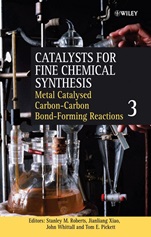
Metal Catalysed Carbon–Carbon Bond–Forming Reactions
ISBN 9780470861998
Autor: Stanley M. Roberts, Jianliang Xiao, John Whittall, Tom E. Pickett
Wydawca: Wiley
Dostępność: 3-6 tygodni
Cena: 1 089,90 zł
Przed złożeniem zamówienia prosimy o kontakt mailowy celem potwierdzenia ceny.
ISBN13: |
9780470861998 |
ISBN10: |
0470861991 |
Autor: |
Stanley M. Roberts, Jianliang Xiao, John Whittall, Tom E. Pickett |
Oprawa: |
Hardback |
Rok Wydania: |
2004-10-15 |
Ilość stron: |
284 |
Wymiary: |
236x166 |
Tematy: |
PN |
Catalysts are increasingly used by chemists working in fine chemical synthesis in industry and academia. Today, there exists a huge choice of high–tech catalysts, which add enormously to the repertoire of synthetic possibilities. However, catalysts are tricky to use and require both skill and experience in order to achieve optimal results.
This Series wants to be a practical help for advanced undergraduate, graduate and postgraduate students, and chemists in industry and academia working in organic and organometallic synthesis.
The Series features:Tested and validated proceduresAuthorative reviews on classes of catalystsAssessments of all types of catalystsThe expertise from the Leverhulme Centre for Innovative Catalysis, Liverpool, UK.The formation of Carbon–Carbon bonds is one of the most important transformations used in the synthesis of fine chemicals. Catalysts promoting such transformations are in ever increasing demand.
In this book the reader will find worked examples of a selection of Carbon–Carbon bond forming reactions including the asymmetric alkylation of aldehydes and ketones, the Michael and Pauson–Khand reactions, aldol protocols as well as hydroformylation and carboxylation. In addition to these well–established transformations, examples of relatively new methodologies are described, for example catalysts for olefin metathesis in organic synthesis are well represented. Furthermore in the light of the popularity of palladium–catalysed coupling reactions, some of the important Heck, Suzuki and Sonogashira catalysts are described in detail and their uses exemplified.
In all chapters the preparative methods are accompanied by hints, tips and comments; safety issues are noted where appropriate.
Spis treści:
Series Preface.
Preface to Volume 3.
Abbreviations.
List of Chemical Names Used.
1 Considerations of Industrial Fine Chemical Synthesis
(Mark W. Hooper).
1.1 Introduction
1.2 Types of processes – flow charts.
1.3 Costs associated with use of catalysts.
2 Alkylation and Allylation Adjacent to a Carbonyl Group.
2.1 The RuH<sub>2</sub>(CO)(PPh<sub>3</sub>)<sub>3</sub>–catalysed alkylation, alkenylation and arylation of aromatic ketones via carbon–hydrogen bond cleavage (Fumitoshi Kakiuchi, Satoshi Ueno and Naoto Chatani).
2.2 Catalytic, asymmetric synthesis of a,a–disubstituted amino acids using a chiral copper–salen complex as a phase transfer catalyst (Michael North and Jose A. Fuentes).
2.3 Asymmetric phase–transfer catalysed alkylation of glycine imines using cinchona alkaloid derived quaternary ammonium salts (Barry Lygo and Benjamin I. Andrews).
3 Asymmetric Alkylation or Amination of Allylic Esters.
3.1 Synthesis and application in palladium–catalysed asymmetric allylic substitution of enantiopure cyclic &Beta;–iminophosphine ligands (Maria Zablocka, Marek Koprowski, Jean–Pierre Majoral, Mathieu Achard and G&eacute;rard Buono).
3.2 (9H,9’H,10H,10’H,11H,11H’,13H,13’H,14H,14’H,15H,15’Hperfluorotricosane–12,12’–diyl)bis[(4S)–4–phenyl–2–oxazoline as a ligand for asymmetric palladium–catalysed alkylation of allylic acetates in fluorous media (J&eacute;r&ocirc;me Bayardon and Denis Sinou).
3.3 Facile synthesis of new axially chiral diphosphine complexes for asymmetric catalysis (Matthias Lotz, Gernot Kramer, Katja Tappe and Paul Knochel).
3.4 Chiral ferrocenyl–imino phosphines as ligands for palladium–catalysed enantioselective allylic alkylations (Pierluigi Barbaro, Claudio Bianchini, Giuliano Giambastiani and Antonio Togni).
4 Suzuki Coupling Reactions.
4.1 Palladium–ca
talysed borylation and Suzuki coupling (BSC) to obtain &Beta;–benzo[b]thienyldehydroamino acid derivatives (Ana S. Abreu, Paula M. T. Ferreira and Maria–Jo&atilde;o R. P. Queiroz).
4.2 Palladium–catalysed cross–coupling reactions of 4–tosylcoumarins and arylboronic acids: synthesis of 4–arylcoumarin compounds (Jie Wu, Lisha Wang, Reza Fathi and Zhen Yang).
4.3 Cyclopropyl arenes, alkynes and alkenes from the in situ generation of B–cyclopropyl–9–BBN and the Suzuki–Miyaura coupling of aryl, alkynyl and alkenyl bromides (Ramon E. Huertas and John A. Soderquist).
4.4 One–pot synthesis of unsymmetrical 1,3–dienes through palladium–catalysed sequential borylation of a vinyl electrophile by a diboron and cross–coupling with a distinct vinyl electrophile (Tatsuo Ishiyama and Norio Miyaura).
4.5 Pd(OAc)<sub>2</sub>/2–Aryl oxazoline catalysed Suzuki coupling reactions of aryl bromides and boronic acids (Bin Tao and David W. Boykin).
4.6 Palladium–catalysed reactions of haloaryl phosphine oxides: modular routes to functionalised ligands (Colin Baillie, Lijin Xu and Jianliang Xiao).
4.7 Bulky electron rich phosphino–amines as ligands for the Suzuki coupling reaction of aryl chlorides (Matthew L. Clarke and J. Derek Woollins).
4.8 Arylation of ketones, aryl amination and Suzuki–Miyaura cross coupling using a well–defined palladium catalyst bearing an N–heterocyclic carbene ligand (Nicholas Marion, Oscar Navarro, Roy A. Kelly III and Steven P. Nolan).
5 Heck Coupling Reactions.
5.1 Palladium–catalysed multiple and asymmetric arylations of vinyl ethers carrying co–ordinating nitrogen auxiliaries: synthesis of arylated ketones and aldehydes (Peter Nilsson and Mats Larhed).
5.2 Palladium–catalysed highly regioselective arylation of electron–rich olefins
(Lijin Xu, Jun Mo and Jianliang Xiao).
5.3 1–[4–(S)–tert–Butyl–2–oxazolin–2–yl]–2–(S)–(diphenylphosphino) ferrocene as a ligand for the palladium–catalysed intermolecular asymmetric Heck reaction of 2,3–dihydrofuran (Tim G. Kilroy, Yvonne M. Malone and Patrick J. Guiry).
6 Sonogashira Coupling Reactions.
6.1 Nonpolar biphasic catalysis: Suzuki– and Sonogashira coupling reactions (Anupama Datta and Herbert Plenio)
6.2 Polystyrene–supported soluble palladacycle catalyst as recyclable catalyst for Heck, Suzuki and Sonogashira reactions (Chih–An Lin and Fen–Tair Luo).
7 Cross–Coupling Reactions.
7.1 Cross–coupling reaction of alkyl halides with Grignard reagents in the presence of 1,3–butadiene catalysed by nickel, palladium, or copper (Jun Terao and Nobuaki Kambe).
7.2 Triorganoindium compounds as efficient reagents for palladium–catalysed cross–coupling reactions with aryl and vinyl electrophiles (Luis A. Sarandeses and Jos&eacute; P&eacute;rez Sestelo).
7.3 Cross–coupling reactions catalysed by heterogeneous nickel–on–charcoal (Bryan A. Frieman and Bruce H. Lipshutz).
7.4 Carbon–carbon bond formation using arylboron reagents with rhodium(I) catalysts in aqueous media (John Mancuso, Masahiro Yoshida and Mark Lautens).
8 Regioselective or Asymmetric 1,2–Addition to Aldehydes.
8.1 Development of a highly regioselective metal–mediated allylation reaction in aqueous media (Kui–Thong Tan, Shu–Sin Chng, Hin–Soon Cheng and Teck–Peng Loh).
8.2 Boronic acids as aryl source for the catalysed enantioselective aryl transfer to aldehydes (Jens Rudolph and Carsten Bolm).
8.3 Jacobsen’s Salen as a chiral ligand for the chromium–catalysed addition of 3–chloro–propenyl pivalate to aldehydes: a ca
Koszyk
Książek w koszyku: 0 szt.
Wartość zakupów: 0,00 zł
Informacje


Kontakt
Gambit
Centrum Oprogramowania
i Szkoleń Sp. z o.o.
Al. Pokoju 29b/22-24
31-564 Kraków
Siedziba Księgarni
ul. Kordylewskiego 1
31-542 Kraków
+48 12 410 5991
+48 12 410 5987
+48 12 410 5989
Subskrypcje
Administratorem danych osobowych jest firma Gambit COiS Sp. z o.o. Na podany adres będzie wysyłany wyłącznie biuletyn informacyjny.
Autoryzacja płatności

Informacje na temat autoryzacji płatności poprzez PayU.

© Copyright 2012: GAMBIT COiS Sp. z o.o. Wszelkie prawa zastrzeżone.
Projekt i wykonanie: Alchemia Studio Reklamy