


Wydawcy
Katalog tematyczny
- Archeologia (109)
- Ekonomia, finanse, business (13704)
- Filozofia (1445)
- Historia (3040)
- Języki i językoznawstwo (2356)
- Lifestyle, hobby i rozrywka (475)
- Medycyna (9704)
- Nauki humanistyczne (4)
- Nauki o Ziemi i środowisku (2638)
- Nauki ścisłe (20412)
- Nauki społeczne (8486)
- Nauki techniczne (13450)
- Budownictwo lądowe (1045)
- Budownictwo komunikacyjne (9)
- Hydraulika (33)
- Konstrukcje budowlane (95)
- Mechanika konstrukcji (182)
- Przemysł budowlany (7)
- Chemia przemysłowa (2258)
- Elektronika i telekomunikacja (3287)
- Energetyka (1122)
- Inne nauki stosowane (363)
- Inżynieria biochemiczna (507)
- Inżynieria transportu (232)
- Mechanika i materiały (3316)
- Nauka o środowisku (321)
- Rolnictwo (507)
- Technika, ogólnie (475)
- Prawo (1696)
- Publikacje informacyjne i interdyscyplinarne (1288)
- Religia i wierzenia (917)
- Technika komputerowa (4067)
- Zdrowie, relacje międzyludzkie i rozwój osobisty (657)





Informacje szczegółowe o książce
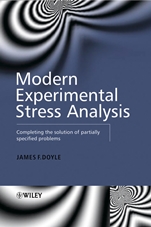
Modern Experimental Stress Analysis: Completing the Solution of Partially Specified Problems
ISBN 9780470861561
Autor: James F. Doyle
Wydawca: Wiley
Dostępność: 3-6 tygodni
Cena: 631,05 zł
Przed złożeniem zamówienia prosimy o kontakt mailowy celem potwierdzenia ceny.
ISBN13: |
9780470861561 |
ISBN10: |
0470861568 |
Autor: |
James F. Doyle |
Oprawa: |
Hardback |
Rok Wydania: |
2004-01-29 |
Ilość stron: |
440 |
Wymiary: |
251x170 |
Tematy: |
TN |
All structures suffer from stresses and strains caused by operating loads and extraneous factors such as wind loading and vibrations; typically, these problems are solved using the finite element method. The most common challenge facing engineers is how to solve a stress analysis problem of real structures when all of the required information is not available. Addressing such stress analysis problems, Modern Experimental Stress Analysis presents a comprehensive and modern approach to combining experimental methods with finite element methods to effect solutions. Focusing on establishing formal methods and algorithms, this book helps in the completion of the construction of analytical models for problems. This book also: Applies to a variety of structures and components.Provides new ideas to researchers in computational mechanics.Discusses complex models.Offers solutions to a large collection of problems ranging from static to dynamic, linear to non–linear.Includes a wealth of documented experimental examples.Enables stress analysts to extend the range of problems and applications they can address.
Offering practical examples, this book is an essential tool for all senior undergraduate and postgraduate students in experimental mechanics and engineering analysis. Practising civil, mechanical and aerospace engineers involved in the stress analysis of structures and components will also find this book a very useful reference.
Spis treści:
Preface.
Notation.
Introduction.
1 Finite Element Methods.
1.1 Deformation and Strain.
1.2 Tractions and Stresses.
1.3 Governing Equations of Motion.
1.4 Material Behavior.
1.5 The Finite Element Method.
1.6 Some Finite Element Discretizations.
1.7 Dynamic Considerations.
1.8 Geometrically Nonlinear Problems.
1.9 Nonlinear Materials.
2 Experimental Methods.
2.1 Electrical Filter Circuits.<
br>2.2 Digital Recording and Manipulation of Signals.
2.3 Electrical Resistance Strain Gages.
2.4 Strain Gage Circuits.
2.5 Motion and Force Transducers.
2.6 Digital Recording and Analysis of Images.
2.7 Moir&eacute; Analysis of Displacement.
2.8 Holographic Interferometry.
2.9 Photoelasticity.
3 Inverse Methods 171
3.1 Analysis of Experimental Data.
3.2 Parametric Modeling of Data.
3.3 Parameter Identification with Extrapolation.
3.4 Identification of Implicit Parameters.
3.5 Inverse Theory for Ill–Conditioned Problems.
3.6 Some Regularization Forms.
3.7 Relocation of Data onto a Grid Pattern.
3.8 Discussion.
4 Static Problems 219
4.1 Force Identification Problems.
4.2 Whole–Field Displacement Data.
4.3 Strain Gages.
4.4 Traction Distributions.
4.5 Nonlinear Data Relations.
4.6 Parameter Identification Problems.
4.7 Choosing the Parameterization.
4.8 Discussion.
5 Transient Problems with Time Data.
5.1 The Essential Difficulty.
5.2 Deconvolution using Sensitivity Responses.
5.3 Experimental Studies.
5.4 Scalability Issues: Recursive Formulation.
5.5 The One–Sided Hopkinson Bar.
5.6 Identifying Localized Stiffness and Mass.
5.7 Implicit Parameter Identification.
5.8 Force Location Problems.
5.9 Discussion.
6 Transient Problems with Space Data.
6.1 Space–Time Deconvolution.
6.2 Preliminary Metrics.
6.3 Traction Distributions.
6.4 Dynamic Photoelasticity.
6.5 Identification Problems.
6.6 Force Location for a Shell Segment.
6.7 Discussion.
7 Nonlinear Problems.
7.1 Static Inverse Method.
7.2 Nonlinear Structural Dynamics.
7.3 Nonlinear Elastic Behavior.
7.4 Elastic–Plastic Materials.
7.5 Nonlinear Parameter Identification.
7.6 Dynamics of Cracks.
7.7 Highly Instrumented Structures.
7.8 Discussion.
Afterword.
References.
Index.
Okładka tylna:
All structures suffer from stresses and strains caused by operating loads and extraneous factors such as wind loading and vibrations; typically, these problems are solved using the finite element method. The most common challenge facing engineers is how to solve a stress analysis problem of real structures when all of the required information is not available. Addressing such stress analysis problems, Modern Experimental Stress Analysis presents a comprehensive and modern approach to combining experimental methods with finite element methods to effect solutions. Focusing on establishing formal methods and algorithms, this book helps in the completion of the construction of analytical models for problems. This book also: Applies to a variety of structures and components.Provides new ideas to researchers in computational mechanics.Discusses complex models.Offers solutions to a large collection of problems ranging from static to dynamic, linear to non–linear.Includes a wealth of documented experimental examples.Enables stress analysts to extend the range of problems and applications they can address.
Offering practical examples, this book is an essential tool for all senior undergraduate and postgraduate students in experimental mechanics and engineering analysis. Practising civil, mechanical and aerospace engineers involved in the stress analysis of structures and components will also find this book a very useful reference.
Koszyk
Książek w koszyku: 0 szt.
Wartość zakupów: 0,00 zł
Informacje


Kontakt
Gambit
Centrum Oprogramowania
i Szkoleń Sp. z o.o.
Al. Pokoju 29b/22-24
31-564 Kraków
Siedziba Księgarni
ul. Kordylewskiego 1
31-542 Kraków
+48 12 410 5991
+48 12 410 5987
+48 12 410 5989
Subskrypcje
Administratorem danych osobowych jest firma Gambit COiS Sp. z o.o. Na podany adres będzie wysyłany wyłącznie biuletyn informacyjny.
Autoryzacja płatności

Informacje na temat autoryzacji płatności poprzez PayU.

© Copyright 2012: GAMBIT COiS Sp. z o.o. Wszelkie prawa zastrzeżone.
Projekt i wykonanie: Alchemia Studio Reklamy