


Wydawcy
Katalog tematyczny
- Archeologia (109)
- Ekonomia, finanse, business (13704)
- Filozofia (1445)
- Historia (3040)
- Języki i językoznawstwo (2356)
- Lifestyle, hobby i rozrywka (475)
- Medycyna (9704)
- Chirurgia (272)
- Inne gałęzie medycyny (1871)
- Medycyna kliniczna (4187)
- Medycyna niekonwencjonalna (14)
- Medycyna przedkliniczna (269)
- Medycyna, ogólnie (1740)
- Historia medycyny (3)
- Lekarze, sprawy zawodowe (8)
- Medycyna, aspekty prawne (10)
- Służba zdrowia (36)
- Wyposażenie medyczne (157)
- Zdrowie publiczne (460)
- Medyczne służby pomocnicze (745)
- Studia medyczne (16)
- Weterynaria (548)
- Nauki humanistyczne (4)
- Nauki o Ziemi i środowisku (2638)
- Nauki ścisłe (20412)
- Nauki społeczne (8486)
- Nauki techniczne (13450)
- Prawo (1696)
- Publikacje informacyjne i interdyscyplinarne (1288)
- Religia i wierzenia (917)
- Technika komputerowa (4067)
- Zdrowie, relacje międzyludzkie i rozwój osobisty (657)





Informacje szczegółowe o książce
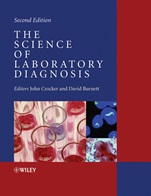
The Science of Laboratory Diagnosis
ISBN 9780470859124
Autor: John Crocker, David Burnett
Wydawca: Wiley
Dostępność: 3-6 tygodni
Cena: 1 314,60 zł
Przed złożeniem zamówienia prosimy o kontakt mailowy celem potwierdzenia ceny.
ISBN13: |
9780470859124 |
ISBN10: |
0470859121 |
Autor: |
John Crocker, David Burnett |
Oprawa: |
Hardback |
Rok Wydania: |
2005-06-17 |
Numer Wydania: |
2nd Edition |
Ilość stron: |
564 |
Wymiary: |
267x200 |
Tematy: |
MB |
This book builds on the highly successful first edition, providing a concise description of all common laboratory tests available in medical practice with notes on their application, the accuracy of each test, the historical background to the adoption of various tests and their effectiveness in diagnosis. It will be an essential primary reference source for everyone working in a clinical laboratory. The text benefits from the use of clear headings, tables, flowcharts and pathology slides, the majority of which are in full colour.
The aim of the Editors has been to provide an accessible reference book in which easy access of information is of primary importance. They succeeded in the first edition, as was apparent from the reviews, and the format has been repeated. All the chapters have been updated and new material has been introduced to cover recently developed techniques, such as fluid–based cytology, telepathology and proteomics.
This book will be essential reading for pathologists, biomedical scientists, medical laboratory scientific officers and all clinicians involved in laboratory research.
Reviews of first edition:
"The text is concise, wide–ranging and easy to digest. The ease of extraction of the important facts make it an ideal source of information for use in a variety of situations from the postgraduate examination to the clinical directors’ board meeting."
Dr Andrea Chapman, Dr Bernard Croal, Dr Richard Hobson and Dr Laura Munro, Bulletin of The Royal College of Pathologists
"The editors have done a marvellous job, more than fulfilling their stated aim of producing a volume describing the multidisciplinary state of modern pathology which will be of interest to a wide range of readers. … I was particularly impressed by the many tables and flow charts, which can be used as aids to decision making." DM Barnes, Journal of Clinical Pathology
"This is an excellent book to dip into and get a feel for techniques us
ed in the other disciplines of pathology." G McCreanor, Annals of Clinical Biochemistry
Spis treści:
Preface to the First Edition.
Preface to the Second Edition.
Contributors Lists.
Section 1: Histopathology.
1: Specimen Handling and Preparation for Routine Diagnostic Histopathology (Paul J. Smith and Janine L. Warfield).
2: General stains (Barrie Sims).
3: Enzyme Histochemistry (Trevor Gray and Neil Hand).
4: Immunohistochemistry (Jane Starczynski and John Crocker).
5: Electron Microscopy in Pathology (Brian Eyden).
6: Light Microscopy (Brian Boullier).
7: Quantitative Methods in Tissue Pathology (Peter W. Hamilton and Derek C. Allen).
8: Proliferation Markers in Histopathology (Cheryl E. Gillett and Diana M. Barnes).
Section 2: Cytology.
9: Cytopathology (Adrian T. Warfield).
Section 3: Microbiology – Bacteriology
10: Microscopy in Bacteriology: Application and Sample Preparation (Dugald R. Baird).
11: Culture Media in Bacteriology (Eric Y. Bridson).
12: Identification of Bacteria (Andrew Hay ).
13: Automated tests in Bacteriology (Paul C. Boreland).
14: Bacteriology Molecular Techniques: sample preparation and application (Richard E. Holliman and Julie D. Johnson).
15: Other tests in bacteriology (Darrel Ho–Yen).
16: Control of antimicrobial chemotherapy (Ian M. Gould).
Section 4: Microbiology – Virology,Mycology and Parasitology.
17: Microscopy in virology: application and sample preparation (Marie M. Ogilvie).
18: Electron microscopy in virology (Hazel Appleton).
19: Tissue culture (William L. Irving and Alan Pawley).
20: Serological tests in virology (Goura Kudesia).
21: Automated tests in virology (Roger P. Eglin).
22: Molecular techniques in virology (Paul E. Klapper).
23: Other tests in Virology (Alex W. L. Joss).
24: Mycology (David W. Warnock).
25: Parasitology (Robert W. A. Girdwood).
Section 5: Haematology.
26: Blood Cell and Bone Marrow Morphology (Supatrik Basu).
27 The Principles of Automated Blood Cell Counters (Graham Martin).
28 Methods for the Identification of the Haemoglobinopathies (Nick Jackson and Anne Sermon).
29: Special von Willebrand Factor investigations (Mohammad S. Enayat).
30 Platelet Investigations (Steven Walton and Peter Rose).
31 A Hospital Transfusion Service (Steven Walton and Peter E. Rose).
32 Flow Cytometry and Molecular Biology in Haematology (Ian Chant).
33: Haematinic Investigations (Frank Wells).
34: Laboratory Investigations of Haemolysis (Paul Revell).
35: Laboratory investigation of haemostasis (Peter E. Rose and Catherine Caveen).
Section 6: Cytogenetics..
36: Chromosome Banding and Analysis (Mervyn Humphreys).
37: Fluorescence in situ hybridization (Ivor Hickey).
Section 7: Clinical Chemistry.
38: The acquisition, uses and interpretation of clinical biochemical data (William J. Marshall).
39: Immunoassay in clinical biochemistry (Joan Butler and Susan M. Chambers).
40: Ion selective electrodes (Alan D. Hirst).
41: Light absorption, scatter and luminescent techniques in routine clinical biochemistry (Bernard F. Rocks).
42: Analytical atomic spectrometry (Andrew Taylor).
43: Dry Reagent Chemistry Techniques (Jessica A. Schroeder, Jacqueline C. Osypiw and Gordon S. Challand).
44: Separation techniques (Roy Sherwood).
Section 8: Immunology.
45: Protein Assays (David Burnett).
46: Complement Assays (Jonathan North and Keith Whaley).
47: Cellular Immunology (Aarnoud Huissoon)
48: Immune Complex Diseases and Cryoglobulins (Siraj A. Misbah).
49: HLA typing (Mark Hathaway).
Section 9: Molecular Pathology.
50: Laser Capture Microdissection (Orla Sheils, Paul Smyth, Esther O’Regan, Stephen Finn, Richard Flavin and John O’Leary).
51: TaqMan PCR Gene Analysis (Cara M. Martin, Or
la Sheils and John J. O’Leary).
52: In–cell PRC (John J. O’Leary, Cara M. Martin and Orla Sheils).
53: High–density SNP and cDNA array analysis (Orla Sheils, Cara M. Martin, Paul Smyth, Jon Sherlock, Stephen Finn, Esther O’Regan, and John O’Leary).
54: CGH Array Analysis of Human Tissues (Esther O’Regan, Paul Smyth, Stephen Finn, Cara M. Martin, Orla Sheils and John J. O’Leary),
55 DNA Sequencing (Cara M. Martin, Steve Picton and John O’Leary).
Index.
Okładka tylna:
This book builds on the highly successful first edition, providing a concise description of all common laboratory tests available in medical practice with notes on their application, the accuracy of each test, the historical background to the adoption of various tests and their effectiveness in diagnosis. It will be an essential primary reference source for everyone working in a clinical laboratory. The text benefits from the use of clear headings, tables, flowcharts and pathology slides, the majority of which are in full colour.
The aim of the Editors has been to provide an accessible reference book in which easy access of information is of primary importance. They succeeded in the first edition, as was apparent from the reviews, and the format has been repeated. All the chapters have been updated and new material has been introduced to cover recently developed techniques, such as fluid–based cytology, telepathology and proteomics.
This book will be essential reading for pathologists, biomedical scientists, medical laboratory scientific officers and all clinicians involved in laboratory research.
Reviews of first edition:
"The text is concise, wide–ranging and easy to digest. The ease of extraction of the important facts make it an ideal source of information for use in a variety of situations from the postgraduate examination to the clinical directors’ board meeting."
Dr Andrea C
Koszyk
Książek w koszyku: 0 szt.
Wartość zakupów: 0,00 zł
Informacje


Kontakt
Gambit
Centrum Oprogramowania
i Szkoleń Sp. z o.o.
Al. Pokoju 29b/22-24
31-564 Kraków
Siedziba Księgarni
ul. Kordylewskiego 1
31-542 Kraków
+48 12 410 5991
+48 12 410 5987
+48 12 410 5989
Subskrypcje
Administratorem danych osobowych jest firma Gambit COiS Sp. z o.o. Na podany adres będzie wysyłany wyłącznie biuletyn informacyjny.
Autoryzacja płatności

Informacje na temat autoryzacji płatności poprzez PayU.

© Copyright 2012: GAMBIT COiS Sp. z o.o. Wszelkie prawa zastrzeżone.
Projekt i wykonanie: Alchemia Studio Reklamy