


Wydawcy
Katalog tematyczny
- Archeologia (109)
- Ekonomia, finanse, business (13704)
- Filozofia (1445)
- Historia (3040)
- Języki i językoznawstwo (2356)
- Lifestyle, hobby i rozrywka (475)
- Medycyna (9704)
- Nauki humanistyczne (4)
- Nauki o Ziemi i środowisku (2638)
- Nauki ścisłe (20412)
- Astronomia (294)
- Biologia (5119)
- Chemia (6540)
- Chemia analityczna (361)
- Chemia fizyczna (346)
- Chemia nieorganiczna (137)
- Chemia organiczna (535)
- Krystalografia (27)
- Minerologia (46)
- Fizyka (3309)
- Matematyka (4574)
- Nauki ścisłe, ogólnie (503)
- Nauki społeczne (8486)
- Nauki techniczne (13450)
- Prawo (1696)
- Publikacje informacyjne i interdyscyplinarne (1288)
- Religia i wierzenia (917)
- Technika komputerowa (4067)
- Zdrowie, relacje międzyludzkie i rozwój osobisty (657)





Informacje szczegółowe o książce
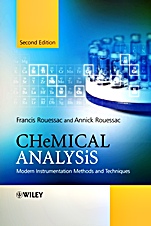
Chemical Analysis: Modern Instrumentation Methods and Techniques
ISBN 9780470859032
Autor: Francis Rouessac, Annick Rouessac
Wydawca: Wiley
Dostępność: 3-6 tygodni
Cena: 296,10 zł
Przed złożeniem zamówienia prosimy o kontakt mailowy celem potwierdzenia ceny.
ISBN13: |
9780470859032 |
ISBN10: |
0470859032 |
Autor: |
Francis Rouessac, Annick Rouessac |
Oprawa: |
Paperback |
Rok Wydania: |
2007-03-30 |
Numer Wydania: |
2nd Edition |
Ilość stron: |
600 |
Wymiary: |
250x171 |
Tematy: |
PN |
Completely revised and updated, Chemical Analysis: Second Edition is an essential introduction to a wide range of analytical techniques and instruments. Assuming little in the way of prior knowledge, this text carefully guides the reader through the more widely used and important techniques, whilst avoiding excessive technical detail.Provides a thorough introduction to a wide range of the most important and widely used instrumental techniquesMaintains a careful balance between depth and breadth of coverageIncludes examples, problems and their solutionsIncludes coverage of latest developments including supercritical fluid chromatography and capillary electrophoresis
Spis treści:
Foreword to the first English edition.
Preface to the first English edition.
Preface to second edition.
Acknowledgments.
Introduction.
PART 1 SEPARATION METHODS.
1 General aspects of chromatography.
1.1 General concepts of analytical chromatography.
1.2 The chromatogram.
1.3 Gaussian–shaped elution peaks.
1.4 The plate theory.
1.5 Nernst partition coefficient (K).
1.6 Column efficiency.
1.7 Retention parameters.
1.8 Separation (or selectivity) factor between two solutes.
1.9 Resolution factor between two peaks.
1.10 The rate theory of chromatography.
1.11 Optimization of a chromatographic analysis.
1.12 Classification of chromatographic techniques.
Problems.
2 Gas chromatography.
2.1 Components of a GC installation.
2.2 Carrier gas and flow regulation.
2.3 Sample introduction and the injection chamber.
2.4 Thermostatically controlled oven.
2.5 Columns.
2.6 Stationary phases.
2.7 Principal gas chromatographic detectors.
2.8 Detectors providing structural data.
2.9 Fast chromatography.
2.10 Multi–dimensional chromatography.
2.11 Retention indexes and stationary phase con
stants.
Problems.
3 High–performance liquid chromatography.
3.1 The beginnings of HPLC.
3.2 General concept of an HPLC system.
3.3 Pumps and gradient elution.
3.4 Injectors.
3.5 Columns.
3.6 Stationary phases.
3.7 Chiral chromatography.
3.8 Mobile phases.
3.9 Paired–ion chromatography.
3.10 Hydrophobic interaction chromatography.
3.11 Principal detectors.
3.12 Evolution and applications of HPLC.
Problems.
4 Ion chromatography.
4.1 Basics of ion chromatography.
4.2 Stationary phases.
4.3 Mobile phases.
4.4 Conductivity detectors.
4.5 Ion suppressors.
4.6 Principle and basic relationship.
4.7 Areas of the peaks and data treatment software.
4.8 External standard method.
4.9 Internal standard method.
4.10 Internal normalization method.
Problems.
5 Thin layer chromatography.
5.1 Principle of TLC.
5.2 Characteristics of TLC.
5.3 Stationary phases.
5.4 Separation and retention parameters.
5.5 Quantitative TLC.
Problems.
6 Supercritical fluid chromatography.
6.1 Supercritical fluids: a reminder.
6.2 Supercritical fluids as mobile phases.
6.3 Instrumentation in SFC.
6.4 Comparison of SFC with HPLC and GC.
6.5 SFC in chromatographic techniques.
7 Size exclusion chromatography.
7.1 Principle of SEC.
7.2 Stationary and mobile phases.
7.3 Calibration curves.
7.4 Instrumentation.
7.5 Applications of SEC.
Problems.
8 Capillary electrophoresis and electrochromatography.
8.1 From zone electrophoresis to capillary electrophoresis.
8.2 Electrophoretic mobility and electro–osmotic flow.
8.3 Instrumentation.
8.4 Electrophoretic techniques.
8.5 Performance of CE.
8.6 Capillary electrochromatography.
Problems.
PART 2 SPECTROSCOPIC METHODS.
9 Ultraviolet and visible absorption spectroscopy.
9.1 The UV/Vis spectral region and the origin of the ab
sorptions.
9.2 The UV/Vis spectrum.
9.3 Electronic transitions of organic compounds.
9.4 Chromophore groups.
9.5 Solvent effects: solvatochromism.
9.6 Fieser–Woodward rules.
9.7 Instrumentation in the UV/Visible.
9.8 UV/Vis spectrophotometers.
9.9 Quantitative analysis: laws of molecular absorption.
9.10 Methods in quantitative analysis.
9.11 Analysis of a single analyte and purity control.
9.12 Multicomponent analysis (MCA).
9.13 Methods of baseline correction.
9.14 Relative error distribution due to instruments.
9.15 Derivative spectrometry.
9.16 Visual colorimetry by transmission or reflection.
Problems.
10 Infrared spectroscopy.
10.1 The origin of light absorption in the infrared.
10.2 Absorptions in the infrared.
10.3 Rotational–vibrational bands in the mid–IR.
10.4 Simplified model for vibrational interactions.
10.5 Real compounds.
10.6 Characteristic bands for organic compounds.
10.7 Infrared spectrometers and analysers.
10.8 Sources and detectors used in the mid–IR.
10.9 Sample analysis techniques.
10.10 Chemical imaging spectroscopy in the infrared.
10.11 Archiving spectra.
10.12 Comparison of spectra.
10.13 Quantitative analysis.
Problems.
11 Fluorimetry and chemiluminescence.
11.1 Fluorescence and phosphorescence.
11.2 The origin of fluorescence.
11.3 Relationship between fluorescence and concentration.
11.4 Rayleigh scattering and Raman bands.
11.5 Instrumentation.
11.6 Applications.
11.7 Time–resolved fluorimetry.
11.8 Chemiluminescence.
Problems.
12 X–ray fluorescence spectrometry.
12.1 Basic principles.
12.2 The X–ray fluorescence spectrum.
12.3 Excitation modes of elements in X–ray fluorescence.
12.4 Detection of X–rays.
12.5 Different types of instruments.
12.6 Sample preparation.
12.7 X–ray absorption – X–ray de
nsimetry.
12.8 Quantitative analysis by X–ray fluorescence.
12.9 Applications of X–ray fluorescence.
Problems.
13 Atomic absorption and flame emission spectroscopy.
13.1 The effect of temperature upon an element.
13.2 Applications to modern instruments.
13.3 Atomic absorption versus flame emission.
13.4 Measurements by AAS or by FES.
13.5 Basic instrumentation for AAS.
13.6 Flame photometers.
13.7 Correction of interfering absorptions.
13.8 Physical and chemical interferences.
13.9 Sensitivity and detection limits in AAS.
Problems.
14 Atomic emission spectroscopy.
14.1 Optical emission spectroscopy (OES).
14.2 Principle of atomic emission analysis.
14.3 Dissociation of the sample into atoms or ions.
14.4 Dispersive systems and spectral lines.
14.5 Simultaneous and sequential instruments.
14.6 Performances.
14.7 Applications of OES.
Problems.
15 Nuclear magnetic resonance spectroscopy.
15.1 General introduction.
15.2 Spin/magnetic field interaction for a nucleus.
15.3 Nuclei that can be studied by NMR.
15.4 Bloch theory for a nucleus of spin number I =1/2.
15.5 Larmor frequency.
15.6 Pulsed NMR.
15.7 The processes of nuclear relaxation.
15.8 Chemical shift.
15.9 Measuring the chemical shift.
15.10 Shielding and deshielding of the nuclei.
15.11 Factors influencing chemical shifts.
15.12 Hyperfine structure – spin–spin coupling.
15.13 Heteronuclear coupling.
15.14 Homonuclear coupling.
15.15 Spin decoupling and particular pulse sequences.
15.16 HPLC–NMR coupling.
15.17 Fluorine and phosphorus NMR.
15.18 Quantitative NMR.
15.19 Analysers using pulsed NMR.
Problems.
PART 3 OTHER METHODS.
16 Mass spectrometry.
16.1 Basic principles.
16.2 The magnetic–sector design.
16.3 ‘EB’ or ‘BE’ geometry mass analysers.
16.4 Time of flight ana
Koszyk
Książek w koszyku: 0 szt.
Wartość zakupów: 0,00 zł
Informacje


Kontakt
Gambit
Centrum Oprogramowania
i Szkoleń Sp. z o.o.
Al. Pokoju 29b/22-24
31-564 Kraków
Siedziba Księgarni
ul. Kordylewskiego 1
31-542 Kraków
+48 12 410 5991
+48 12 410 5987
+48 12 410 5989
Subskrypcje
Administratorem danych osobowych jest firma Gambit COiS Sp. z o.o. Na podany adres będzie wysyłany wyłącznie biuletyn informacyjny.
Autoryzacja płatności

Informacje na temat autoryzacji płatności poprzez PayU.

© Copyright 2012: GAMBIT COiS Sp. z o.o. Wszelkie prawa zastrzeżone.
Projekt i wykonanie: Alchemia Studio Reklamy