


Wydawcy
Katalog tematyczny
- Archeologia (109)
- Ekonomia, finanse, business (13704)
- Filozofia (1445)
- Historia (3040)
- Języki i językoznawstwo (2356)
- Lifestyle, hobby i rozrywka (475)
- Medycyna (9704)
- Nauki humanistyczne (4)
- Nauki o Ziemi i środowisku (2638)
- Nauki ścisłe (20412)
- Nauki społeczne (8486)
- Nauki techniczne (13450)
- Prawo (1696)
- Publikacje informacyjne i interdyscyplinarne (1288)
- Religia i wierzenia (917)
- Technika komputerowa (4067)
- Zdrowie, relacje międzyludzkie i rozwój osobisty (657)





Informacje szczegółowe o książce
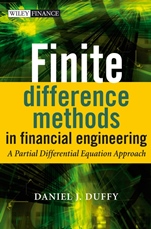
Finite Difference Methods in Financial Engineering: A Partial Differential Equation Approach
ISBN 9780470858820
Autor: Daniel J. Duffy
Wydawca: Wiley
Dostępność: 3-6 tygodni
Cena: 422,10 zł
Przed złożeniem zamówienia prosimy o kontakt mailowy celem potwierdzenia ceny.
ISBN13: |
9780470858820 |
ISBN10: |
0470858826 |
Autor: |
Daniel J. Duffy |
Oprawa: |
Hardback |
Rok Wydania: |
2006-03-31 |
Ilość stron: |
442 |
Wymiary: |
254x176 |
Tematy: |
KF |
The world of quantitative finance (QF) is one of the fastest growing areas of research and its practical applications to derivatives pricing problem. Since the discovery of the famous Black–Scholes equation in the 1970’s we have seen a surge in the number of models for a wide range of products such as plain and exotic options, interest rate derivatives, real options and many others. Gone are the days when it was possible to price these derivatives analytically. For most problems we must resort to some kind of approximate method.
In this book we employ partial differential equations (PDE) to describe a range of one–factor and multi–factor derivatives products such as plain European and American options, multi–asset options, Asian options, interest rate options and real options. PDE techniques allow us to create a framework for modeling complex and interesting derivatives products. Having defined the PDE problem we then approximate it using the Finite Difference Method (FDM). This method has been used for many application areas such as fluid dynamics, heat transfer, semiconductor simulation and astrophysics, to name just a few. In this book we apply the same techniques to pricing real–life derivative products. We use both traditional (or well–known) methods as well as a number of advanced schemes that are making their way into the QF literature:Crank–Nicolson, exponentially fitted and higher–order schemes for one–factor and multi–factor optionsEarly exercise features and approximation using front–fixing, penalty and variational methodsModelling stochastic volatility models using Splitting methodsCritique of ADI and Crank–Nicolson schemes; when they work and when they don’t workModelling jumps using Partial Integro Differential Equations (PIDE)Free and moving boundary value problems in QF
Included with the book is a CD containing information on ho
w to set up FDM algorithms, how to map these algorithms to C++ as well as several working programs for one–factor and two–factor models. We also provide source code so that you can customize the applications to suit your own needs.
Spis treści:
0 Goals of this Book and Global Overview.
PART I THE CONTINUOUS THEORY OF PARTIAL DIFFERENTIAL EQUATIONS.
1 An Introduction to Ordinary Differential Equations.
2 An Introduction to Partial Differential Equations.
3 Second–Order Parabolic Differential Equations.
4 An Introduction to the Heat Equation in One Dimension.
5 An Introduction to the Method of Characteristics.
PART II FINITE DIFFERENCE METHODS: THE FUNDAMENTALS.
6 AnIntroduction to the Finite Difference Method.
7 An Introduction to the Method of Lines.
8 General Theory of the Finite Difference Method.
9 Finite Difference Schemes for First–Order Partial Differential Equations.
10 FDM for the One–Dimensional Convection–Diffusion Equation.
11 Exponentially Fitted Finite Difference Schemes.
PART III APPLYING FDM TO ONE–FACTOR INSTRUMENT PRICING.
12 Exact Solutions and Explicit Finite Difference Method for One–Factor Models.
13 An Introduction to the Trinomial Method.
14 Exponentially Fitted Difference Schemes for Barrier Options.
15 Advanced Issues in Barrier and Lookback Option Modelling.
16 The Meshless (Meshfree) Method in Financial Engineering.
17 Extending the Black–Scholes Model: Jump Processes.
PART IV FDM FOR MULTIDIMENSIONAL PROBLEMS.
18 Finite Difference Schemes for Multidimensional Problems.
19 An Introduction to Alternating Direction Implicit and Splitting Methods.
20 Advanced Operator Splitting Methods: Fractional Steps.
21 Modern Splitting Methods.
PART V APPLYING FDM TO MULTI–FACTOR INSTRUMENT PRICING.
22 Options with Stochastic Volatility: The Heston Model.
23 Finite Difference Methods for Asian Options and Other ‘Mixed’ Problems.
24 Multi–Asset Options.
25 Finite Difference Methods for Fixed–Income Problems.
PART VI FREE AND MOVING BOUNDARY VALUE PROBLEMS.
26 Background to Free and Moving Boundary Value Problems.
27 Numerical Methods for Free Boundary Value Problems: Front–Fixing Methods.
28 Viscosity Solutions and Penalty Methods for American Option Problems.
29 Variational Formulation of American Option Problems.
PART VII DESIGN AND IMPLEMENTATION IN C++.
30 Finding the Appropriate Finite Difference Schemes for your Financial Engineering Problem.
31 Design and Implementation of First–Order Problems.
32 Moving to Black–Scholes.
33 C++ Class Hierarchies for One–Factor and Two–Factor Payoffs.
Appendices.
A1 An introduction to integral and partial integro–differential equations.
A2 An introduction to the finite element method.
Bibliography.
Index.
Nota biograficzna:
Daniel Duffy is a numerical analyst who has been working in the IT business since 1979. He has been involved in the analysis, design and implementation of systems using object–oriented, component and (more recently) intelligent agent technologies to large industrial and financial applications. As early as 1993 he was involved in C++ projects for risk management and options applications with a large Dutch bank. His main interest is in finding robust and scalable numerical schemes that approximate the partial differential equations that model financial derivatives products. He has an M.Sc. in the Finite Element Method first–order hyperbolic systems and a Ph.D. in robus
t finite difference methods for convection–diffusion partial differential equations. Both degrees are from Trinity College, Dublin, Ireland.
Daniel Duffy is founder of Datasim Education and Datasim Component Technology, two companies involved in training, consultancy and software development.
Okładka tylna:
The world of quantitative finance (QF) is one of the fastest growing areas of research and its practical applications to derivatives pricing problem. Since the discovery of the famous Black–Scholes equation in the 1970’s we have seen a surge in the number of models for a wide range of products such as plain and exotic options, interest rate derivatives, real options and many others. Gone are the days when it was possible to price these derivatives analytically. For most problems we must resort to some kind of approximate method.
In this book we employ partial differential equations (PDE) to describe a range of one–factor and multi–factor derivatives products such as plain European and American options, multi–asset options, Asian options, interest rate options and real options. PDE techniques allow us to create a framework for modeling complex and interesting derivatives products. Having defined the PDE problem we then approximate it using the Finite Difference Method (FDM). This method has been used for many application areas such as fluid dynamics, heat transfer, semiconductor simulation and astrophysics, to name just a few. In this book we apply the same techniques to pricing real–life derivative products. We use both traditional (or well–known) methods as well as a number of advanced schemes that are making their way into the QF literature:Crank–Nicolson, exponentially fitted and higher–order schemes for one–factor and multi–factor optionsEarly exercise features and approximation using front–fixing, penalty and variational methodsModelling
Koszyk
Książek w koszyku: 0 szt.
Wartość zakupów: 0,00 zł
Informacje


Kontakt
Gambit
Centrum Oprogramowania
i Szkoleń Sp. z o.o.
Al. Pokoju 29b/22-24
31-564 Kraków
Siedziba Księgarni
ul. Kordylewskiego 1
31-542 Kraków
+48 12 410 5991
+48 12 410 5987
+48 12 410 5989
Subskrypcje
Administratorem danych osobowych jest firma Gambit COiS Sp. z o.o. Na podany adres będzie wysyłany wyłącznie biuletyn informacyjny.
Autoryzacja płatności

Informacje na temat autoryzacji płatności poprzez PayU.

© Copyright 2012: GAMBIT COiS Sp. z o.o. Wszelkie prawa zastrzeżone.
Projekt i wykonanie: Alchemia Studio Reklamy