


Wydawcy
Katalog tematyczny
- Archeologia (109)
- Ekonomia, finanse, business (13704)
- Filozofia (1445)
- Historia (3040)
- Języki i językoznawstwo (2356)
- Lifestyle, hobby i rozrywka (475)
- Medycyna (9704)
- Chirurgia (272)
- Inne gałęzie medycyny (1871)
- Medycyna kliniczna (4187)
- Choroby wewnętrzne (514)
- Dermatologia (51)
- Diagnostyka medyczna (3)
- Endokrynologia (144)
- Gastroenterologia (27)
- Geriatria (50)
- Ginekologia i położnictwo (134)
- Hematologia (46)
- Hepatologia (10)
- Kardiologia (71)
- Laryngologia (12)
- Nefrologia (10)
- Neurologia (500)
- Oftalmologia (50)
- Pediatria (33)
- Pulmunologia (32)
- Reumatologia (14)
- Terapia genowa (1)
- Układ mięśniowo-szkieletowy (1)
- Urologia (14)
- Medycyna niekonwencjonalna (14)
- Medycyna przedkliniczna (269)
- Medycyna, ogólnie (1740)
- Medyczne służby pomocnicze (745)
- Studia medyczne (16)
- Weterynaria (548)
- Nauki humanistyczne (4)
- Nauki o Ziemi i środowisku (2638)
- Nauki ścisłe (20412)
- Nauki społeczne (8486)
- Nauki techniczne (13450)
- Prawo (1696)
- Publikacje informacyjne i interdyscyplinarne (1288)
- Religia i wierzenia (917)
- Technika komputerowa (4067)
- Zdrowie, relacje międzyludzkie i rozwój osobisty (657)





Informacje szczegółowe o książce
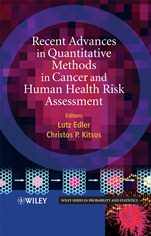
Recent Advances in Quantitative Methods in Cancer and Human Health Risk Assessment
ISBN 9780470857564
Autor: Lutz Edler, Christos Kitsos
Wydawca: Wiley
Dostępność: 3-6 tygodni
Cena: 684,60 zł
Przed złożeniem zamówienia prosimy o kontakt mailowy celem potwierdzenia ceny.
ISBN13: |
9780470857564 |
ISBN10: |
0470857560 |
Autor: |
Lutz Edler, Christos Kitsos |
Oprawa: |
Hardback |
Rok Wydania: |
2005-04-22 |
Ilość stron: |
502 |
Wymiary: |
239x159 |
Tematy: |
MJ |
Human health risk assessment involves the measuring of risk of exposure to disease, with a view to improving disease prevention. Mathematical, biological, statistical, and computational methods play a key role in exposure assessment, hazard assessment and identification, and dose–response modelling.
Recent Advances in Quantitative Methods in Cancer and Human Health Risk Assessmentis a comprehensive text that accounts for the wealth of new biological data as well as new biological, toxicological, and medical approaches adopted in risk assessment. It provides an authoritative compendium of state–of–the–art methods proposed and used, featuring contributions from eminent authors with varied experience from academia, government, and industry.Provides a comprehensive summary of currently available quantitative methods for risk assessment of both cancer and non–cancer problems.Describes the applications and the limitations of current mathematical modelling and statistical analysis methods (classical and Bayesian).Includes an extensive introduction and discussion to each chapter.Features detailed studies of risk assessments using biologically–based modelling approaches.Discusses the varying computational aspects of the methods proposed.Provides a global perspective on human health risk assessment by featuring case studies from a wide range of countries.Features an extensive bibliography with links to relevant background information within each chapter.Recent Advances in Quantitative Methods in Cancer and Human Health Risk Assessment will appeal to researchers and practitioners in public health & epidemiology, and postgraduate students alike. It will also be of interest to professionals working in risk assessment agencies.
Spis treści:
Contributors.
Preface.
Introduction.
I CANCER AND HUMAN HEALTH RISK ASSESSMEN
T.
Introductory remarks.
1. Principles of Cancer Risk Assessment: The Risk Assessment Paradigm (Vincent J. Cogliano).
1.1 The risk assessment paradigm.
1.2 Hazard identification.
1.3 Dose–response assessment.
II BIOLOGICAL ASPECTS OF CARCINOGENESIS.
Introductory remarks.
2. Molecular Epidemiology in Cancer Research (Gerassimos Voutsinas, Anastasia Apostolidou and Natalia Spyrou).
2.1 Introduction.
2.2 From carcinogen exposure to cancer.
2.3 Biomarkers.
2.4 Validation of biomarkers.
2.5 Factors influencing cancer risk.
2.6 New tools in molecular epidemiology.
2.7 Conclusions.
3. Genetic Polymorphisms in Metabolising Enzymes as Lung Cancer Risk Factors (Angela Risch, Heike Dally and Lutz Edler).
3.1 Introduction.
3.2 Methodological aspects.
3.3 Examples.
3.4 Discussion.
Acknowledgements.
4. Biological Carcinogenesis: Theories and Models (Sylvia Solakidi, Constantinos E. Vorgias and Constantine E. Sekeris).
4.1 Introduction.
4.2 Models of human carcinogenesis.
4.3 The multistage mouse skin carcinogenesis model.
4.4 Epilogue.
5. Biological and Mathematical Aspects of Multistage Carcinogenesis (E. Georg Luebeck and Suresh H. Moolgavkar).
5.1 Introduction.
5.2 Features of multistage carcinogenesis.
5.3 Generalized TSCE model.
5.4 Modeling cancer incidence.
5.5 Summary.
6. Risk Assessment and Chemical and Radiation Hormesis: A Short Commentary and Bibliographic Review (Jose J. Amaral Mendes and Eric Pluygers).
6.1 Introduction.
6.2 The concept of hormesis.
6.3 Chemical hormesis.
6.4 Radiation hormesis.
6.5 Concluding remarks.
III MODELING FOR CANCER RISK ASSESSMENT.
Introductory remarks.
7. Modeling Exposure and Target Organ Concentrations (Karen H. Watanabe).
7.1 Introduction.
7.2 Data from molecular biology.
7.3 The next generation of physiological models.
7.4 Discussion and conclusions
.
Acknowledgements.
8. Stochastic Carcinogenesis Models (Annette Kopp–Schneider, Iris Burkholder and Jutta Groos).
8.1 Introduction.
8.2 Stochastic models for hepatocarcinogenesis.
8.3 Model–based evaluation of liver focal lesion data.
8.4 Conclusions.
9. A Unified Modeling Approach: From Exposure to Disease Endpoints (Chao W. Chen).
9.1 Background.
9.2 Conventional approach to modeling carcinogenesis.
9.3 State space modeling using sampling techniques.
9.4 Self–organizing algorithm for state space modeling.
9.5 Some examples of state space models.
9.6 A computing procedure for the three–stage model.
9.7 Discussion.
Appendix: Simulation programs.
10. Modeling Lung Cancer Screening (Marek Kimmel, Olga Y. Gorlova and Claudia I. Henschke).
10.1 Introduction.
10.2 Screening and Other Relevant Studies.
10.3 Principles of modeling of lung cancer screening.
10.4 Review of modeling approaches.
10.5 Modeling the impact of new screening modalities on reduction of mortality from lung cancer.
10.6 Comparison of models and concluding remarks.
11. Optimal Regimens of Cancer Screening (Leonid G. Hanin and Lyudmila V. Pavlova).
11.2 Optimal screening.
11.3 Formula for the screening efficiency functional.
11.4 The data and parameter estimation.
11.5 Numerical experiments.
11.6 Discussion.
Acknowledgement.
IV STATISTICAL APPROACHES FOR CARCINOGENESIS STUDIES.
Introductory remarks
12. Analysis of Survival Data with Non–proportional Hazards and Crossings of Survival Functions (Vilijandas B. Bagdonavicˇius and Mikhail S. Nikuline).
12.1 Introduction.
12.2 Models.
12.3 Parametric and semiparametric estimation.
12.4 Goodness–of–fit for the Cox model against the cross–effects models.
12.5 Examples.
12.6 Concluding remarks.
Appendix: Proof of Theorem 12.1.
13. Dose–response Modeling (Lutz Edler, Annette Kop
p–Schneider and Harald Heinzl).
13.1 Introduction.
13.2 Elements of the dose–response assessment.
13.3 Dose–response models.
13.4 Dose–response models in risk assessment.
13.5 Dose–Response modeling of 2,3,7,8–tetrachlorodibenzo–p–dioxin.
13.6 Concluding remarks.
14 Benchmark Dose Approach (Fred Parham and Christopher Portier).
14.1 Introduction.
14.2 Use by regulatory agencies.
14.3 Calculation methods.
14.4 Literature survey.
14.5 Software and calculation example.
15. Uncertainty Analysis: The Bayesian Approach (Frédéric Y. Bois and Cheikh T. Diack
15.1 Introduction.
15.2 Representations of uncertainty.
15.3 Causes of uncertainty.
15.4 Types of uncertainty.
15.5 Quantifying uncertainty.
15.6 Reducing uncertainty.
15.7 Conclusion.
Acknowledgements.
16. Optimal Designs for Bioassays in Carcinogenesis (Christos P. Kitsos).
16.1 Introduction.
16.2 On the optimal design theory.
16.3 The Michaelis–Menten model.
16.4 Dose extrapolation designs.
16.4.1 The Weibull model.
16.5 Discussion.
Acknowledgements.
V SPECIFIC MODELING APPROACHES FOR HEALTH RISK ASSESSMENT.
Introductory remarks
17. Cancer Risk Assessment for Mixtures (Christos P. Kitsos and Lutz Edler).
17.1 Introduction.
17.2 Basic principles.
17.3 Design of mixture experiments.
17.4 Discussion.
18. Designs and Models for Mixtures: Assessing Cumulative Risk (James J. Chen, Ralph L. Kodell and Yi–Ju Chen).
18.1 Introduction.
18.2 Experimental designs and models for whole mixture.
18.3 Dose–response modeling for component–based approach.
18.4 Component–based risk assessment for quantitative response data.
18.5 Discussion.
19 Estimating the Natural History of Breast Cancer from Bivariate Data on Age and Tumor Size at Diagnosis (Alexander V. Zorin, Lutz Edler, Leonid G. Hanin and Andrej Y. Yakovlev
Koszyk
Książek w koszyku: 0 szt.
Wartość zakupów: 0,00 zł
Informacje


Kontakt
Gambit
Centrum Oprogramowania
i Szkoleń Sp. z o.o.
Al. Pokoju 29b/22-24
31-564 Kraków
Siedziba Księgarni
ul. Kordylewskiego 1
31-542 Kraków
+48 12 410 5991
+48 12 410 5987
+48 12 410 5989
Subskrypcje
Administratorem danych osobowych jest firma Gambit COiS Sp. z o.o. Na podany adres będzie wysyłany wyłącznie biuletyn informacyjny.
Autoryzacja płatności

Informacje na temat autoryzacji płatności poprzez PayU.

© Copyright 2012: GAMBIT COiS Sp. z o.o. Wszelkie prawa zastrzeżone.
Projekt i wykonanie: Alchemia Studio Reklamy