


Wydawcy
Katalog tematyczny
- Archeologia (109)
- Ekonomia, finanse, business (13704)
- Filozofia (1445)
- Historia (3040)
- Języki i językoznawstwo (2356)
- Lifestyle, hobby i rozrywka (475)
- Medycyna (9704)
- Nauki humanistyczne (4)
- Nauki o Ziemi i środowisku (2638)
- Nauki ścisłe (20412)
- Astronomia (294)
- Biologia (5119)
- Chemia (6540)
- Fizyka (3309)
- Elektryczność i magnetyzm (90)
- Fizyka atomowa i molekularna (110)
- Fizyka cząstek elementarnych (36)
- Fizyka jądra atomowego (36)
- Fizyka kwantowa (210)
- Fizyka matematyczna (121)
- Fizyka relatywistyczna (36)
- Fizyka statystyczna (51)
- Fizyka stosowana (498)
- Mechanika klasyczna (186)
- Optyka i światło (133)
- Stany materii (202)
- Matematyka (4574)
- Nauki ścisłe, ogólnie (503)
- Nauki społeczne (8486)
- Nauki techniczne (13450)
- Prawo (1696)
- Publikacje informacyjne i interdyscyplinarne (1288)
- Religia i wierzenia (917)
- Technika komputerowa (4067)
- Zdrowie, relacje międzyludzkie i rozwój osobisty (657)





Informacje szczegółowe o książce
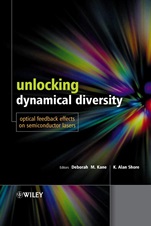
Unlocking Dynamical Diversity: Optical Feedback Effects on Semiconductor Lasers
ISBN 9780470856192
Autor: Deborah M. Kane, K. Alan Shore
Wydawca: Wiley
Dostępność: 3-6 tygodni
Cena: 694,05 zł
Przed złożeniem zamówienia prosimy o kontakt mailowy celem potwierdzenia ceny.
ISBN13: |
9780470856192 |
ISBN10: |
047085619X |
Autor: |
Deborah M. Kane, K. Alan Shore |
Oprawa: |
Hardback |
Rok Wydania: |
2005-03-24 |
Ilość stron: |
356 |
Wymiary: |
244x168 |
Tematy: |
PH |
Applications of semiconductor lasers with optical feedback systems are driving rapid developments in theoretical and experimental research. The very broad wavelength–gain–bandwidth of semiconductor lasers combined with frequency–filtered, strong optical feedback create the tunable, single frequency laser systems utilised in telecommunications, environmental sensing, measurement and control. Those with weak to moderate optical feedback lead to the chaotic semiconductor lasers of private communication. This resource illustrates the diversity of dynamic laser states and the technological applications thereof, presenting a timely synthesis of current findings, and providing the roadmap for exploiting their future potential.Provides theory–based explanations underpinned by a vast range of experimental studies on optical feedback, including conventional, phase conjugate and frequency– filtered feedback in standard, commercial and single–stripe semiconductor lasersIncludes the classic Lang–Kobayashi equation model, through to more recent theory, with new developments in techniques for solving delay differential equations and bifurcation analysisExplores developments in self–mixing interferometry to produce sub–nanometre sensitivity in path–length measurementsReviews tunable single frequency semiconductor lasers and systems and their diverse range of applications in sensing and optical communicationsEmphasises the importance of synchronised chaotic semiconductor lasers using optical feedback and private communications systems
Unlocking Dynamical Diversity illustrates all theory using real world examples gleaned from international cutting–edge research. Such an approach appeals to industry professionals working in semiconductor lasers, laser physics and laser applications and is essential reading for researchers and postgraduates in these fields.
Spis
treści:
List of Contributors.
Preface.
Acknowledgements.
1 Introduction (Deborah M. Kane and K. Alan Shore).
1.1 Semiconductor Laser Basics.
1.2 Nonlinear Dynamical Systems.
1.3 Semiconductor Lasers with Optical Feedback.
1.4 Landmark Results: Theory and Experiment.
1.5 Overview of Feedback Response: Regimes I–V.
1.6 Outline of Applications.
References.
2 Theoretical Analysis (Paul Spencer, Paul Rees and Iestyn Pierce).
2.1 Introduction.
2.2 Basic Model: Single Mode Lasers with Weak Optical Feedback.
2.3 Steady State Analysis of the Lang–Kobayashi Equations.
2.4 Multimode Iterative Analysis of the Dynamics of Laser Diodes Subject to Optical Feedback.
2.5 Cavity Length Effects.
2.6 Coupled Cavity Analysis.
2.7 Conclusion.
References.
3 Generalized Optical Feedback: Theory (Daan Lenstra, Gautam Vemuri and Mirvais Yousefi).
3.1 Varieties of Optical Feedback.
3.2 Compound–Cavity Analysis: Validity of Lang–Kobayashi Approach.
3.3 Filtered Optical Feedback.
3.4 Phase–Conjugate Feedback.
3.5 Conclusion.
Acknowledgements.
Note.
References.
4 Experimental Observations (A. Tom Gavrielides and David W. Sukow).
4.1 Introduction.
4.2 Experimental Apparatus.
4.3 Extremely Weak Feedback Effects – Regime I.
4.4 Very Weak Feedback Effects – Regime II.
4.5 Weak Feedback Effects – Regime III–IV.
4.6 Moderate Feedback Effects – Low Frequency Fluctuations.
4.7 Short Cavity Regime.
4.8 Double–Cavity Systems.
4.9 Multimode Effects.
4.10 Control.
4.11 Feedback and Modulation.
4.12 Phase Conjugate Feedback.
4.13 Conclusion.
References.
5 Bifurcation Analysis of Lasers with Delay (Bernd Krauskopf).
5.1 Introduction.
5.2 Bifurcation Theory of DDEs.
5.3 Numerical Methods.
5.4 Bifurcations in the COF Laser
.
5.5 Bifurcations in the PCF Laser.
5.6 Conclusion.
Acknowledgements.
References.
6 Chaos Synchronization (Siva Sivaprakasam and Cristina Masoller Ottieri).
6.1 Introduction.
6.2 Synchronization of Unidirectionally Coupled Semiconductor Lasers.
6.3 Synchronization of Mutually Coupled Semiconductor Lasers.
6.4 Conclusion.
References.
7 Laser Interferometry (Guido Giuliani and Silvano Donati).
7.1 Introduction.
7.2 Laser Diode Feedback Interferometry: Theory and Basic Experiments.
7.3 Application to Measurements.
7.4 Laser Diode Diagnostics Using Self–Mixing Techniques.
7.5 Conclusion.
Acknowledgements.
References.
8 Single Frequency and Tunable Single Frequency Semiconductor Laser Systems (Esa Jaatinen).
8.1 Introduction.
8.2 Effect of Frequency Filtering the Feedback for Robust Single Frequency Operation.
8.3 Tunable Semiconductor Laser System Designs and Operating Characteristics.
8.4 Frequency Stabilization.
8.5 Tunable Semiconductor Laser System Applications.
8.6 Conclusion.
References.
9 Chaotic Optical Communication (Junji Ohtsubo and Peter Davis).
9.1 Introduction.
9.2 Communication Using Synchronized Laser Chaos.
9.3 Methods for Modulation and Recovery of Messages.
9.4 Mechanisms for Synchronization and Signal Recovery.
9.5 Parameter Sensitivity, Robustness and Security for Synchronized Chaos Communication.
9.6 Communication Bandwidth.
9.7 Conclusion.
Acknowledgements.
References.
Index.
Okładka tylna:
Applications of semiconductor lasers with optical feedback systems are driving rapid developments in theoretical and experimental research. The very broad wavelength–gain–bandwidth of semiconductor lasers combined with frequency–filtered, strong optical feedback create the tunable, single frequency laser systems utilised in telecommunications,
environmental sensing, measurement and control. Those with weak to moderate optical feedback lead to the chaotic semiconductor lasers of private communication. This resource illustrates the diversity of dynamic laser states and the technological applications thereof, presenting a timely synthesis of current findings, and providing the roadmap for exploiting their future potential.Provides theory–based explanations underpinned by a vast range of experimental studies on optical feedback, including conventional, phase conjugate and frequency– filtered feedback in standard, commercial and single–stripe semiconductor lasersIncludes the classic Lang–Kobayashi equation model, through to more recent theory, with new developments in techniques for solving delay differential equations and bifurcation analysisExplores developments in self–mixing interferometry to produce sub–nanometre sensitivity in path–length measurementsReviews tunable single frequency semiconductor lasers and systems and their diverse range of applications in sensing and optical communicationsEmphasises the importance of synchronised chaotic semiconductor lasers using optical feedback and private communications systems
Unlocking Dynamical Diversity illustrates all theory using real world examples gleaned from international cutting–edge research. Such an approach appeals to industry professionals working in semiconductor lasers, laser physics and laser applications and is essential reading for researchers and postgraduates in these fields.
Koszyk
Książek w koszyku: 0 szt.
Wartość zakupów: 0,00 zł
Informacje


Kontakt
Gambit
Centrum Oprogramowania
i Szkoleń Sp. z o.o.
Al. Pokoju 29b/22-24
31-564 Kraków
Siedziba Księgarni
ul. Kordylewskiego 1
31-542 Kraków
+48 12 410 5991
+48 12 410 5987
+48 12 410 5989
Subskrypcje
Administratorem danych osobowych jest firma Gambit COiS Sp. z o.o. Na podany adres będzie wysyłany wyłącznie biuletyn informacyjny.
Autoryzacja płatności

Informacje na temat autoryzacji płatności poprzez PayU.

© Copyright 2012: GAMBIT COiS Sp. z o.o. Wszelkie prawa zastrzeżone.
Projekt i wykonanie: Alchemia Studio Reklamy