


Wydawcy
Katalog tematyczny
- Archeologia (109)
- Ekonomia, finanse, business (13704)
- Filozofia (1445)
- Historia (3040)
- Języki i językoznawstwo (2356)
- Lifestyle, hobby i rozrywka (475)
- Medycyna (9704)
- Chirurgia (272)
- Inne gałęzie medycyny (1871)
- Medycyna kliniczna (4187)
- Medycyna niekonwencjonalna (14)
- Medycyna przedkliniczna (269)
- Medycyna, ogólnie (1740)
- Historia medycyny (3)
- Lekarze, sprawy zawodowe (8)
- Medycyna, aspekty prawne (10)
- Służba zdrowia (36)
- Wyposażenie medyczne (157)
- Zdrowie publiczne (460)
- Medyczne służby pomocnicze (745)
- Studia medyczne (16)
- Weterynaria (548)
- Nauki humanistyczne (4)
- Nauki o Ziemi i środowisku (2638)
- Nauki ścisłe (20412)
- Nauki społeczne (8486)
- Nauki techniczne (13450)
- Prawo (1696)
- Publikacje informacyjne i interdyscyplinarne (1288)
- Religia i wierzenia (917)
- Technika komputerowa (4067)
- Zdrowie, relacje międzyludzkie i rozwój osobisty (657)





Informacje szczegółowe o książce
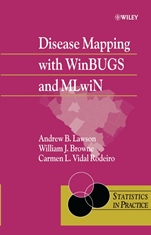
Disease Mapping with WinBUGS and MLwiN
ISBN 9780470856048
Autor: Andrew B. Lawson, William J. Browne, Carmen L. Vidal Rodeiro
Wydawca: Wiley
Dostępność: 3-6 tygodni
Cena: 554,40 zł
Przed złożeniem zamówienia prosimy o kontakt mailowy celem potwierdzenia ceny.
ISBN13: |
9780470856048 |
ISBN10: |
0470856041 |
Autor: |
Andrew B. Lawson, William J. Browne, Carmen L. Vidal Rodeiro |
Oprawa: |
Hardback |
Rok Wydania: |
2003-08-08 |
Ilość stron: |
296 |
Wymiary: |
241x165 |
Tematy: |
MB |
Disease mapping involves the analysis of geo–referenced disease incidence data and has many applications, for example within resource allocation, cluster alarm analysis, and ecological studies. There is a real need amongst public health workers for simpler and more efficient tools for the analysis of geo–referenced disease incidence data. Bayesian and multilevel methods provide the required efficiency, and with the emergence of software packages such as WinBUGS and MLwiN are now easy to implement in practice.Provides an introduction to Bayesian and multilevel modelling in disease mapping.Adopts a practical approach, with many detailed worked examples.Includes introductory material on WinBUGS and MLwiN.Discusses three applications in detail relative risk estimation, focused clustering, and ecological analysis.Suitable for public health workers and epidemiologists with a sound statistical knowledge.Supported by a Website featuring data sets and WinBUGS and MLwiN programs.
Disease Mapping with WinBUGS and MLwiN provides a practical introduction to the use of software for disease mapping for researchers, practitioners and graduate students from statistics, public health and epidemiology who analyse disease incidence data.
Spis treści:
Preface.
Notation.
0.1 Standard notation for multilevel modelling.
0.2 Spatial multiple–membership models and the MMMC notation.
0.3 Standard notation for WinBUGS models.
1. Disease mapping basics.
1.1 Disease mapping and map reconstruction.
1.2 Disease map restoration.
2. Bayesian hierarchical modelling.
2.1 Likelihood and posterior distributions.
2.2 Hierarchical models.
2.3 Posterior inference.
2.4 Markov chain Monte Carlo methods.
2.5 Metropolis and Metropolis–Hastings algorithms.
2.6 Residuals and goodness of fit.
3. Multilevel modelling.
3.1 Continuous response models.
3.2 Estimation
procedures for multilevel models.
3.3 Poisson response models.
3.4 Incorporating spatial information.
3.5 Discussion.
4. WinBUGS basics.
4.1 About WinBUGS.
4.2 Start using WinBUGS.
4.3 Specification of the model.
4.4 Model fitting.
4.5 Scripts.
4.6 Checking convergence.
4.7 Spatial modelling: GeoBUGS.
4 .8 Conclusions.
5. MLwiN basics.
5.1 About MLwiN.
5.2 Getting started.
5.3 Fitting statistical models.
5.4 MCMC estimation in MLwiN.
5.5 Spatial modelling.
5.6 Conclusions.
6. Relative risk estimation.
6.1 Relative risk estimation using WinBUGS.
6.2 Spatial prediction.
6.3 An analysis of the Ohio dataset using MLwiN.
7. Focused clustering: the analysis of putative health hazards.
7.1 Introduction.
7.2 Study design.
7.3 Problems of inference.
7.4 Modelling the hazard exposure risk.
7.5 Models for count data.
7.6 Bayesian models.
7.7 Focused clustering in WinBUGS.
7.8 Focused clustering in MLwiN.
8. Ecological analysis.
8.1 Introduction.
8.2 Statistical models.
8.3 WinBUGS analyses of ecological datasets.
8.4 MLwiN analyses of ecological datasets.
9. Spatially–correlated survival analysis.
9.1 Survival analysis in WinBUGS.
9.2 Survival analysis in MLwiN.
10. Epilogue.
Appendix 1: WinBUGS code for focused clustering models.
A.1: Falkirk example.
A.2: Ohio example.
Appendix 2: S–Plus function for conversion to GeoBUGS format.
Bibliography.
Index.
Okładka tylna:
Disease mapping involves the analysis of geo–referenced disease incidence data and has many applications, for example within resource allocation, cluster alarm analysis, and ecological studies. There is a real need amongst public health workers for simpler and more efficient tools for the analysis of geo–referenced disease incidence data. Bayesian and multilevel methods provide the required efficiency, and with the emergence of s
oftware packages such as WinBUGS and MLwiN are now easy to implement in practice.Provides an introduction to Bayesian and multilevel modelling in disease mapping.Adopts a practical approach, with many detailed worked examples.Includes introductory material on WinBUGS and MLwiN.Discusses three applications in detail relative risk estimation, focused clustering, and ecological analysis.Suitable for public health workers and epidemiologists with a sound statistical knowledge.Supported by a Website featuring data sets and WinBUGS and MLwiN programs.
Disease Mapping with WinBUGS and MLwiN provides a practical introduction to the use of software for disease mapping for researchers, practitioners and graduate students from statistics, public health and epidemiology who analyse disease incidence data.
Koszyk
Książek w koszyku: 0 szt.
Wartość zakupów: 0,00 zł
Informacje


Kontakt
Gambit
Centrum Oprogramowania
i Szkoleń Sp. z o.o.
Al. Pokoju 29b/22-24
31-564 Kraków
Siedziba Księgarni
ul. Kordylewskiego 1
31-542 Kraków
+48 12 410 5991
+48 12 410 5987
+48 12 410 5989
Subskrypcje
Administratorem danych osobowych jest firma Gambit COiS Sp. z o.o. Na podany adres będzie wysyłany wyłącznie biuletyn informacyjny.
Autoryzacja płatności

Informacje na temat autoryzacji płatności poprzez PayU.

© Copyright 2012: GAMBIT COiS Sp. z o.o. Wszelkie prawa zastrzeżone.
Projekt i wykonanie: Alchemia Studio Reklamy