


Wydawcy
Katalog tematyczny
- Archeologia (109)
- Ekonomia, finanse, business (13704)
- Filozofia (1445)
- Historia (3040)
- Języki i językoznawstwo (2356)
- Lifestyle, hobby i rozrywka (475)
- Medycyna (9704)
- Nauki humanistyczne (4)
- Nauki o Ziemi i środowisku (2638)
- Nauki ścisłe (20412)
- Astronomia (294)
- Biologia (5119)
- Chemia (6540)
- Chemia analityczna (361)
- Chemia fizyczna (346)
- Chemia nieorganiczna (137)
- Chemia organiczna (535)
- Krystalografia (27)
- Minerologia (46)
- Fizyka (3309)
- Matematyka (4574)
- Nauki ścisłe, ogólnie (503)
- Nauki społeczne (8486)
- Nauki techniczne (13450)
- Prawo (1696)
- Publikacje informacyjne i interdyscyplinarne (1288)
- Religia i wierzenia (917)
- Technika komputerowa (4067)
- Zdrowie, relacje międzyludzkie i rozwój osobisty (657)





Informacje szczegółowe o książce
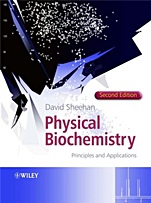
Physical Biochemistry: Principles and Applications
ISBN 9780470856024
Autor: David Sheehan
Wydawca: Wiley
Dostępność: 3-6 tygodni
Cena: 746,55 zł
Przed złożeniem zamówienia prosimy o kontakt mailowy celem potwierdzenia ceny.
ISBN13: |
9780470856024 |
ISBN10: |
0470856025 |
Autor: |
David Sheehan |
Oprawa: |
Hardback |
Rok Wydania: |
2009-03-27 |
Numer Wydania: |
2nd Edition |
Ilość stron: |
422 |
Wymiary: |
258x199 |
Tematy: |
PN |
The second edition of this successful textbook explains the basic principles behind the key techniques currently used in the modern biochemical laboratory and describes the pros and cons of each technique and compares one to another. It is non–mathematical, comprehensive and approachable for students who are not physical chemists.
• A major update of this comprehensive, accessible introduction to physical biochemistry.
• Includes two new chapters on proteomics and bioinformatics.
• Introduces experimental approaches with a minimum of mathematics and numerous practical examples.
• Provides a bibliography at the end of each chapter
Written by an author with many years teaching and research experience, Physical Biochemistry: Principles and Applications, Second Edition will prove invaluable to students of biochemistry, biophysics, molecular and life sciences and food science.
Spis treści:
Preface.
Chapter 1 Introduction.
1.1 Special Chemical Requirements of Biomolecules.
1.2 Factors Affecting Analyte Structure and Stability.
1.2.1 pH Effects.
1.2.2 Temperature Effects.
1.2.3 Effects of Solvent Polarity.
1.3 Buffering Systems Used in Biochemistry.
1.3.1 How Does a Buffer Work?
1.3.2 Some Common Buffers.
1.3.3 Additional Components Often Used in Buffers.
1.4 Quantitation, Units and Data Handling.
1.4.1 Units Used in the Text.
1.4.2 Quantification of Protein and Biological Activity.
1.5 The Worldwide Web as a Resource in Physical Biochemistry.
1.5.1 The Worldwide Web.
1.5.2 Web–Based Resources for Physical Biochemistry.
1.6 Objectives of this Volume.
References.
Chapter 2 Chromatography.
2.1 Principles of Chromatography.
2.1.1 The Partition Coefficient.
2.1.2 Phase Systems Used in Biochemistry.
2.1.3 Liquid Chromatography.
2.1.4 Gas Chromatography.
2.2 Performance Parameters Used in Chromatograp
hy.
2.2.1 Retention.
2.2.2 Resolution.
2.2.3 Physical Basis of Peak Broadening.
2.2.4 Plate Height Equation.
2.2.5 Capacity Factor.
2.2.6 Peak Symmetry.
2.2.7 Significance of Performance Criteria in Chromatography.
2.3 Chromatography Equipment.
2.3.1 Outline of Standard System Used.
2.3.2 Components of Chromatography System.
2.3.3 Stationary Phases Used.
2.3.4 Elution.
2.4 Modes of Chromatography.
2.4.1 Ion Exchange.
2.4.2 Gel Filtration.
2.4.3 Reversed Phase.
2.4.4 Hydrophobic Interaction.
2.4.5 Affinity.
2.4.6 Immobilized Metal Affinity Chromatography.
2.4.7 Hydroxyapatite.
2.5 Open Column Chromatography.
2.5.1 Equipment Used.
2.5.2 Industrial Scale Chromatography of Proteins.
2.6 High Performance Liquid Chromatography (HPLC).
2.6.1 Equipment Used.
2.6.2 Stationary Phases in HPLC.
2.6.3 Liquid Phases in HPLC.
2.6.4 Two Dimensional HPLC.
2.7 Fast Protein Liquid Chromatography.
2.7.1 Equipment Used.
2.7.2 Comparison with HPLC.
2.8 Perfusion Chromatography.
2.8.1 Theory of Perfusion Chromatography.
2.8.2 Practice of Perfusion Chromatography.
2.9 Membrane–Based Chromatography Systems.
2.9.1 Theoretical Basis.
2.9.2 Applications of Membrane–Based Separations.
2.10 Chromatography of a Sample Protein.
2.10.1 Designing a Purification Protocol.
2.10.2 Ion Exchange Chromatography of a Sample Protein: Glutathione Transferases.
2.10.3 HPLC of Peptides From Glutathione Transferases.
References.
Chapter 3 Spectroscopic Techniques.
3.1 The Nature of Light.
3.1.1 A Brief History of the Theories of Light.
3.1.2 Wave–Particle Duality Theory of Light.
3.2 The Electromagnetic Spectrum.
3.2.1 The Electromagnetic Spectrum.
3.2.2 Transitions in Spectroscopy.
3.3 Ultraviolet/Visible Absorption Spectroscopy.
3.3.1 Physical Basis.
3.3.2 Equipment Used in Absorption Spectroscopy.
3.3.3 Applications of Absorpt
ion Spectroscopy.
3.4 Fluorescence Spectroscopy.
3.4.1 Physical Basis of Fluorescence and Related Phenomena.
3.4.2 Measurement of Fluorescence and Chemiluminescence.
3.4.3 External Quenching of Fluorescence.
3.4.4 Uses of Fluorescence in Binding Studies.
3.4.5 Protein Folding Studies.
3.4.6 Resonance Energy Transfer.
3.4.7 Applications of Fluorescence in Cell Biology.
3.5 Spectroscopic Techniques Using Plane–Polarized Light.
3.5.1 Polarized Light.
3.5.2 Chirality in Biomolecules.
3.5.3 Circular Dichroism (CD).
3.5.4 Equipment Used in CD.
3.5.5 CD of Biopolymers.
3.5.6 Linear Dichroism (LD).
3.5.7 LD of Biomolecules.
3.6 Infrared Spectroscopy.
3.6.1 Physical Basis of Infrared Spectroscopy.
3.6.2 Equipment Used in Infrared Spectroscopy.
3.6.3 Uses of Infrared Spectroscopy in Structure Determination.
3.6.4 Fourier Transform Infrared Spectroscopy.
3.6.5 Raman Infrared Spectroscopy.
3.7 Nuclear Magnetic Resonance (NMR) Spectroscopy.
3.7.1 Physical Basis of NMR Spectroscopy.
3.7.2 Effect of Atomic Identity on NMR.
3.7.3 The Chemical Shift.
3.7.4 Spin Coupling in NMR.
3.7.5 Measurement of NMR Spectra.
3.8 Electron Spin Resonance (ESR) Spectroscopy.
3.8.1 Physical Basis of ESR Spectroscopy.
3.8.2 Measurement of ESR Spectra.
3.8.3 Uses of ESR Spectroscopy in Biochemistry.
3.9 Lasers.
3.9.1 Origin of Laser Beams.
3.9.2 Some Uses of Laser Beams.
3.10 Surface Plasmon Resonance.
3.10.1 Equipment Used in SPR.
3.10.2 Use of SPR in Measurement of Adsorption Kinetics.
References.
Chapter 4 Mass Spectrometry.
4.1 Principles of Mass Spectrometry.
4.1.1 Physical Basis.
4.1.2 Overview of MS Experiment.
4.1.3 Ionization Modes.
4.1.4 Equipment Used in MS Analysis.
4.2 Mass Spectrometry of Proteins/Peptides.
4.2.1 Sample Preparation.
4.2.2 MS Modes Used in the Study of Proteins/Peptides.
4.2.3 Fragmentation of Proteins/Peptides in
MS Systems.
4.3 Interfacing MS With other Methods.
4.3.1 MS/MS.
4.3.2 LC/MS.
4.3.3 GC/MS.
4.3.4 Electrophoresis/MS.
4.4 Uses of Mass Spectrometry in Biochemistry.
4.4.1 MS and Microheterogeneity in Proteins.
4.4.2 Confirmation and Analysis of Peptide Synthesis.
4.4.3 Peptide Mapping.
4.4.4 Post–Translational Modification Analysis of Proteins.
4.4.5 Determination of Protein Disulfide Patterns.
4.4.6 Protein Sequencing by MS.
4.4.7 Studies on Enzymes.
4.4.8 Analysis of DNA Components.
References.
Chapter 5 Electrophoresis.
5.1 Principles of Electrophoresis.
5.1.1 Physical Basis.
5.1.2 Historical Development of Electrophoresis.
5.1.3 Gel Electrophoresis.
5.2 Nondenaturing Electrophoresis.
5.2.1 Polyacrylamide Nondenaturing Electrophoresis.
5.2.2 Protein Mass Determination by Nondenaturing Electrophoresis.
5.2.3 Activity Staining.
5.2.4 Zymograms.
5.3 Denaturing Electrophoresis.
5.3.1 SDS Polyacrylamide Gel Electrophoresis.
5.3.2 SDS Polyacrylamide Gel Electrophoresis in Reducing Conditions.
5.3.3 Chemical Crosslinking of Proteins – Quaternary Structure.
5.3.4 Urea Electrophoresis.
5.4 Electrophoresis in DNA Sequencing.
5.4.1 Sanger Dideoxynucleotide Sequencing of DNA.
5.4.2 Sequencing of DNA.
5.4.3 Footprinting of DNA.
5.4.4 Single Strand Conformation Polymorphism Analysis of DNA.
5.5 Isoelectric Focusing (IEF).
5.5.1 Ampholyte Structure.
5.5.2 Isoelectric Focusing.
5.5.3 Titration Curve Analysis.
5.5.4 Chromatofocusing.
5.6 Immunoelectrophoresis.
5.6.1 Dot Blotting and Immunodiffusion Tests with Antibodies.
5.6.2 Zone Electrophoresis/Immunodiffusion Immunoelectrophoresis.
5.6.3 Rocket Immunoelectrophoresis.
5.6.4 Counter Immunoelectrophoresis.
5.6.5 Crossed Immunoelectrophoresis (CIE).
5.7 Agarose Gel Electrophoresis of Nucleic Acids.
5.7.1 Formation of an Agarose Gel.
5.7.2 Equipment for Agarose Gel Ele
Koszyk
Książek w koszyku: 0 szt.
Wartość zakupów: 0,00 zł
Informacje


Kontakt
Gambit
Centrum Oprogramowania
i Szkoleń Sp. z o.o.
Al. Pokoju 29b/22-24
31-564 Kraków
Siedziba Księgarni
ul. Kordylewskiego 1
31-542 Kraków
+48 12 410 5991
+48 12 410 5987
+48 12 410 5989
Subskrypcje
Administratorem danych osobowych jest firma Gambit COiS Sp. z o.o. Na podany adres będzie wysyłany wyłącznie biuletyn informacyjny.
Autoryzacja płatności

Informacje na temat autoryzacji płatności poprzez PayU.

© Copyright 2012: GAMBIT COiS Sp. z o.o. Wszelkie prawa zastrzeżone.
Projekt i wykonanie: Alchemia Studio Reklamy