


Wydawcy
Katalog tematyczny
- Archeologia (1)
- Ekonomia, finanse, business (698)
- Filozofia (20)
- Historia (57)
- Języki i językoznawstwo (4)
- Lifestyle, hobby i rozrywka (32)
- Medycyna (1025)
- Nauki humanistyczne (2)
- Nauki o Ziemi i środowisku (430)
- Nauki ścisłe (1680)
- Nauki społeczne (1297)
- Nauki techniczne (530)
- Budownictwo lądowe (6)
- Chemia przemysłowa (27)
- Elektronika i telekomunikacja (163)
- Energetyka (25)
- Inne nauki stosowane (16)
- Inżynieria biochemiczna (11)
- Inżynieria transportu (17)
- Mechanika i materiały (176)
- Nauka o środowisku (27)
- Rolnictwo (8)
- Technika, ogólnie (46)
- Prawo (1437)
- Publikacje informacyjne i interdyscyplinarne (32)
- Religia i wierzenia (15)
- Technika komputerowa (237)
- Zdrowie, relacje międzyludzkie i rozwój osobisty (4)





Informacje szczegółowe o książce
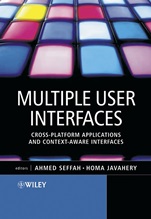
Multiple User Interfaces: Cross–Platform Applications and Context–Aware Interfaces
ISBN 9780470854440
Autor: Ahmed Seffah, Homa Javahery
Wydawca: Wiley
Dostępność: 3-6 tygodni
Cena: 605,85 zł
Przed złożeniem zamówienia prosimy o kontakt mailowy celem potwierdzenia ceny.
ISBN13: |
9780470854440 |
ISBN10: |
0470854448 |
Autor: |
Ahmed Seffah, Homa Javahery |
Oprawa: |
Hardback |
Rok Wydania: |
2003-11-28 |
Ilość stron: |
414 |
Wymiary: |
244x174 |
Tematy: |
TJ |
Today’s communication systems consist of a bewildering array of devices and technologies. Mobile phones, PDAs, personal computers, corporate servers, Internet sites, even wearable devices – all of these compete for our attention and require us to interact with them in different ways.
A Multiple User Interface (MUI) helps with this variety of communication systems and devices by offering a coherent, integrated user experience across platforms. A MUI manages and coordinates services provided to the user through multiple devices and platforms. In addition, it adapts the view of the information to the computing platform in use.
The following questions and more are addressed in Multiple User Interfaces:What kinds of design methods are needed for building MUIs?How can we enable users to customise a device?How can the customisation of one device be reflected on all of the other devices available to the user?What is the best way to deal with device–specific constraints while assuring maintainability and cross–platform consistency of interfaces?How can we build interfaces that dynamically respond to changes in the environment, such as variations in network connectivity, user location, ambient sound and lighting conditions?
The authors, who represent a wide range of research expertise in both industry and academia, introduce design and development frameworks for multi–device, cross–platform and context–aware systems. These frameworks are valuable to researchers and practitioners in usability and software engineering, and to anyone interested in the problem of developing and evaluating MUIs. Designers and developers, students and educators will find this book useful for its applied and theoretical content, supported by well–established HCI (Human–Computer Interaction) methodologies.
Spis treści:
Acknowledgements.
About the Editors.
Contributors.
PA
RT I. BASIC TERMINOLOGY, CONCEPTS, AND CHALLENGES.
1. Executive Summary and Book Overview (Ahmed Seffah and Homa Javahery).
2. Multiple User Interfaces: Cross–Platform Applications and Context–Aware Interfaces (Ahmed Seffah and Homa Javahery).
PART II. ADAPTATION AND CONTEXT–AWARE USER INTERFACES.
3. A Reference Framework for the Development of Plastic User Interfaces (David Thevenin, et al.).
4. Temporal Aspects of Multi–Platform Interaction (David England and Min Du).
5. The PALIO Framework for Adaptive Information Services (Constantine Stephanidis, et al.).
PART III. DEVELOPMENT TECHNOLOGY AND LANGUAGES.
6. Building Multi–Platform User Interfaces with UIML (Mir Farooq Ali, et al.).
7. XIML: A Multiple User Interface Representation Framework for Industry (Angel Puerta and Jacob Eisenstein).
8. AUIT: Adaptable User Interface Technology, with Extended Java Server Pages (John Grundy and Wenjing Zou).
PART IV. MODEL–BASED DEVELOPMENT.
9. Adaptive Task Modeling: From Formal Models to XML Representations (Peter Forbrig, <i>et al.</i>).
10. Multi–Model and Multi–Level Development of User Interfaces (Jean Vanderdonckt, et al.).
11. Supporting Interactions with Multiple Platforms Through User and Task Models (L. Marucci, et al.).
PART. V ARCHITECTURES, PATTERNS, AND DEVELOPMENT TOOLKITS.
12. Migrating User Interfaces Across Platforms Using HCI Patterns (Homa Javahery, et al.).
13. Support for the Adapting Applications and Interfaces to Context (Anind K. Dey and Gregory D. Abowd).
14. A Run–time Infrastructure to Support the Construction of Distributed, Multi–User, Multi–Device Interactive Applications (Simon Lock and Harry Brignull).
PART VI. EVALUATION AND SOCIAL IMPACTS.
15 Assessing Usability across Multiple User Interfaces (Gustav Öquist, et al.).
16
. Iterative Design and Evaluation of Multiple Interfaces for a Complex Commercial Word Processor (Joanna McGrenere).
17. Inter–Usability of Multi–Device Systems – A Conceptual Framework (Charles Denis and Laurent Karsenty).
Subject Index.
Nota biograficzna:
Ahmed Seffah is a professor in the department of Computer Science at Concordia University. He is director of the Human–Centered Software Engineering Group and the co–founder of the Concordia Software Usability and Empirical Studies Lab. He holds a PhD in software engineering from the Ecole Centrale de Lyon (France). His research interest are at the crossroads between software engineering and Human–Computer Interaction (HCI), including usability measurement, user interface design, empirical studies on developer experiences with CASE tools, human–centered software engineering, and patterns as a vehicle for integrating HCI knowledge in software engineering practices. Dr. Seffah is the vice–chair of the IFIP working group on user–centered design methodologies. During the last 10 years, he has been involved in different projects in North America and Europe.
Homa Javahery is a researcher and project manager with the Human–Centered Software Engineering Group, including the Usability and Empirical Studies Lab, in the department of Computer Science at Concordia University. She holds a Master′s degree in Computer Science from Concordia University, and a Bachelor of Science degree from McGill University. She is combining different design approaches from human sconces and engineering disciplines to develop a pattern–oriented framework for designing a large variety of interfaces. She has been involved in different collaborative projects at the INRIA Research Institute in Nancy, France and the Daimler–Chrysler Research Institute in Ulm, Germany.
Okładka tylna:
Today
’s communication systems consist of a bewildering array of devices and technologies. Mobile phones, PDAs, personal computers, corporate servers, Internet sites, even wearable devices – all of these compete for our attention and require us to interact with them in different ways.
A Multiple User Interface (MUI) helps with this variety of communication systems and devices by offering a coherent, integrated user experience across platforms. A MUI manages and coordinates services provided to the user through multiple devices and platforms. In addition, it adapts the view of the information to the computing platform in use.
The following questions and more are addressed in Multiple User Interfaces:What kinds of design methods are needed for building MUIs?How can we enable users to customise a device?How can the customisation of one device be reflected on all of the other devices available to the user?What is the best way to deal with device–specific constraints while assuring maintainability and cross–platform consistency of interfaces?How can we build interfaces that dynamically respond to changes in the environment, such as variations in network connectivity, user location, ambient sound and lighting conditions?
The authors, who represent a wide range of research expertise in both industry and academia, introduce design and development frameworks for multi–device, cross–platform and context–aware systems. These frameworks are valuable to researchers and practitioners in usability and software engineering, and to anyone interested in the problem of developing and evaluating MUIs. Designers and developers, students and educators will find this book useful for its applied and theoretical content, supported by well–established HCI (Human–Computer Interaction) methodologies.
Koszyk
Książek w koszyku: 0 szt.
Wartość zakupów: 0,00 zł
Informacje


Kontakt
Gambit
Centrum Oprogramowania
i Szkoleń Sp. z o.o.
Al. Pokoju 29b/22-24
31-564 Kraków
Siedziba Księgarni
ul. Kordylewskiego 1
31-542 Kraków
+48 12 410 5991
+48 12 410 5987
+48 12 410 5989
Subskrypcje
Administratorem danych osobowych jest firma Gambit COiS Sp. z o.o. Na podany adres będzie wysyłany wyłącznie biuletyn informacyjny.
Autoryzacja płatności

Informacje na temat autoryzacji płatności poprzez PayU.

© Copyright 2012: GAMBIT COiS Sp. z o.o. Wszelkie prawa zastrzeżone.
Projekt i wykonanie: Alchemia Studio Reklamy