


Wydawcy
Katalog tematyczny
- Archeologia (109)
- Ekonomia, finanse, business (13704)
- Filozofia (1445)
- Historia (3040)
- Języki i językoznawstwo (2356)
- Lifestyle, hobby i rozrywka (475)
- Medycyna (9704)
- Nauki humanistyczne (4)
- Nauki o Ziemi i środowisku (2638)
- Nauki ścisłe (20412)
- Nauki społeczne (8486)
- Nauki techniczne (13450)
- Budownictwo lądowe (1045)
- Chemia przemysłowa (2258)
- Elektronika i telekomunikacja (3287)
- Energetyka (1122)
- Inne nauki stosowane (363)
- Inżynieria biochemiczna (507)
- Inżynieria transportu (232)
- Mechanika i materiały (3316)
- Nauka o środowisku (321)
- Rolnictwo (507)
- Technika, ogólnie (475)
- Prawo (1696)
- Publikacje informacyjne i interdyscyplinarne (1288)
- Religia i wierzenia (917)
- Technika komputerowa (4067)
- Zdrowie, relacje międzyludzkie i rozwój osobisty (657)





Informacje szczegółowe o książce
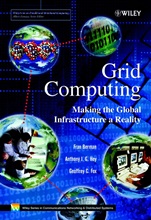
Grid Computing: Making the Global Infrastructure a Reality
ISBN 9780470853191
Autor: Fran Berman, Geoffrey Fox, Anthony J. G. Hey
Wydawca: Wiley
Dostępność: 3-6 tygodni
Cena: 718,20 zł
Przed złożeniem zamówienia prosimy o kontakt mailowy celem potwierdzenia ceny.
ISBN13: |
9780470853191 |
ISBN10: |
0470853190 |
Autor: |
Fran Berman, Geoffrey Fox, Anthony J. G. Hey |
Oprawa: |
Hardback |
Rok Wydania: |
2003-03-11 |
Ilość stron: |
1060 |
Wymiary: |
251x170 |
Tematy: |
TJ |
A few years ago ‘The Grid’ emerged as one of the most important new developments in building the infrastructure for computational science in the 21st century. The tremendous enthusiasm for grid computing has led to an extremely rapid growth of our knowledge about how to make grids a reality. This is a timely book with contributions by the world’s leading experts on building grids – it synthesizes all the exciting developments of the recent years.
I highly recommend this book to anyone interested in a comprehensive and up to date treatment of one of the most important topics in computing."
Horst D. Simon, Director, NERSC Center and Computational Research
The Grid is the computing and data management infrastructure that will provide the electronic underpinning for a global society.
As our life styles change with the development of technology, the demand for global interaction and networking in business, government, research, science and entertainment increases.
The Grid integrates networking, communication, computation and information to provide a virtual platform for computation and data management, just as the Internet provides a virtual platform for access to information. Using the Grid, users can access remote computers and gain the ability to use networked resources (computers, data archives, scientific instruments, etc.) together to solve a single problem.
Large–scale grids are intrinsically distributed, heterogeneous and dynamic. They promise effectively infinite cycles and storage, as well as access to instruments, visualization devices, and much more, without regard to geographic location. To make good this promise, complex systems of software and services must be developed.
In this book the authors consider the Grid in depth, describing its immense potential and complexity from the perspective of the community of individuals working hard to transform the Grid computing vision into reality.
Grid Computing: Making the Global Infrastructure a Reality:covers all aspects of grid technology;provides a comprehensive reference to the state–of–the–art in grid computing;features an extensive set of authors – the major players in the field;describes mature projects, working applications and cutting–edge research.
This book describes the "state of the art" in Grid Computing, and is a "must read" for all researchers in computing and engineering, physicists, statisticians, engineers and mathematicians, as well as IT policy makers involved in peer–to–peer and high performance computing. Over 50% of Chief Information Officers worldwide are expected to invest in Grid technology this year: can you afford to be left behind?
Spis treści:
Overview of the Book: Grid Computing – Making the Global Infrastructure a Reality (F. Berman, et al.).
The Grid: Past, Present, Future (F. Berman, et al.).
The Grid: A New Infrastructure for 21st Century Science (I. Foster).
The Evolution of the Grid (D. De Roure, et al.).
Software Infrastructure for the I–WAY High–prformance Distributed Computing Experiment (Foster, et al.).
Implementing Production Grids (W. Johnston).
The Anatomy of the Grid (I. Foster, et al.).
Rationale for Choosing the Open Grid Services Architecture (M. Atkinson).
The Physiology of the Grid (I. Foster, et al.).
Grid Web Services and Application Factories (D. Gannon, et al.).
From Legion to Avaki: The Persistence of Vision (A. Grimshaw, et al.).
Condor and the Grid (D. Thain, et al.).
Architecture of a Commercial Enterprise Desktop Grid: The Entropia System (A. Chien).
Autonomic Computing and Grid (P. Pattnaik, et al.).
Databases and the Grid (P. Watson).
The Open Grid Services Architecture, and Data Grids (P. Kunszt & L. G
uy).
Virtualization Services for Data Grids (R. Moore & C. Baru).
The Semantic Grid: A Future e–Science Infrastructure (D. De Roure, et al.).
Peer–to–Peer Grids (G. Fox, et al.).
Peer–to–Peer Grid Databases for Web Service Discovery (W. Hoschek).
Overview of Grid Computing Environments (G. Fox, et al.).
Grid Programming Models: Current Tools, Issues and Directions (C. Lee & D. Talia).
NaradaBrokering: An Event–based Infrastructure for Building Scalable Durable Peer–to–Peer Grids (G. Fox & S. Pallickara).
Classifying and Enabling Grid Applications (G. Allen, et al.).
NetSolve: Past, Present, and Future – A Look at a Grid Enabled Server (S. Agrawal, et al.).
Ninf–G: a GridRPC System on the Globus Toolkit (H. Nakada, et al.).
Commodity Grid Kits – Middleware for building Grid Computing Environments (G. von Laszewski, et al.).
The Grid Portal Development Kit (J. Novotny).
Building Grid Computing Portals: The NPACI Grid Portal Toolkit (M. Thomas & J. Boisseau).
Unicore and the Open Grid Services Architecture (D. Snelling).
Distributed Object–based Grid Computing Environments (T. Haupt & M. Pierce).
DISCOVER: a Computational Collaboratory for Interactive Grid Applications (V. Mann & M. Parashar).
Grid Resource Allocation and Control using Computational Economies (R. Wolski, et al.).
Parameter Sweeps on the Grid with APST (H. Casanova & F. Berman).
Storage Manager and File Transfer Web Services (W. Watson, et al.).
Application Overview for the Book: Grid Computing – Making the Global Infrastructure a Reality (F. Berman, et al.).
The Data Deluge: An e–Science Perspective (T. Hey & A. Trefethen).
Metacomputing (L. Smarr & C. Catlett)
.
Grids and the Virtual Observatory (R. Williams).
Data–intensive Grids for High–energy Physics (J. Bunn & H. Newman).
The New Biology and the Grid (K. Baldridge & P. Bourne).
eDiamond: a Grid–enabled Federated Database of Annotated Mammograms (M. Brady, et al.).
Combinatorial Chemistry and the Grid (J. Frey, et al.).
Education and the Enterprise with the Grid (G. Fox).
Index.
Views of the Grid.
Indirect Glossary.
List of Grid Projects.
Okładka tylna:
"A few years ago ‘The Grid’ emerged as one of the most important new developments in building the infrastructure for computational science in the 21st century. The tremendous enthusiasm for grid computing has led to an extremely rapid growth of our knowledge about how to make grids a reality. This is a timely book with contributions by the world’s leading experts on building grids – it synthesizes all the exciting developments of the recent years.
I highly recommend this book to anyone interested in a comprehensive and up to date treatment of one of the most important topics in computing."
Horst D. Simon, Director, NERSC Center and Computational Research
The Grid is the computing and data management infrastructure that will provide the electronic underpinning for a global society.
As our life styles change with the development of technology, the demand for global interaction and networking in business, government, research, science and entertainment increases.
The Grid integrates networking, communication, computation and information to provide a virtual platform for computation and data management, just as the Internet provides a virtual platform for access to information. Using the Grid, users can access remote computers and gain the ability to use networked resources (computers, data archives, scientific instruments, etc.) together to solve a single problem.
Koszyk
Książek w koszyku: 0 szt.
Wartość zakupów: 0,00 zł
Informacje


Kontakt
Gambit
Centrum Oprogramowania
i Szkoleń Sp. z o.o.
Al. Pokoju 29b/22-24
31-564 Kraków
Siedziba Księgarni
ul. Kordylewskiego 1
31-542 Kraków
+48 12 410 5991
+48 12 410 5987
+48 12 410 5989
Subskrypcje
Administratorem danych osobowych jest firma Gambit COiS Sp. z o.o. Na podany adres będzie wysyłany wyłącznie biuletyn informacyjny.
Autoryzacja płatności

Informacje na temat autoryzacji płatności poprzez PayU.

© Copyright 2012: GAMBIT COiS Sp. z o.o. Wszelkie prawa zastrzeżone.
Projekt i wykonanie: Alchemia Studio Reklamy