


Wydawcy
Katalog tematyczny
- Archeologia (109)
- Ekonomia, finanse, business (13704)
- Filozofia (1445)
- Historia (3040)
- Języki i językoznawstwo (2356)
- Lifestyle, hobby i rozrywka (475)
- Medycyna (9704)
- Nauki humanistyczne (4)
- Nauki o Ziemi i środowisku (2638)
- Nauki ścisłe (20412)
- Astronomia (294)
- Biologia (5119)
- Chemia (6540)
- Chemia analityczna (361)
- Chemia fizyczna (346)
- Chemia nieorganiczna (137)
- Chemia organiczna (535)
- Krystalografia (27)
- Minerologia (46)
- Fizyka (3309)
- Matematyka (4574)
- Nauki ścisłe, ogólnie (503)
- Nauki społeczne (8486)
- Nauki techniczne (13450)
- Prawo (1696)
- Publikacje informacyjne i interdyscyplinarne (1288)
- Religia i wierzenia (917)
- Technika komputerowa (4067)
- Zdrowie, relacje międzyludzkie i rozwój osobisty (657)





Informacje szczegółowe o książce
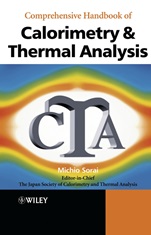
Comprehensive Handbook of Calorimetry and Thermal Analysis
ISBN 9780470851524
Autor: The Japan Society of Calorimetry and Thermal Analysis, Michio Sorai
Wydawca: Wiley
Dostępność: 3-6 tygodni
Cena: 1 444,80 zł
Przed złożeniem zamówienia prosimy o kontakt mailowy celem potwierdzenia ceny.
ISBN13: |
9780470851524 |
ISBN10: |
047085152X |
Autor: |
The Japan Society of Calorimetry and Thermal Analysis, Michio Sorai |
Oprawa: |
Hardback |
Rok Wydania: |
2004-07-27 |
Ilość stron: |
556 |
Wymiary: |
241x157 |
Tematy: |
PN |
This handbook offers an invaluable source of information that describes both the basic principles and current state of the art in the fields of calorimetry and thermal analysis. The greatest merit of this handbook is that it provides abundant examples, connecting with actual applications to inorganic– and organic–based materials, biomolecules, medicines, foods and biomaterials, which provide definitive clues to interpretations in a thermodynamic sense. Current topics related to nanoscience and nanotechnology are also included.
Since many practical examples covering a wide range of research fields are featured, this unique handbook is indispensable, not only for everyone in the field of calorimetry and thermal analysis, but also for all the people who work in fields outside of thermodynamics but who have an interest in thermodynamic interpretations.
Spis treści:
Preface.
Acknowledgements.
List of Contributors.
Part I PRINCIPLES OF CALORIMETRY AND THERMAL ANALYSIS.
1.1 Calorimetry.
1.1.1 Overview.
1.1.2 Thermodynamic quantities characteristic of multi–component system.
1.1.3 Thermodynamic quantities characteristic of surface and interface.
1.1.4 Thermodynamic quantities in chemical reactions.
1.1.5 Thermodynamics of non–equilibrium states.
1.1.6 Biothermodynamics.
1.2 Thermal Analysis.
1.2.1 Overview.
1.2.2 Thermal analysis for chemical reactions.
1.2.3 Thermal analysis for mechanical properties.
1.2.4 Dynamic viscoelastic phenomena and thermal analysis.
1.2.5 Reaction kinetics in the solid state.
1.2.6 Periodic heating method.
Part II EXPERIMENTAL METHODS.
2.1 Temperature Measurement in Thermal Study.
2.2 Principles and Methods of Calorimetry.
2.2.1 Classification and basic principles of calorimeters.
2.2.2 Adiabatic heat capacity calorimetry.
2.2.3 Heat capacity calorimetry by relaxation method.
2.2.4 AC
calorimetry.
2.2.5 Laser–flash calorimetry.
2.2.6 High–temperature calorimetry.
2.2.7 Low–temperature calorimetry.
2.2.8 Calorimetry under pressure.
2.2.9 Calorimetry under magnetic field.
2.2.10 Temperature jump calorimetry.
2.2.11 Calvet calorimeter.
2.2.12 Heat of vaporization and sublimation.
2.2.13 Reaction calorimetry.
2.2.14 Heat of solution and mixing.
2.2.15 Heat of immersion and adsorption.
2.2.16 Titration calorimetry.
2.2.17 Flow calorimetry.
2.2.18 Heat capacity spectroscopy.
2.2.19 Calorimetry at extremely high temperatures.
2.2.20 Adiabatic differential scanning calorimetry for biothermodynamics.
2.3 Principles and Methods of Thermal Analysis.
2.3.1 Thermogravimetry (TG) and controlled–rate TG.
2.3.2 Differential thermal analysis (DTA) and differential scanning calorimetry (DSC).
2.3.3 Thermomechanical analysis (TMA) and dynamic mechanical analysis (DMA).
2.3.4 Temperature–modulated DSC.
2.3.5 Temperature wave analysis.
2.3.6 Triple–cell DSC.
2.3.7 Simultaneous thermal analysis.
2.3.8 Micro thermal analysis by scanning probe microscopes.
2.3.9 Micromechanical calorimetry.
2.4 Other Experiments.
2.4.1 Determination of thermal expansivity.
2.4.2 Steady state method of determination of thermal conductivity/diffusivity.
2.4.3 Transient method for determination of thermal conductivity/diffusivity.
2.4.4 Mass spectrometry.
2.4.5 Determination of electromotive force.
2.4.6 Surface tension.
Part III DATA ANALYSIS.
3.1 Data Analysis of Calorimetry.
3.1.1 Purity determination.
3.1.2 Phase transition and normal heat capacity.
3.1.3 Determination of partial molar quantities.
3.1.4 Statistical thermodynamic analysis in biocalorimetry.
3.1.5 Data analysis in titration calorimetry.
3.2 Techniques of Thermal Analysis and the Data Analysis.
3.2.1 Solid–state reaction
kinetics by TG.
3.2.2 Baseline and thermal anomaly in DTA and DSC.
3.2.3 Heat capacity measurement by DSC and TM–DSC.
3.2.4 Analysis of isothermal crystallization by DSC.
3.2.5 Glass transition and relaxation phenomena.
3.2.6 Determination of phase diagrams by DTA/DSC.
3.2.7 Purity determination by DSC.
Part IV HOW TO UTILIZE THE THERMODYNAMIC DATABASE.
4.1 Thermodynamic and Related Database.
4.1.1 Recent development of thermodynamic database systems.
4.1.2 Phase diagram calculations.
4.1.3 Thermophysical property database.
4.2 Utilization of Thermodynamic Database.
4.2.1 Calculated phase diagram vs observed phase diagram.
4.2.2 Application of chemical equilibrium calculations.
4.2.3 Application of chemical potential diagram.
4.3 Thermodynamic Database for Biomolecules.
4.3.1 Proteins and mutants.
4.3.2 Protein–nucleic acid interaction.
Part V ACTUAL APPLICATIONS.
5.1 Metals and Alloys.
5.1.1 Thermal analysis of amorphous alloys.
5.1.2 Thermal analysis of hydrogen–absorbing alloy.
5.1.3 Thermal analyses of heat–resistant type steels and alloys.
5.1.4 Thermodynamic analysis of liquid alloys by temperature–jump calorimetry.
5.1.5 EMF method with solid electrolyte for liquid alloys.
5.1.6 Construction of alloy phase diagrams.
5.1.7 Electronic density of states of quasicrystals.
5.1.8 Kinetics of oxidation in thin metal films.
5.1.9 Lattice–defect concentration in solids from thermal expansion.
5.2 Inorganic Materials and Ceramics.
5.2.1 Heat capacity of UO2 up to 8000K.
5.2.2 Battery materials: Spinels containing Mn for lithium secondary battery.
5.2.3 Thermal conductivity of diamond film.
5.2.4 Kinetic features of the thermal dehydration of inorganic hydrates.
5.2.5 Dehydration of inorganic salts under reduced pressure.
5.2.6 Thermal analysis of water–containing silicate
minerals.
5.2.7 Heat of adsorption and evaluation of active sites on the surface.
5.2.8 Nonstoichiometry of oxides by constant temperature TG.
5.2.9 Heat of hydration of zeolite.
5.2.10 Heat capacity of yttria–stabilized zirconia.
5.2.11 Acoustic emission and thermal analysis of phase transitions.
5.2.12 Pore–size distributions in silica gels.
5.2.13 Calorimetry for fast ion conducting glasses.
5.2.14 Negative thermal expansion of ZrW2O8.
5.2.15 Calorimetry of high–pressure minerals.
5.2.16 Heat capacity of diamond and graphite.
5.2.17 Heat capacity anomaly in lead–based complex perovskite relaxors.
5.3 Organic Materials and Polymers.
5.3.1 Strain and resonance energies of fullerenes.
5.3.2 Heat capacity of molecular monolayers.
5.3.3 Entropy of transition of mixed crystals.
5.3.4 Glass transition and residual entropy.
5.3.5 Heat capacity of exotic superconductors.
5.3.6 Magnetic dimensionality and spin–wave excitation of molecule–based magnet.
5.3.7 Calorimetry of liquid crystals.
5.3.8 Alkyl–chain–length dependence of entropy of transition.
5.3.9 High–pressure DTA of liquid crystals.
5.3.10 Crystallization of polymers.
5.3.11 Melting of polymer crystals studied by temperature–modulated DSC.
5.3.12 Origin of double melting peaks of drawn nylon 6.
5.3.13 Glass transition and relaxation in polymers.
5.3.14 Thermal decomposition of polyurethanes containing natural compounds.
5.3.15 Curing of epoxy resins containing plant components.
5.3.16 Phase transition in spin–crossover complex.
5.3.17 Frequency–dependent heat capacity near a glass transition.
5.3.18 Heat capacity of molecular magnets under magnetic field.
5.3.19 Micro thermal analysis of polymers by scanning probe microscopy.
5.4 Biomolecules.
5.4.1 Phase transition of lipid.
5.4.2 Thermal stability and fu
Koszyk
Książek w koszyku: 0 szt.
Wartość zakupów: 0,00 zł
Informacje


Kontakt
Gambit
Centrum Oprogramowania
i Szkoleń Sp. z o.o.
Al. Pokoju 29b/22-24
31-564 Kraków
Siedziba Księgarni
ul. Kordylewskiego 1
31-542 Kraków
+48 12 410 5991
+48 12 410 5987
+48 12 410 5989
Subskrypcje
Administratorem danych osobowych jest firma Gambit COiS Sp. z o.o. Na podany adres będzie wysyłany wyłącznie biuletyn informacyjny.
Autoryzacja płatności

Informacje na temat autoryzacji płatności poprzez PayU.

© Copyright 2012: GAMBIT COiS Sp. z o.o. Wszelkie prawa zastrzeżone.
Projekt i wykonanie: Alchemia Studio Reklamy