


Wydawcy
Katalog tematyczny
- Archeologia (109)
- Ekonomia, finanse, business (13704)
- Filozofia (1445)
- Historia (3040)
- Języki i językoznawstwo (2356)
- Lifestyle, hobby i rozrywka (475)
- Medycyna (9704)
- Nauki humanistyczne (4)
- Nauki o Ziemi i środowisku (2638)
- Nauki ścisłe (20412)
- Nauki społeczne (8486)
- Nauki techniczne (13450)
- Budownictwo lądowe (1045)
- Chemia przemysłowa (2258)
- Elektronika i telekomunikacja (3287)
- Energetyka (1122)
- Inne nauki stosowane (363)
- Inżynieria biochemiczna (507)
- Inżynieria transportu (232)
- Mechanika i materiały (3316)
- Nauka o środowisku (321)
- Rolnictwo (507)
- Technika, ogólnie (475)
- Prawo (1696)
- Publikacje informacyjne i interdyscyplinarne (1288)
- Religia i wierzenia (917)
- Technika komputerowa (4067)
- Zdrowie, relacje międzyludzkie i rozwój osobisty (657)





Informacje szczegółowe o książce
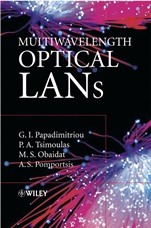
Multiwavelength Optical LANs
ISBN 9780470851081
Autor: Georgios I. Papadimitriou, Paraskevas A. Tsimoulas, Mohammed S. Obaidat, Andreas S. Pomportsis
Wydawca: Wiley
Dostępność: 3-6 tygodni
Cena: 572,25 zł
Przed złożeniem zamówienia prosimy o kontakt mailowy celem potwierdzenia ceny.
ISBN13: |
9780470851081 |
ISBN10: |
0470851082 |
Autor: |
Georgios I. Papadimitriou, Paraskevas A. Tsimoulas, Mohammed S. Obaidat, Andreas S. Pomportsis |
Oprawa: |
Hardback |
Rok Wydania: |
2003-09-26 |
Ilość stron: |
334 |
Wymiary: |
243x153 |
Tematy: |
TJ |
Optical fibre is the key transmission medium capable of serving both the ever–growing demand for bandwidth and the unceasing need for new services. In this context, Wavelength Division Multiplexing (WDM) is the most popular technique for introducing concurrency among multiple user transmissions into the network exploiting the huge amount of fibre bandwidth available. Optical WDM will develop into a viable alternative for implementing high–performance Local Areas Networks (LANs). Multiwavelength Optical LANs focuses on the application of multiwavelength optical networking within the local area.Investigates the major architectural issues in multiwavelength optical LANsDiscusses the main distinctive characteristics of multiwavelength optical LANs including the physical topology, the logical topology and the structure of network nodesConsiders the constant advances on optical component technology that make WDM optical LANs all the more feasible for wide commercial deploymentExamines the key protocol characteristics of Media–Access Control (MAC) protocols and adaptive protocols whose operation is based on network feedback information and whose overall higher performance can be compared to many other non–adaptive schemes
This valuable, up–to–date and concise reference targets students, researchers, network designers and network operators, who are interested in multiwavelength optical LANs. In addition it provides a complete and comprehensive introduction to more general aspects of optical networking, including first generation optical networks, other classes of second generation optical networks and the underlying enabling device technology.
Spis treści:
Preface.
Acknowledgements.
1. Introduction.
Advantages of Optical Fibre as a Transmission Medium.
Basic Multiplexing Techniques.
Evolution of Optical NetworkingMajor Technological Milestones.
First Generation
Optical Networks.
Second Generation Optical NetworksMain Classes.
A Closer Look at WDM Broadcast–and–Select Local Area Networks.
2. Enabling Technologies.
Introduction.
Classes of Optical Networks.
Optical Network Components.
Summary.
3. Medium Access Control Protocols.
Fixed–Assignment Protocols.
Random Access Protocols.
Pretransmission Coordination–Based Protocols.
4. Adaptive Protocols.
Adaptive TDMA Protocols.
Adaptive Random Access Protocols.
Adaptive Pretransmission Coordination Protocols.
Centralized Packet Filtering Protocols.
Index.
Okładka tylna:
Optical fibre is the key transmission medium capable of serving both the ever–growing demand for bandwidth and the unceasing need for new services. In this context, Wavelength Division Multiplexing (WDM) is the most popular technique for introducing concurrency among multiple user transmissions into the network exploiting the huge amount of fibre bandwidth available. Optical WDM will develop into a viable alternative for implementing high–performance Local Areas Networks (LANs). Multiwavelength Optical LANs focuses on the application of multiwavelength optical networking within the local area.Investigates the major architectural issues in multiwavelength optical LANsDiscusses the main distinctive characteristics of multiwavelength optical LANs including the physical topology, the logical topology and the structure of network nodesConsiders the constant advances on optical component technology that make WDM optical LANs all the more feasible for wide commercial deploymentExamines the key protocol characteristics of Media–Access Control (MAC) protocols and adaptive protocols whose operation is based on network feedback information and whose overall higher performance can be compared to many other non–adaptive schemes
This valuable, up–to–date a
nd concise reference targets students, researchers, network designers and network operators, who are interested in multiwavelength optical LANs. In addition it provides a complete and comprehensive introduction to more general aspects of optical networking, including first generation optical networks, other classes of second generation optical networks and the underlying enabling device technology.
Koszyk
Książek w koszyku: 0 szt.
Wartość zakupów: 0,00 zł
Informacje


Kontakt
Gambit
Centrum Oprogramowania
i Szkoleń Sp. z o.o.
Al. Pokoju 29b/22-24
31-564 Kraków
Siedziba Księgarni
ul. Kordylewskiego 1
31-542 Kraków
+48 12 410 5991
+48 12 410 5987
+48 12 410 5989
Subskrypcje
Administratorem danych osobowych jest firma Gambit COiS Sp. z o.o. Na podany adres będzie wysyłany wyłącznie biuletyn informacyjny.
Autoryzacja płatności

Informacje na temat autoryzacji płatności poprzez PayU.

© Copyright 2012: GAMBIT COiS Sp. z o.o. Wszelkie prawa zastrzeżone.
Projekt i wykonanie: Alchemia Studio Reklamy