


Wydawcy
Katalog tematyczny
- Archeologia (109)
- Ekonomia, finanse, business (13704)
- Filozofia (1445)
- Historia (3040)
- Języki i językoznawstwo (2356)
- Lifestyle, hobby i rozrywka (475)
- Medycyna (9704)
- Nauki humanistyczne (4)
- Nauki o Ziemi i środowisku (2638)
- Nauki ścisłe (20412)
- Nauki społeczne (8486)
- Nauki techniczne (13450)
- Prawo (1696)
- Publikacje informacyjne i interdyscyplinarne (1288)
- Religia i wierzenia (917)
- Technika komputerowa (4067)
- Zdrowie, relacje międzyludzkie i rozwój osobisty (657)





Informacje szczegółowe o książce
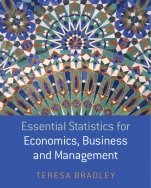
Essential Statistics for Economics, Business and Management
ISBN 9780470850794
Autor: Teresa Bradley
Wydawca: Wiley
Dostępność: 3-6 tygodni
Cena: 336,00 zł
Przed złożeniem zamówienia prosimy o kontakt mailowy celem potwierdzenia ceny.
ISBN13: |
9780470850794 |
ISBN10: |
0470850795 |
Autor: |
Teresa Bradley |
Oprawa: |
Paperback |
Rok Wydania: |
2007-04-20 |
Ilość stron: |
674 |
Wymiary: |
245x189 |
Tematy: |
KM |
Essential Statistics for Economics, Business and Management is an indispensable text for students taking an introductory undergraduate course in statistics, as well as being highly relevant for the statistics component of courses in quantitative methods.
Key Features:
Assumes no prior knowledge of statisticsEmphasis is placed on verbalising concepts, problems and results of statistical analysis, thereby helping students to learn how to start a problem, complete calculations and report results in a way that will make sense to a non–statistician.Each concept is introduced with a brief and plausible explanation followed by worked examples. The worked examples provide students with the necessary practice that they need in order to succeed at the subject.Excel and Minitab are used throughout the text to introduce students to statistical software and enhance understanding.Progress exercises on theory and applications are provided at the end of each section for students to test their knowledge.
The accessible style of the text is consistent with that of the highly successful Essential Mathematics for Economics and Business, also by Teresa Bradley and published by John Wiley & Sons, Ltd.
A comprehensive website to support the book has been produced and includes: PowerPoint slides, datasets, further worked examples, a testbank for lecturers, and additional test exercises for students.
Spis treści:
Introduction
1. Data collection and its graphical presentation.
1.1 Introduction to statistics .
1.2 Data collection, samples, surveys and experiments.
1.3 Some sources of statistical data.
1.4 Sorting and classifying data.
1.5 Bar charts and pie chart. Plotting in Excel.
1.6 Graphs: histograms and Ogives. Graphs in Excel.
1.7 Line and Lorenz graphs.
1.8<
/b> Graphical misrepresentation of data.
2. Descriptive statistics.
2.1 Summary statistics for raw data: mean, quartiles and mode.
2.2 Summary statistics for grouped data: mean, quartiles and mode.
2.3 Measures of dispersion for raw data. Variance, QD, IQR.
2.4 Measures of dispersion for grouped data. Variance, QD, IQR.
2.5 Use of calculator for descriptive statistics.
2.6 Other descriptive statistics. CV, skewness and box plots.
2.7 Descriptive statistics in Excel .
3. Regression and correlation Introduction.
3.1 Introduction to regression. Scatter plots and lines.
3.2 The least–squares line. Criteria and equation for a best fit line.
3.3 Excel: XY (Scatter) plots, least–squares line and formulae.
3.4 Coefficient of Determination and Correlation. .
3.5 Rank correlation. Calculate and interpret rank correlation.
3.6 Use the calculator for regression and correlation.
3.7 Why bother with formulae?
4. Probability .
4.1 Introduction to probability.
4.2 The multiplication and addition rules for probability.
4.3 Joint, marginal and conditional probability.
4.4 Bayes Rule.
5. Introduction Probability Distributions.
5.1 Introduction: probability distributions and random variables.
5.2 The Binomial probability distributions.
5.3 The Poisson probability distributions.
5.4 Normal probability distribution.
5.5 Expected values.
6. Sampling distributions for means and proportions.
6.1 Statistical inference and sampling distribution of the mean.
6.2 Sampling distribution for proportions for n > 30.
6.3 Some desirable properties of estimators.
7 Confidence intervals for means and proportion
s.
7.1 Confidence intervals for means.
7.2 Confidence intervals for proportions.
7.3 Precision of a confidence interval: sample size determination.
7.4 Confidence intervals for the difference between proportions.
8. Tests of hypothesis for means and proportions.
8.1 Tests of hypothesis for the population mean.
8.2 Tests of hypothesis for a population proportion.
8.3 Tests of hypothesis for difference between means and proportions.
8.4 Minitab and Excel for confidence intervals and tests of hypothesis.
9. Inference from small samples. Confidence intervals and tests of hypothesis.
9.1 Inference from small samples: Normal population, σ known. .
9.2 The Student t–distribution.
9.3 Inference from small samples: Normal population, σ not known.
9.4 Differences between means, small independent samples.
9.5 F–tests for equality of variances.
9.6 Difference between means, paired samples.
10. Analysis of variance.
10.1 The rationale behind one–way analysis of variance.
10.2 One–way Analysis of variance: The ANOVA Table .
10.3 Two–way Analysis of variance.
10.4 Observation studies and Designed experiments.
10.5 Excel and Minitab for ANOVA.
11. Chi–squared tests.
11.1 Introduction.
11.2 The χ2 probability distribution.
11.3 Contingency tables.
11.4 Tests for independence (no association).
11.5 Test for homogeneous populations.
11.6 Tests for the equality of several proportions.
11.7 Goodness of fit tests.
11.8 Use of Excel and Minitab in χ2 tests.
12. Regression analysis.
12.1 The Simple Linear Reg
ression model: description and model assumptions.
12.2 Inference about the population slope (rates of change).
12.3 Confidence intervals and prediction intervals.
12.4 Checks for the model assumptions based on residual plots.
12.5 Regression analysis in Minitab and Excel.
12.6 Multiple Regression.
Appendix A. Technicalities and Conventions for Defining Class Intervals, Mid–Interval, Widths, Limits, Boundaries.
Appendix B. Formulae for Calculating the Quartiles for Grouped Data.
Appendix C. Outline of Derivation of Formulae (3.2) and (3.3) for the Slope and Intercept of the Least–Squares Line, Y=a + bX
Appendix D. Brief Review of the Mathematics for the Binomial.
Appendix E. The Number e.
Appendix F. Calculation of Mean and Variance of Proportions by Expected Values.
Appendix G. Confidence Intervals for Means and Proportions.
Appendix H. Degrees of Freedom.
Appendix I. Notes on Summations and Double Summations.
Appendix J. Expressing the Estimates of Variance as Sums of Squares Divided by Degrees of Freedom in Their Simplest Form.
Appendix K. Sums of Squares for the One–Way ANOVA.
Appendix L. Fitted Values and Residuals.
Appendix M. Sums of Squares Identity for Two–Way ANOVA
Chapter Solutions.
Tables:
Glossary.
Index.
Okładka tylna:
Essential Statistics for Economics, Business and Management is an indispensable text for students taking an introductory undergraduate course in statistics, as well as being highly relevant for the statistics component of courses in quantitative methods.
Key Features:
Assumes no prior knowledge of statisticsEmphasis is placed on verbalising concepts, problems and results of statistical analysis, thereby helping students to learn how to start a problem, complete calculations and report results in a way that will make
Koszyk
Książek w koszyku: 0 szt.
Wartość zakupów: 0,00 zł
Informacje


Kontakt
Gambit
Centrum Oprogramowania
i Szkoleń Sp. z o.o.
Al. Pokoju 29b/22-24
31-564 Kraków
Siedziba Księgarni
ul. Kordylewskiego 1
31-542 Kraków
+48 12 410 5991
+48 12 410 5987
+48 12 410 5989
Subskrypcje
Administratorem danych osobowych jest firma Gambit COiS Sp. z o.o. Na podany adres będzie wysyłany wyłącznie biuletyn informacyjny.
Autoryzacja płatności

Informacje na temat autoryzacji płatności poprzez PayU.

© Copyright 2012: GAMBIT COiS Sp. z o.o. Wszelkie prawa zastrzeżone.
Projekt i wykonanie: Alchemia Studio Reklamy