


Wydawcy
Katalog tematyczny
- Archeologia (109)
- Ekonomia, finanse, business (13704)
- Filozofia (1445)
- Historia (3040)
- Języki i językoznawstwo (2356)
- Lifestyle, hobby i rozrywka (475)
- Medycyna (9704)
- Nauki humanistyczne (4)
- Nauki o Ziemi i środowisku (2638)
- Nauki ścisłe (20412)
- Astronomia (294)
- Biologia (5119)
- Chemia (6540)
- Chemia analityczna (361)
- Chemia fizyczna (346)
- Chemia nieorganiczna (137)
- Chemia organiczna (535)
- Krystalografia (27)
- Minerologia (46)
- Fizyka (3309)
- Matematyka (4574)
- Nauki ścisłe, ogólnie (503)
- Nauki społeczne (8486)
- Nauki techniczne (13450)
- Prawo (1696)
- Publikacje informacyjne i interdyscyplinarne (1288)
- Religia i wierzenia (917)
- Technika komputerowa (4067)
- Zdrowie, relacje międzyludzkie i rozwój osobisty (657)





Informacje szczegółowe o książce
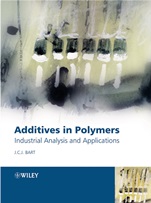
Additives in Polymers: Industrial Analysis and Applications
ISBN 9780470850626
Autor: Jan C. J. Bart
Wydawca: Wiley
Dostępność: 3-6 tygodni
Cena: 2 085,30 zł
Przed złożeniem zamówienia prosimy o kontakt mailowy celem potwierdzenia ceny.
ISBN13: |
9780470850626 |
ISBN10: |
0470850620 |
Autor: |
Jan C. J. Bart |
Oprawa: |
Hardback |
Rok Wydania: |
2005-02-04 |
Ilość stron: |
836 |
Wymiary: |
261x192 |
Tematy: |
PN |
Designed to inspire analytical chemists, polymer and material scientists, graduates and post–graduates, laboratory technicians and other practitioners working for industry, academia, government and regulatory agencies concerned with plastic products, this title provides systematic coverage of the latest instrumental methods for monitoring, deformulation and troubleshooting with an emphasis on additive analysis. The book is extensively illustrated with figures, flow diagrams and tables to facilitate a rapid understanding of this topic and the many thousands of references make this text an invaluable and up–to–date–guide.
Current analytical strategy and best practice of this highly multidisciplinary field are outlined and illustrated with key industrial applications and case studies. Detailed coverage comprises sample preparation, separation, identification, hyphenation and quantification techniques, and much, much more ……
Spis treści:
Foreword.
Preface.
About the Author.
Acknowledgements.
Chapter 1: Introduction.
1.1 Additives.
1.2 Plastics formulations .
1.3 Economic impact of polymer additives.
1.4 Analysis of plastics.
1.5 Bibliography.
1.6 References.
Chapter 2: Deformulation Principles.
2.1 Polymer identification.
2.2 Additive analysis of rubbers: ‘Best Practice’.
2.3 Polymer extract analysis.
2.4 In situ polymer/additive analysis.
2.5 Class–specific polymer/additive analysis.
2.6 Bibliography.
2.7 References.
Chapter 3: Sample Preparation Perspectives.
3.1 Solvents.
3.2 Extraction strategy.
3.3 Conventional extraction technologies.
3.4 High–pressure solvent extraction methods
.
3.5 Sorbent extraction.
3.6 Methodological comparison of extraction methods.
3.7 Polymer/additive dissolution methods.
3.8 Hydrolysis.
3.9 Bibliography.
3.10 References.
Chapter 4: Separation Techniques.
4.1 Analytical detectors.
4.2 Gas chromatography.
4.3 Supercritical fluid chromatography.
4.4 Liquid chromatography techniques.
4.5 Capillary electrophoretic techniques.
4.6 Bibliography.
4.7 References.
Chapter 5: Polymer/Additive Analysis: The Spectroscopic Alternative.
5.1 Ultraviolet/visible spectrophotometry.
5.2 Infrared spectroscopy.
5.3 Luminescence spectroscopy.
5.4 High–resolution nuclear magnetic resonance spectroscopy.
5.5 Bibliography.
5.6 References.
Chapter 6: Organic Mass–Spectrometric Methods.
6.1 Basic instrumentation.
6.2 Ion sources.
6.3 Mass analysers.
6.4 Direct mass–spectrometric polymer compound analysis.
6.5 Ion mobility spectrometry.
6.6 Bibliography.
6.7 References.
Chapter 7: Multihyphenation and Multidimensionality in Polymer/Additive Analysis.
7.1 Precolumn hyphenation.
7.2 Coupled sample preparation – spectroscopy/spectrometry.
7.3 Postcolumn hyphenation.
7.4 Multidimensional chromatography.
7.5 Multidimensional spectroscopy.
7.6 Bibliography.
7.7 References.
Chapter 8: Inorganic and Element Analytical Methods.
8.1 Element analytical protocols.
8.2 Sample destruction for classical elemental analysis.
8.3 Analytical atomic spectrometry.
8.4 X–ray spectrometry.
8.5 Inorgani
c mass spectrometry.
8.6 Radioanalytical and nuclear analytical methods.
8.7 Electroanalytical techniques.
8.8 Solid–state speciation analysis.
8.9 Bibliography.
8.10 References.
Chapter 9: Direct Methods of Deformulation of Polymer/Additive Dissolutions.
9.1 Chromatographic methods.
9.2 Spectroscopic techniques.
9.3 Mass–spectrometric methods.
9.4 References.
Chapter 10: A Vision for the Future.
10.1 Trends in polymer technology.
10.2 Trends in additive technology.
10.3 Environmental, legislative and regulatory constraints.
10.4 Analytical consequences.
10.5 Epilogue.
10.6 Bibliography.
10.7 References.
Appendix I: List of Symbols.
Appendix II: Functionality of Common Additives Used in Commercial Thermoplastics, Rubbers and Thermosetting Resins.
Appendix III: Specimen Polymer Additives Product Sheets.
Index.
Nota biograficzna:
Jan C.J. Bart (PhD Structural Chemistry, University of Amsterdam) is a senior scientist with broad interest in materials characterisation, heterogeneous catalysis and product development who spent an industrial carrier in R&D with Monsanto, Montedison and DSM Research in various countries. The author has held several teaching assignments and researched extensively in both academic and industrial areas; he authored over 250 scientific papers, including chapters in books. Dr Bart has acted as a Ramsay Memorial Fellow at the Universities of Leeds (Colour Chemistry) and Oxford (Material Science), a visiting scientist at Institut de Recherches sur la Catalyse (CNRS, Villeurbanne), and a Meyerhoff Visiting Professor at WIS (Rehovoth), and held an Invited Professorship at USTC (Hefei). He is currently a Full Professor of Industrial Chemistry at the University of
Messina.
He is also a member of the Royal Society of Chemistry, Royal Dutch Chemical Society, Society of Plastic Engineers and The Institute of Materials.
Okładka tylna:
Designed to inspire analytical chemists, polymer and material scientists, graduates and post–graduates, laboratory technicians and other practitioners working for industry, academia, government and regulatory agencies concerned with plastic products, this title provides systematic coverage of the latest instrumental methods for monitoring, deformulation and troubleshooting with an emphasis on additive analysis. The book is extensively illustrated with figures, flow diagrams and tables to facilitate a rapid understanding of this topic and the many thousands of references make this text an invaluable and up–to–date–guide.
Current analytical strategy and best practice of this highly multidisciplinary field are outlined and illustrated with key industrial applications and case studies. Detailed coverage comprises sample preparation, separation, identification, hyphenation and quantification techniques, and much, much more ……
Koszyk
Książek w koszyku: 0 szt.
Wartość zakupów: 0,00 zł
Informacje


Kontakt
Gambit
Centrum Oprogramowania
i Szkoleń Sp. z o.o.
Al. Pokoju 29b/22-24
31-564 Kraków
Siedziba Księgarni
ul. Kordylewskiego 1
31-542 Kraków
+48 12 410 5991
+48 12 410 5987
+48 12 410 5989
Subskrypcje
Administratorem danych osobowych jest firma Gambit COiS Sp. z o.o. Na podany adres będzie wysyłany wyłącznie biuletyn informacyjny.
Autoryzacja płatności

Informacje na temat autoryzacji płatności poprzez PayU.

© Copyright 2012: GAMBIT COiS Sp. z o.o. Wszelkie prawa zastrzeżone.
Projekt i wykonanie: Alchemia Studio Reklamy