


Wydawcy
Katalog tematyczny
- Archeologia (109)
- Ekonomia, finanse, business (13704)
- Filozofia (1445)
- Historia (3040)
- Języki i językoznawstwo (2356)
- Lifestyle, hobby i rozrywka (475)
- Medycyna (9704)
- Nauki humanistyczne (4)
- Nauki o Ziemi i środowisku (2638)
- Nauki ścisłe (20412)
- Nauki społeczne (8486)
- Nauki techniczne (13450)
- Budownictwo lądowe (1045)
- Chemia przemysłowa (2258)
- Elektronika i telekomunikacja (3287)
- Energetyka (1122)
- Inne nauki stosowane (363)
- Inżynieria biochemiczna (507)
- Inżynieria transportu (232)
- Mechanika i materiały (3316)
- Nauka o środowisku (321)
- Rolnictwo (507)
- Technika, ogólnie (475)
- Prawo (1696)
- Publikacje informacyjne i interdyscyplinarne (1288)
- Religia i wierzenia (917)
- Technika komputerowa (4067)
- Zdrowie, relacje międzyludzkie i rozwój osobisty (657)





Informacje szczegółowe o książce
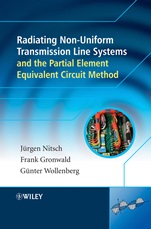
Radiating Nonuniform Transmission–Line Systems and the Partial Element Equivalent Circuit Method
ISBN 9780470845363
Autor: Prof. Dr. Juergen Nitsch, Dr. Frank Gronwald, Prof. Dr. Gunter Wollenberg
Wydawca: Wiley
Dostępność: 3-6 tygodni
Cena: 589,05 zł
Przed złożeniem zamówienia prosimy o kontakt mailowy celem potwierdzenia ceny.
ISBN13: |
9780470845363 |
ISBN10: |
0470845368 |
Autor: |
Prof. Dr. Juergen Nitsch, Dr. Frank Gronwald, Prof. Dr. Gunter Wollenberg |
Oprawa: |
Hardback |
Rok Wydania: |
2009-10-27 |
Ilość stron: |
348 |
Wymiary: |
252x175 |
Tematy: |
TJ |
High frequencies of densely packed modern electronic equipment turn even the smallest piece of wire into a transmission line with signal retardation, dispersion, attenuation, and distortion. In electromagnetic environments with high–power microwave or ultra–wideband sources, transmission lines pick up noise currents generated by external electromagnetic fields. These are superimposed on essential signals, the lines acting not only as receiving antennas but radiating parts of the signal energy into the environment.
This book is outstanding in its originality. While many textbooks rephrase that which has been written before, this book features:
an accessible introduction to the fundamentals of electromagnetics;an explanation of the newest developments in transmission line theory, featuring the transmission line super theory developed by the authors;a unique exposition of the increasingly popular PEEC (partial element equivalent circuit) method, including recent research results.
Both the Transmission Line Theory and the PEEC method are well suited to combine linear structures with circuit networks.
For engineers, researchers, and graduate students, this text broadens insight into the basics of electrical engineering. It provides a deeper understanding of Maxwellian–circuit–like representations of multi–conductor transmission lines, justifies future research in this field.
Spis treści:
Preface.
References.
Acknowledgments.
List of Symbols.
Introduction.
1 Fundamentals of Electrodynamics.
1.1 Maxwell Equations Derived from Conservation Laws – an Axiomatic Approach.
1.2 The Electromagnetic Field as a Gauge Field – a Gauge Field Approach.
1.3 The Relation Between the Axiomatic Approach and the Gauge Field Approach.
1.4 Solutions of Maxwell Equations.
1.5 Boundary Value Problems and Integral Equations.
References.
2 Nonuniform Transmission–Line Systems.
2.1 Multiconductor Transmission Lines: General Equations.
2.2 General Calculation Methods for the Product Integral/Matrizant.
2.3 Semi–Analytic and Numerical Solutions for Selected Transmission Lines in the TLST.
2.4 Analytic Approaches.
References.
3 Complex Systems and Electromagnetic Topology.
3.1 The Concept of Electromagnetic Topology.
3.2 Topological Networks and BLT Equations.
3.3 Transmission Lines and Topological Networks.
3.4 Shielding.
References.
4 The Method of Partial Element Equivalent Circuits (PEEC Method).
4.1 Fundamental Equations.
4.2 Derivation of the Generalized PEEC Method in the Frequency Domain.
4.3 Classification of PEEC Models.
4.4 PEEC Models for the Plane Half Space.
4.5 Geometrical Discretization in PEEC Modeling.
4.6 PEEC Models for the Time Domain and the Stability Issue.
4.7 Skin Effect in PEEC Models.
4.8 PEEC Models Based on Dyadic Green’s Functions for Conducting Structures in Layered Media.
4.9 PEEC Models and Uniform Transmission Lines.
4.10 Power Considerations in PEEC Models.
References.
Appendix A: Tensor Analysis, Integration and Lie Derivative.
A.1 Integration Over a Curve and Covariant Vectors as Line Integrands.
A.2 Integration Over a Surface and Contravariant Vector Densities as Surface Integrands.
A.3 Integration Over a Volume and Scalar Densities as Volume Integrands.
A.4 Poincaré Lemma.
A.5 Stokes’ Theorem.
A.6 Lie Derivative.
References.
Appendix B: Elements of Functional Analysis.
B.1 Function Spaces.
B.2 Linear Operators.
B.3 Spectrum of a Linear Operator.
B.4 Spectral Expansions and Representations.
References.
Appendix C: Some Formulas of Vector and Dyadic Calculus.
C.1 Vector Identities.
C.2 Dyadic Identities.
C.3 Integral Identities.
Reference.
Appendix
D: Adaption of the Integral Equations to the Conductor Geometry.
Appendix E: The Product Integral/Matrizant.
E.1 The Differential Equation and Its Solution.
E.2 The Determination of the Product Integral.
E.3 Inverse Operation.
E.4 Calculation Rules for the Product Integral.
References.
Appendix F: Solutions for Some Important Integrals.
F.1 Integrals Involving Powers of √x2 + b2.
F.2 Integrals Involving Exponential and Power Functions.
F.3 Integrals Involving Trigonometric and Exponential Functions.
Reference.
Index.
Okładka tylna:
High frequencies of densely packed modern electronic equipment turn even the smallest piece of wire into a transmission line with signal retardation, dispersion, attenuation, and distortion. In electromagnetic environments with high–power microwave or ultra–wideband sources, transmission lines pick up noise currents generated by external electromagnetic fields. These are superimposed on essential signals, the lines acting not only as receiving antennas but radiating parts of the signal energy into the environment.
This book is outstanding in its originality. While many textbooks rephrase that which has been written before, this book features:
an accessible introduction to the fundamentals of electromagnetics;an explanation of the newest developments in transmission line theory, featuring the transmission line super theory developed by the authors;a unique exposition of the increasingly popular PEEC (partial element equivalent circuit) method, including recent research results.
Both the Transmission Line Theory and the PEEC method are well suited to combine linear structures with circuit networks.
For engineers, researchers, and graduate students, this text broadens insight into the basics of electrical engineering. It provides a deeper understanding of Maxwellian–circuit–like representa
tions of multi–conductor transmission lines, justifies future research in this field.
Koszyk
Książek w koszyku: 0 szt.
Wartość zakupów: 0,00 zł
Informacje


Kontakt
Gambit
Centrum Oprogramowania
i Szkoleń Sp. z o.o.
Al. Pokoju 29b/22-24
31-564 Kraków
Siedziba Księgarni
ul. Kordylewskiego 1
31-542 Kraków
+48 12 410 5991
+48 12 410 5987
+48 12 410 5989
Subskrypcje
Administratorem danych osobowych jest firma Gambit COiS Sp. z o.o. Na podany adres będzie wysyłany wyłącznie biuletyn informacyjny.
Autoryzacja płatności

Informacje na temat autoryzacji płatności poprzez PayU.

© Copyright 2012: GAMBIT COiS Sp. z o.o. Wszelkie prawa zastrzeżone.
Projekt i wykonanie: Alchemia Studio Reklamy