


Wydawcy
Katalog tematyczny
- Archeologia (109)
- Ekonomia, finanse, business (13704)
- Filozofia (1445)
- Historia (3040)
- Języki i językoznawstwo (2356)
- Lifestyle, hobby i rozrywka (475)
- Medycyna (9704)
- Nauki humanistyczne (4)
- Nauki o Ziemi i środowisku (2638)
- Geografia (299)
- Nauki o Ziemi (1661)
- Geologia (414)
- Hydrologia (237)
- Meteorologia i klimatologia (114)
- Paleontologia (33)
- Wulkanologia i sejsmologia (44)
- Planowanie przestrzenne (53)
- Środowisko (607)
- Nauki ścisłe (20412)
- Nauki społeczne (8486)
- Nauki techniczne (13450)
- Prawo (1696)
- Publikacje informacyjne i interdyscyplinarne (1288)
- Religia i wierzenia (917)
- Technika komputerowa (4067)
- Zdrowie, relacje międzyludzkie i rozwój osobisty (657)





Informacje szczegółowe o książce
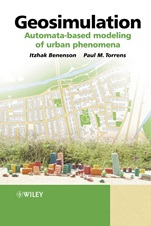
Geosimulation: Automata–based modeling of urban phenomena
ISBN 9780470843499
Autor: Itzhak Benenson, Paul Torrens
Wydawca: Wiley
Dostępność: 3-6 tygodni
Cena: 457,80 zł
Przed złożeniem zamówienia prosimy o kontakt mailowy celem potwierdzenia ceny.
ISBN13: |
9780470843499 |
ISBN10: |
0470843497 |
Autor: |
Itzhak Benenson, Paul Torrens |
Oprawa: |
Hardback |
Rok Wydania: |
2004-07-16 |
Ilość stron: |
312 |
Wymiary: |
252x177 |
Tematy: |
RB |
′Geosimulation′ is a rapidly developing area in geography. Merging GIS, complex systems theory and the latest developments in computer science, it revolutionizes the way in which we think about and model real world complex systems.
Applicable across a wide variety of disciplines, Geosimulation: automata–based modelling of urban phenomena details some of the most exciting developments in the emerging field of geosimulation. Primarily concerned with developing realistic representations of geographic systems and simulating processes within a computing environment, the emphasis lies in the latest research and development using cellular automata and multi–agent systems.Details the current state–of–the–art in advanced urban simulationProvides the most extensive and thorough investigation into a new and rapidly developing fieldHas a strong applied focus, with examples from urban studies, city and regional planning, environmental science, political science, sociology, biology, chemistry and physicsPresents the reader with a sound theoretical basis of the science of geosimulation, along with applied material on the construction of geosimulation modelsApplications, examples and working code available from an associated Website providing readers with the tools to carry out their own modelling and testingGeosimulation: automata–based modelling of urban phenomena is essential reading for postgraduates and academic researchers interested in GIS, spatial science, urban modelling, quantitative geography and computer science. It will be useful supplementary reading for Masters and upper level undergraduate students of geocomputation, GIS, remote sensing and spatial information science. It is also key reading for local government and public policy groups in urban planning.
Spis treści:
Preface.
Acknowledgements.
Foreword.
1. Introductio
n to urban Geosimulation.
1.1 A new wave of urban geographic models is coming.
1.2 Defining urban Geosimulation.
1.3 Automata as a basis of Geosimulation.
1.4 High–resolution GIS as a driving force of Geosimulation.
1.5 The origins of support for Geosimulation.
1.6 Geosimulation of complex adaptive systems.
1.7 Book layout.
2. Formalizing Geosimulation with Geographic Automata Systems (GAS).
2.1 Cellular Automata and Multi–Agent Systems – Unite!
2.2 Geographic Automata Systems (GAS).
2.3 GAS as a tool for modelling Complex Adaptive Systems.
2.4 From Gas to software environment for urban modelling.
2.5 Object Based Environment for Urban Simulation (OBEUS) – a minimal implementation of GAS.
2.6 Universality of GAS.
2.7 Verifying GAS models.
3. System Theory, Geography, and Urban Modelling.
3.1 The basic notions of system theory.
3.2 The 1960s, geography meets system theory.
3.3 ‘Stocks and flows’ urban modelling.
3.4 Critics of comprehensive modelling.
3.5 What next? Geosimulation of collective dynamics!
4. Modelling urban land usage with cellular automata.
4.1 Introduction.
4.2 Cellular Automata as a framework for modelling complex spatial systems.
4.3 Urban Cellular Automata.
4.4 From Markov models to urban Cellular Automata.
4.5 Integration of the CA and Markov approaches at a regional level.
4.6 Conclusions.
5. Modelling Urban Dynamics with Multi–Agent Systems.
5.1 Introduction.
5.2 MAS as a tool for modelling complex human–driven systems.
5.3 Interpreting agency.
5.4 Urban agents, urban agency, and multi–agent cities.
5.5 Agent behaviour in urban environments.
5.6 General models of agents’ collectives in urban interpretation.
5.7 Abstract MAS models of urban phenomena.
5.8 Real–world agent–based simulations of urban phenomena.
5.9 MAS models as pla
nning and assessment tools.
5.10 Conclusions.
6. Finale: Epistemology of Geosimulation.
6.1 Universal questions.
6.2 The future of Geosimulation.
Bibliography.
Index.
Okładka tylna:
′Geosimulation′ is a rapidly developing area in geography. Merging GIS, complex systems theory and the latest developments in computer science, it revolutionizes the way in which we think about and model real world complex systems.
Applicable across a wide variety of disciplines, Geosimulation: automata–based modelling of urban phenomena details some of the most exciting developments in the emerging field of geosimulation. Primarily concerned with developing realistic representations of geographic systems and simulating processes within a computing environment, the emphasis lies in the latest research and development using cellular automata and multi–agent systems.Details the current state–of–the–art in advanced urban simulationProvides the most extensive and thorough investigation into a new and rapidly developing fieldHas a strong applied focus, with examples from urban studies, city and regional planning, environmental science, political science, sociology, biology, chemistry and physicsPresents the reader with a sound theoretical basis of the science of geosimulation, along with applied material on the construction of geosimulation modelsApplications, examples and working code available from an associated Website providing readers with the tools to carry out their own modelling and testingGeosimulation: automata–based modelling of urban phenomena is essential reading for postgraduates and academic researchers interested in GIS, spatial science, urban modelling, quantitative geography and computer science. It will be useful supplementary reading for Masters and upper level undergraduate students of geocomputation, GIS, remote sensi
ng and spatial information science. It is also key reading for local government and public policy groups in urban planning.
Koszyk
Książek w koszyku: 0 szt.
Wartość zakupów: 0,00 zł
Informacje


Kontakt
Gambit
Centrum Oprogramowania
i Szkoleń Sp. z o.o.
Al. Pokoju 29b/22-24
31-564 Kraków
Siedziba Księgarni
ul. Kordylewskiego 1
31-542 Kraków
+48 12 410 5991
+48 12 410 5987
+48 12 410 5989
Subskrypcje
Administratorem danych osobowych jest firma Gambit COiS Sp. z o.o. Na podany adres będzie wysyłany wyłącznie biuletyn informacyjny.
Autoryzacja płatności

Informacje na temat autoryzacji płatności poprzez PayU.

© Copyright 2012: GAMBIT COiS Sp. z o.o. Wszelkie prawa zastrzeżone.
Projekt i wykonanie: Alchemia Studio Reklamy