


Wydawcy
Katalog tematyczny
- Archeologia (109)
- Ekonomia, finanse, business (13704)
- Filozofia (1445)
- Historia (3040)
- Języki i językoznawstwo (2356)
- Lifestyle, hobby i rozrywka (475)
- Medycyna (9704)
- Nauki humanistyczne (4)
- Nauki o Ziemi i środowisku (2638)
- Nauki ścisłe (20412)
- Nauki społeczne (8486)
- Nauki techniczne (13450)
- Budownictwo lądowe (1045)
- Chemia przemysłowa (2258)
- Elektronika i telekomunikacja (3287)
- Energetyka (1122)
- Inne nauki stosowane (363)
- Inżynieria biochemiczna (507)
- Inżynieria transportu (232)
- Mechanika i materiały (3316)
- Nauka o środowisku (321)
- Rolnictwo (507)
- Technika, ogólnie (475)
- Prawo (1696)
- Publikacje informacyjne i interdyscyplinarne (1288)
- Religia i wierzenia (917)
- Technika komputerowa (4067)
- Zdrowie, relacje międzyludzkie i rozwój osobisty (657)





Informacje szczegółowe o książce
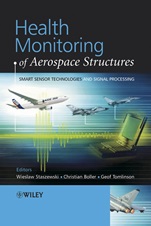
Health Monitoring of Aerospace Structures: Smart Sensor Technologies and Signal Processing
ISBN 9780470843406
Autor: Wieslaw Staszewski, C. Boller, G. R. Tomlinson
Wydawca: Wiley
Dostępność: 3-6 tygodni
Cena: 614,25 zł
Przed złożeniem zamówienia prosimy o kontakt mailowy celem potwierdzenia ceny.
ISBN13: |
9780470843406 |
ISBN10: |
0470843403 |
Autor: |
Wieslaw Staszewski, C. Boller, G. R. Tomlinson |
Oprawa: |
Hardback |
Rok Wydania: |
2003-12-19 |
Ilość stron: |
288 |
Wymiary: |
262x179 |
Tematy: |
TG |
Aerospace structures are currently inspected using traditional non–destructive techniques. However, in recent years the application of a range of different technologies and sensing techniques have advanced damage detection in metallic and composite materials. New developments are capable of allowing continuous monitoring as well as integrated and on–line damage detection systems for aircraft maintenance. These technologies are attractive to manufacturers and operators of civil and military aircraft for their reduced life cycle costs, reduced inspection/maintenance effort, improved high rate operator availability, extended life of structures and improved safety. These factors all lead to more efficient aircraft.
Written by industrial and academic experts in the field, this book brings together recent developments in sensor technologies, damage detection techniques and signal processing procedures for health and usage monitoring of aerospace structures.
Health Monitoring of Aerospace Structure:Is the first book fully dedicated to health monitoring of aerospace structures usi ng recent advancements in smart sensor technologies and signal processing.Discusses how new technologies need to be developed for efficient and reliable damage monitoring systems in aircraft.Demonstrates the feasibility of smart technologies for health and usage monitoring of aerospace structures.Covers numerous aspects related to end–user requirements, specifications and design parameters.Presents real case studies and applications including in–flight tests.
A truly multidisciplinary book, Health Monitoring of Aerospace Structures is essential reading for academic and industrial researchers, post–graduate students, aircraft designers, manufacturers, end–users and maintenance providers. This book will also appeal to many working on structural health monitoring and smart structures in other fields such as civil
engineering and ground and sea transportation.
Spis treści:
List of Contributors.
Preface.
1. Introduction (G. Bartelds, J.H. Heida, J. McFeat and C. Boller).
1.1 Health and Usage Monitoring in Aircraft Structures – Why and How?
1.2 Smart Solution in Aircraft Monitoring.
1.3 End–User Requirements.
1.3.1 Damage Detection.
1.3.2 Load History Monitoring.
1.4 Assessment of Monitoring Technologies.
1.5 Background of Technology Qualification Process.
1.6 Technology Qualification.
1.6.1 Philosophy.
1.6.2 Performance and Operating Requirements.
1.6.3 Qualification Evidence – Requirements and Provision.
1.6.4 Risks.
1.7 Flight Vehicle Certification.
1.8 Summary.
References.
2. Aircraft Structural Health and Usage Monitoring (C. Boller and W.J. Staszewski).
2.1 Introduction.
2.2 Aircraft Structural Damage.
2.3 Ageing Aircraft Problem.
2.4 LifeCycle Cost of Aerospace Structures.
2.4.1 Background.
2.4.2 Example.
2.5 Aircraft Structural Design.
2.5.1 Background.
2.5.2 Aircraft Design Process.
2.6 Damage Monitoring Systems in Aircraft.
2.6.1 Loads Monitoring.
2.6.2 Fatigue Monitoring.
2.6.3 Load Models.
2.6.4 Disadvantages of Current Loads Monitoring Systems.
2.6.5 Damage Monitoring and Inspections.
2.7 Non–Destructive Testing.
2.7.1 Visual Inspection.
2.7.2 Ultrasonic Inspection.
2.7.3 Eddy Current.
2.7.4 Acoustic Emission.
2.7.5 Radiography, Thermography and Shearography.
2.7.6 Summary.
2.8 Structural Health Monitoring.
2.8.1 Vibration and Modal Analysis.
2.8.2 Impact Damage Detection.
2.9 Emerging Monitoring Techniques and Sensor Technologies.
2.9.1 Smart Structures and Materials.
2.9.2 Damage Detection Techniques.
2.9.3 Sensor Technologies.
2.9.4 Intelligent Signal Processing.
2.10 Conclusions.
References.
3. Operational Load Monitoring Using Optic
al Fibre Sensors (P. Foote, M. Breidne, K. Levin, P. Papadopolous, I. Read, M. Signorazzi, L.K. Nilsson, R. Stubbe and A. Claesson).
3.1 Introduction.
3.2 Fibre Optics.
3.2.1 Optical Fibres.
3.2.2 Optical Fibre Sensors.
3.2.3 Fibre Bragg Grating Sensors.
3.3 Sensor Target Specifications.
3.4 Reliability of Fibre Bragg Grating Sensors.
3.4.1 Fibre Strength Degradation.
3.4.2 Grating Decay.
3.4.3 Summary.
3.5 Fibre Coating Technology.
3.5.1 Polyimide Chemistry and Processing.
3.5.2 Polyimide Adhesion to Silica.
3.5.3 Silane Adhesion Promoters.
3.5.4 Experimental Example.
3.5.5 Summary.
3.6 Example of Surface Mounted Operational Load Monitoring Sensor System.
3.6.1 Sensors.
3.6.2 Optical Signal Processor.
3.6.3 Optical Interconnections.
3.7 Optical Fibre Strain Rosette.
3.8 Example of Embedded Optical Impact Detection System.
3.9 Summary.
References.
4. Damage Detection Using Stress and Ultrasonic Waves (W.J. Staszewski, C. Boller, S. Grondel, C. Biemans, E. O’Brien, C. Delebarre and G.R. Tomlinson).
4.1 Introduction.
4.2 Acoustic Emission.
4.2.1 Background.
4.2.2 Transducers.
4.2.3 Signal Processing.
4.2.4 Testing and Calibration.
4.3 Ultrasonics.
4.3.1 Background.
4.3.2 Inspection Modes.
4.3.3 Transducers.
4.3.4 Display Modes.
4.4 Acousto–Ultrasonics.
4.5 Guided Wave Ultrasonics.
4.5.1 Background.
4.5.2 Guided Waves.
4.5.3 Lamb Waves.
4.5.4 Monitoring Strategy.
4.6 Piezoelectric Transducers.
4.6.1 Piezoelectricity and Piezoelectric Materials.
4.6.2 Constitutive Equations.
4.6.3 Properties.
4.7 Passive Damage Detection Examples.
4.7.1 Crack Monitoring Using Acoustic Emission.
4.7.2 Impact Damage Detection in Composite Materials.
4.8 Active Damage Detection Examples.
4.8.1 Crack Monitoring in Metallic Structures Using Broadband Acousto–Ultrasonics.
4.8.2 Impact Damage Detection in Compo
site Structures Using Lamb Waves.
4.9 Summary.
References.
5. Signal Processing for Damage Detection (W.J. Staszewski and K. Worden).
5.1 Introduction.
5.2 Data Pre–Processing.
5.2.1 Signal Smoothing.
5.2.2 Signal Smoothing Filters.
5.3 Signal Features for Damage Identification.
5.3.1 Feature Extraction.
5.3.2 Feature Selection.
5.4 Time–Domain Analysis.
5.5 Spectral Analysis.
5.6 Instantaneous Phase and Frequency.
5.7 Time–Frequency Analysis.
5.8 Wavelet Analysis.
5.8.1 Continuous Wavelet Transform.
5.8.2 Discrete Wavelet Transform.
5.9 Dimensionality Reduction Using Linear and Nonlinear Transformation.
5.9.1 Principal Component Analysis.
5.9.2 Sammon Mapping.
5.10 Data Compression Using Wavelets.
5.11 Wavelet–Based Denoising.
5.12 Pattern Recognition for Damage Identification.
5.13 Artificial Neural Networks.
5.13.1 Parallel Processing Paradigm.
5.13.2 The Artificial Neuron.
5.13.3 Multi–Layer Networks.
5.13.4 Multi–Layer Perceptron Neural Networks and Others.
5.13.5 Applications.
5.14 Impact Detection in Structures Using Pattern Recognition.
5.14.1 Detection of Impact Positions.
5.14.2 Detection of Impact Energy.
5.15 Data Fusion.
5.16 Optimised Sensor Distributions.
5.16.1 Informativeness of Sensors.
5.16.2 Optimal Sensor Location.
5.17 Sensor Validation.
5.18 Conclusions.
References.
6. Structural Health Monitoring Evaluation Tests (P.A. Lloyd, R. Pressland, J. McFeat, I. Read, P. Foote, J.P. Dupuis, E. O’Brien, L. Reithler, S. Grondel, C. Delebarre, K. Levin, C. Boller, C. Biemans and W.J. Staszewski).
6.1 Introduction.
6.2 Large–Scale Metallic Evaluator.
6.2.1 Lamb Wave Results from Riveted Metallic Specimens.
6.2.2 Acoustic Emission Results from a Full–Scale Fatigue Test.
6.3 Large–Scale Composite Evaluator.
6.3.1 Test Article.
6.3.2 Sensor and S
pecimen Integration.
6.3.3 Impact Tests.
6.3.4 Damage Detection Results – Distributed Optical Fibre Sensors.
6.3.5 Damage Detection Results – Bragg Grating Sensors.
6.3.6 Lamb Wave Damage Detection System.
6.4 Flight Tests.
6.4.1 Flying Test–Bed.
6.4.2 Acoustic Emission Optical Damage Detection System.
6.4.3 Bragg Grating Optical Load Measurement System.
6.4.4 Fibre Optic Load Measurement Rosette System.
6.5 Summary.
References.
Index.
Okładka tylna:
Aerospace structures are currently inspected using traditional non–destructive techniques. However, in recent years the application of a range of different technologies and sensing techniques have advanced damage detection in metallic and composite materials. New developments are capable of allowing continuous monitoring as well as integrated and on–line damage detection systems for aircraft maintenance. These technologies are attractive to manufacturers and operators of civil and military aircraft for their reduced life cycle costs, reduced inspection/maintenance effort, improved high rate operator availability, extended life of structures and improved safety. These factors all lead to more efficient aircraft.
Written by industrial and academic experts in the field, this book brings together recent developments in sensor technologies, damage detection techniques and signal processing procedures for health and usage monitoring of aerospace structures.
Health Monitoring of Aerospace Structure:Is the first book fully dedicated to health monitoring of aerospace structures usi ng recent advancements in smart sensor technologies and signal processing.Discusses how new technologies need to be developed for efficient and reliable damage monitoring systems in aircraft.Demonstrates the feasibility of smart technologies for health and usage monitoring of aerospace structures.Covers numerous aspects rela
ted to end–user requirements, specifications and design parameters.Presents real case studies and applications including in–flight tests.
A truly multidisciplinary book, Health Monitoring of Aerospace Structures is essential reading for academic and industrial researchers, post–graduate students, aircraft designers, manufacturers, end–users and maintenance providers. This book will also appeal to many working on structural health monitoring and smart structures in other fields such as civil engineering and ground and sea transportation.
Koszyk
Książek w koszyku: 0 szt.
Wartość zakupów: 0,00 zł
Informacje


Kontakt
Gambit
Centrum Oprogramowania
i Szkoleń Sp. z o.o.
Al. Pokoju 29b/22-24
31-564 Kraków
Siedziba Księgarni
ul. Kordylewskiego 1
31-542 Kraków
+48 12 410 5991
+48 12 410 5987
+48 12 410 5989
Subskrypcje
Administratorem danych osobowych jest firma Gambit COiS Sp. z o.o. Na podany adres będzie wysyłany wyłącznie biuletyn informacyjny.
Autoryzacja płatności

Informacje na temat autoryzacji płatności poprzez PayU.

© Copyright 2012: GAMBIT COiS Sp. z o.o. Wszelkie prawa zastrzeżone.
Projekt i wykonanie: Alchemia Studio Reklamy