


Wydawcy
Katalog tematyczny
- Archeologia (109)
- Ekonomia, finanse, business (13704)
- Filozofia (1445)
- Historia (3040)
- Języki i językoznawstwo (2356)
- Lifestyle, hobby i rozrywka (475)
- Medycyna (9704)
- Nauki humanistyczne (4)
- Nauki o Ziemi i środowisku (2638)
- Nauki ścisłe (20412)
- Nauki społeczne (8486)
- Edukacja (229)
- Kryminologia, opieka spełeczna (284)
- Obronność (10)
- Polityka (1389)
- Psychologia (777)
- Socjologia (410)
- Społeczeństwo i kultura (187)
- Nauki techniczne (13450)
- Prawo (1696)
- Publikacje informacyjne i interdyscyplinarne (1288)
- Religia i wierzenia (917)
- Technika komputerowa (4067)
- Zdrowie, relacje międzyludzkie i rozwój osobisty (657)





Informacje szczegółowe o książce
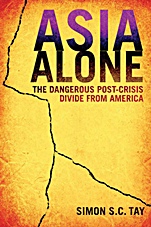
Asia Alone: The Dangerous Post–Crisis Divide from America
ISBN 9780470825822
Autor: Simon S. C. Tay
Wydawca: Wiley
Dostępność: 3-6 tygodni
Cena: 168,00 zł
Przed złożeniem zamówienia prosimy o kontakt mailowy celem potwierdzenia ceny.
ISBN13: |
9780470825822 |
ISBN10: |
0470825820 |
Autor: |
Simon S. C. Tay |
Oprawa: |
Paperback |
Rok Wydania: |
2010-07-06 |
Ilość stron: |
228 |
Wymiary: |
227x153 |
Tematy: |
JPS |
The geopolitics of Asia will play an increasingly central role in global affairs. Simon Tay is one the most intelligent and reliable guides to the region.
Fareed Zakaria
Editor, Newsweek International; Host of CNN′s Fareed Zakaria GPS
In this thoughtful book, Simon Tay, a distinguished Singaporean, argues that the relationship between Asia and the United States must become more equal. The United States must change and so, too, must Asia: the former must eschew past hubris and present isolationism, while the latter must overcome present hubris and past divisions. I found Asia Alone to be thought–provoking.
Martin Wolf
Associate Editor and Chief Economics Commentator, The Financial Times
Nowhere are the changes taking place in the world more evident than in Asia, where the United States has vital security interests and faces a rising China. Simon Tay′s stimulating book expertly frames the issues in ways that will be helpful to policy makers and informed readers alike.
J. Stapleton Roy
U.S. Ambassador to Singapore (1984–86), China (1991–95) and Indonesia (1996–99)
Director, Kissinger Institute on China and the United States
Asia Alone is a welcome addition to the growing literature on Asia′s rise and America′s decline as it uniquely makes a strong case for a new form of partnership among Asian countries and the US. Tay is not only a clear thinker, but also a lucid writer who makes complex trends highly readable.
Vishaka Desai
President, Asia Society (New York)
Tay′s thoughtful analysis and unique perspective make this book a necessary read for anyone studying or interested in the relationship between Asia and the United States. I highly recommend this book for those searching for greater understanding of regional dynamics and the changing nature of relations between Asia and the U.S.
Han Sung–Joo
Foreign Minister of the Republic of Korea (1993–94)
Ambassador to the United States (2003–05)
In his wonderfully–written new book Asia Alone, Simon Tay captures the essence of America′s Asia challenge—a United States that stands outside Asia, while the region increasingly looks within for its future. While Tay′s book is bound to become an essential read for every Asia hand, it will be equally compelling to anyone interested in how America can thrive as a global power in the twenty–first century.
Elizabeth Economy
C.V. Starr Senior Fellow and Director for Asia Studies, Council on Foreign Relations
There is no better–informed or more nuanced observer of the great Pacific relationship than Simon Tay. In Asia Alone, Tay shares the perspective gained from his many years of observation and involvement at the highest levels. He moves seamlessly from history to economics to business to politics to environment to security, and weaves an image of Asian and U.S. competition and cooperation that is both unique and compelling. Policy–makers, strategic managers, and commentators who need to understand the past, present and future of the Pacific basin relationship need this book to show them that there is an important relationship that, if managed well with the clear–eyed perspective that Tay provides, can survive the Great Recession, the growth of Chinese power, and the end of unipolarity.
Joel P. Trachtman
Professor of International Law
The Fletcher School of Law and Diplomacy
Tufts University
This is an important and provocative book. Asia is rising, but is it going on its own path, absent America? I do not think so. But whether you agree with the author or not, this is a book you should read.
Tommy Koh
Ambassador–At–Large, Singapore
Chairman, Singapore Institute of Policy Studies
The thoughtful, timely, and distinctively Singapo
rean case that Simon Tay makes—for an "Asian normative community" in partnership with "post–American American leadership"—merits attention not just in Washington but in Beijing and Tokyo as well.
Donald K. Emmerson
Stanford University
This book is a joy to read. Simon Tay has presented his insights in an engaging and highly readable style. Asia Alone seeks to answer the grand strategic question of this century, "how can Asian stability and prosperity be sustained as American primacy wanes?" Tay′s thoughts will assuredly resonate with those who shape policies across the region and beyond, from Kuala Lumpur to Canberra, from Bangkok to Beijing, and perhaps most importantly, Washington, DC.
Dato’ Dr. Mahani Zainal Abidin
Chief Executive, Institute of Strategic and
International Studies (ISIS) Malaysia
Simon Tay offers an astute and beautifully written account of the impact of the global financial crisis on the relationship between the United States and Asia, arguing that economic decoupling doesn′t have to mean an ugly divorce. His vision of how to remake the partnership so that it works better for both should be essential reading for businesspeople and diplomats alike.
Susan Shirk
U.S. Deputy Assistant Secretary of State
East Asia and Pacific Affairs 1997–2000
Ho Miu Lam Endowed Chair in China and Pacific Relations
University of California, San Diego
It′s not often that I read a book from cover to cover these days, let alone in one sitting. But Simon Tay′s Asia Alone is one of those rare books that leads to "a–ha!" moments of new understanding on almost every page. His explanation of the underlying forces that are shaping the post–crisis world not only in Asia, but globally, is unmatched. I hope this book will be translated from its superbly written English into many languages to support the emergence of a new generation of leade
rs in the region on an issue that is central to the future of humanity.
Peter Hayes
Professor of International Relations
RMIT University
Dr. Tay asks whether the traditional symbiosis between the US and Asia has begun to dissolve as a result. The answer is not an easy one. But it makes reading Asia Alone a thought–provoking experience.
Bindu Lohani
Vice–President, Asian Development Bank
Amid the celebration of Asia’s rise, Simon Tay, one of the region′s clear–headed thinkers, has struck a valuable cautionary note: if the Asian drift away from the United States cannot be reversed the much–heralded prosperity of the region and America′s economic recovery could be in jeopardy. It is a wise counsel leaders on both sides of the Pacific would do well to heed.
Nayan Chanda
Author, Bound Together: How Traders, Preachers, Adventurers and Warriors Shaped Globalization
Editor, YaleGlobal Online
America is an open society with a closed mind. Outrageous? Why then do Americans only read books written by Americans instead of non–Americans to understand the non–American world? The time has come for Americans to pay more heed to sympathetic voices outside America. Hence, Simon Tay′s book is truly timely as it provides valuable and constructive advice for American
policymakers.
Kishore Mahbubani
Author, The New Asian Hempishere: The Irresistible Shift of Global Power to the East
Dean, Lee Kuan Yew School of Public Policy
National University of Singapore
This is a book rich in scholarship and common sense. It argues for a more regionally cohesive Asia but one in which the United States forgoes its prior dominance in favor of a more cooperative role as Asia′s partner. As a Singaporean steeped in both Asian and American experiences, Tay is well– positioned to offer this timely analysis of the complex dynamics shaping
developments in this challenging pan–Pacific relationship.
T.J. Pempel
Professor, Political Science
University of California, Berkeley
Whether Simon Tay′s commentary will stand the test of the time only time can tell. But he has written a readable and carefully thought out analysis that should be read with keen interest and consideration on both sides of the Pacific.
John S. Wolf
U.S. Ambassador to Malaysia, 1992–95
President, Eisenhower Fellowships
Placing in relief the important perennial issue of Asian regionalism in the context of the 2008 financial crisis, the book considers Washington′s coupling/
decoupling with Asia in the wake of the 2008 financial crisis. Bearing in mind historical developments and ongoing changes in Asia, Professor Tay provides insights on the future regional order and related options, suggesting where the rising China is heading and the viability of "the Power of &"—the simultaneous burgeoning of regionalism in Asia and its engagement with the United States.
Akiko Fukushima
Senior Fellow, The Japan Foundation
Simon′s latest book offers a superb analysis of the consequence of America′s decoupling with Asia, and presents a penetrating view why Asia and America are still and shall continue to be codependent.
Shen Dingli
Professor and Deputy Director, Center of American Studies
Fudan University Executive Dean
Institute of International Studies (China)
Simon Tay has lucidly framed the new realities of geopolitics that result from the Global financial crisis. There is no way back but the right way forward remains unclear. As Tay makes clear the challenges ahead are inherent in our perceptions of our shared future. In Asia Alone, Asian and American leaders will find a helpful guide to their critical choices.
Peter Schwartz
Cofounder, Global Business Network
Not only is this book a clear–headed a
rgument for the changing relationship between the United States and Asia, and of Asians among themselves, in the wake of the global economic crisis, but it also offers a big idea about the ways to balance U.S.–centric bilateral relations with Asian regional integration processes. There is much in this book to enrich the debate on seeking new ways and forms of cooperation and interdependence between the United States and Asia.
Shin–wha Lee
Professor, Department of Political Science and International Relations
Korea University
At a time when a rising Asia and a humbled America are causing leaders across the Pacific to take a new look at Asia–U.S. relations, leading Asian affairs expert Simon Tay provides a penetrating analysis of the immense challenges facing the rapidly changing region and a thoughtful proscription for how Asians and Americans can best work together to realize the great potential promise of this Asia–Pacific century. Asia Alone is a terrific book!
Jamie Metzl
Executive Vice President, Asia Society (New York)
Simon Tay′s narrative of Asian and American interaction in the future imparts just the right balance of caution, wonder, and hope we all need to thrive in a world of increasing connectivity and fragmentation. A sharp read for all generations!
Mar Roxas
Senator, Republic of the Philippines
A timely book and a very good read too.
Dewi Fortuna Anwar
Professor and Deputy Chair for Social Sciences and Humanities
Indonesian Institute of Sciences
With compelling logic and vivid illustrations, Asia Alone explains the danger of Asia′s detachment from America. Simon Tay, with his acute sense of politics and business savvy, provides sharp analysis of how the Bush Administration "lost" Asia, and the region is becoming self–absorbed especially after the 2008 Global Financial Crisis. He advocates positive sum interaction among the Asian countries an
d more equal relationship between the United States and Asia. Fluidly written, the book is a must read for not only those engage with Asian affairs in business and foreign policy, but also anyone who ponder the future of international relations.
Saori N. Katada
Associate Professor, School of International Relations
University of Southern California
We are living in a highly interdependent world. Neither Asia, nor the U.S. alone could meet the new challenges. However, Asia will play a more important role in restructuring and rebalancing the future world economy and also politics.
Zhang Yunling
Professor, Chinese Academy of Social Sciences
Spis treści:
Introduction.
Acknowledgments.
1. From Interdependence to a Dangerous Divide: How is the Crisis Changing Asia and America?
Langfang and Interdependence.
Origins in Crisis.
A New Asian Balance.
Meeting Mr. Post–American.
The Blame Game.
From American Soft Power to Chinese Charm.
Why It Matters.
What Can Be Done.
2. Two Crises, One Asia: Is Asia Coming Together as a Region Without the United States? Why?
Asia as One.
The "Asian" Crisis and America.
How America Lost Asia.
Asia Decoupling.
3. Leading Asia′s Rise: Who′s In and Who Leads?
China and Southeast Asia: From Alarm to Charm.
Gaining from Crises, Gaining from China.
ASEAN′s Example.
The Problem with Japan and Others.
ASEAN′s Limits and the Regional Mess.
4. When Buffalo Fight: Can Rivalries Be Resolved as Asian Powers Emerge?
Tribute to China.
Contested Histories, Future Doubts.
Enter India.
The Status Quo: Containment and Balance.
Economic Logic and Political Insanities.
5. American Adjustments and Continuing Interests: Does the United States Really Want and Need Asia?
When the Going Gets Tough, the Tough (Don′t) Go Shopping.
Chinese Trading Junk, Global
ization Blues.
The Asian Opportunity (Again).
From Americanization to Global–as–Asian.
"Buy American": Investment as Invasion.
6. Bridging the Divide, Rebalancing the Region: How Can America and Asia Adjust to Their Post–Crisis Relationship?
Eight Days in Asia: Kowtowing and Not Being Kennedy.
A Risen China and the Power of &.
The City of &: The Equi–Proximate Policy.
Asia′s Normative Community.
7. A Shared Future?: What Can Go Wrong?
A Dubai–ous Global Future.
Getting Asia on the Global Stage.
What Can Asians and Americans Do?
American Presence Not Past.
Asia Alone and the Options.
The Post–Crisis World.
Notes.
Index.
Nota biograficzna:
Simon S.C. Tay, LLM (Harvard) LLB Hons (NUS) is a public intellectual focusing on international and public affairs. He chairs the Singapore Institute of International Affairs, a leading independent think tank in Asia. Simon is concurrently an associate professor in the National University of Singapore at both the Faculty of Law and the LKY School of Public Policy, and has taught at Harvard Law School, Yale University and the Fletcher School. In 2009, he was based at the Asia Society in New York City as the Schwartz Fellow and continues as the Society′s Global Council co–chair. He has previously written or edited five books on international law and public policy. Simon has appeared on CNN, BBC, CNBC, and Bloomberg and published in leading newspapers and academic journals. He has spoken at many international meetings, including the World Economic Forum (Davos) and the APEC CEO Summit. Simon has served as a Member of Parliament in Singapore and initiated the Singapore Volunteers Overseas, the country′s equivalent of the Peace Corps. He is also an award–winning author of stories and essays.
Okładka tylna:
The geopolitics of Asia will play an incr
Koszyk
Książek w koszyku: 0 szt.
Wartość zakupów: 0,00 zł
Informacje


Kontakt
Gambit
Centrum Oprogramowania
i Szkoleń Sp. z o.o.
Al. Pokoju 29b/22-24
31-564 Kraków
Siedziba Księgarni
ul. Kordylewskiego 1
31-542 Kraków
+48 12 410 5991
+48 12 410 5987
+48 12 410 5989
Subskrypcje
Administratorem danych osobowych jest firma Gambit COiS Sp. z o.o. Na podany adres będzie wysyłany wyłącznie biuletyn informacyjny.
Autoryzacja płatności

Informacje na temat autoryzacji płatności poprzez PayU.

© Copyright 2012: GAMBIT COiS Sp. z o.o. Wszelkie prawa zastrzeżone.
Projekt i wykonanie: Alchemia Studio Reklamy