


Wydawcy
Katalog tematyczny
- Archeologia (109)
- Ekonomia, finanse, business (13704)
- Filozofia (1445)
- Historia (3040)
- Języki i językoznawstwo (2356)
- Lifestyle, hobby i rozrywka (475)
- Medycyna (9704)
- Nauki humanistyczne (4)
- Nauki o Ziemi i środowisku (2638)
- Nauki ścisłe (20412)
- Nauki społeczne (8486)
- Nauki techniczne (13450)
- Budownictwo lądowe (1045)
- Chemia przemysłowa (2258)
- Elektronika i telekomunikacja (3287)
- Energetyka (1122)
- Inne nauki stosowane (363)
- Inżynieria biochemiczna (507)
- Inżynieria transportu (232)
- Mechanika i materiały (3316)
- Nauka o środowisku (321)
- Rolnictwo (507)
- Technika, ogólnie (475)
- Prawo (1696)
- Publikacje informacyjne i interdyscyplinarne (1288)
- Religia i wierzenia (917)
- Technika komputerowa (4067)
- Zdrowie, relacje międzyludzkie i rozwój osobisty (657)





Informacje szczegółowe o książce
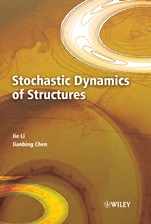
Stochastic Dynamics of Structures
ISBN 9780470824245
Autor: Jie Li, Jianbing Chen
Wydawca: Wiley
Dostępność: 3-6 tygodni
Cena: 729,75 zł
Przed złożeniem zamówienia prosimy o kontakt mailowy celem potwierdzenia ceny.
ISBN13: |
9780470824245 |
ISBN10: |
0470824247 |
Autor: |
Jie Li, Jianbing Chen |
Oprawa: |
Hardback |
Rok Wydania: |
2009-05-15 |
Ilość stron: |
424 |
Wymiary: |
251x168 |
Tematy: |
TG |
In Stochastic Dynamics of Structures, Li and Chen present a unified view of the theory and techniques for stochastic dynamics analysis, prediction of reliability, and system control of structures within the innovative theoretical framework of physical stochastic systems. The authors outline the fundamental concepts of random variables, stochastic process and random field, and orthogonal expansion of random functions. Readers will gain insight into core concepts such as stochastic process models for typical dynamic excitations of structures, stochastic finite element, and random vibration analysis. Li and Chen also cover advanced topics, including the theory of and elaborate numerical methods for probability density evolution analysis of stochastic dynamical systems, reliability–based design, and performance control of structures.
Stochastic Dynamics of Structures presents techniques for researchers and graduate students in a wide variety of engineering fields: civil engineering, mechanical engineering, aerospace and aeronautics, marine and offshore engineering, ship engineering, and applied mechanics. Practicing engineers will benefit from the concise review of random vibration theory and the new methods introduced in the later chapters.
"The book is a valuable contribution to the continuing development of the field of stochastic structural dynamics, including the recent discoveries and developments by the authors of the probability density evolution method (PDEM) and its applications to the assessment of the dynamic reliability and control of complex structures through the equivalent extreme–value distribution."
—A. H–S. Ang, NAE, Hon. Mem. ASCE, Research Professor, University of California, Irvine, USA
"The authors have made a concerted effort to present a responsible and even holistic account of modern stochastic dynamics. Beyond the traditional concepts, they also discuss theoretical tools of recent
currency such as the Karhunen–Loève expansion, evolutionary power spectra, etc. The theoretical developments are properly supplemented by examples from earthquake, wind, and ocean engineering. The book is integrated by also comprising several useful appendices, and an exhaustive list of references; it will be an indispensable tool for students, researchers, and practitioners endeavoring in its thematic field."
—Pol Spanos, NAE, Ryon Chair in Engineering, Rice University, Houston, USA
Source code for readers and lecture supplements for instructors available at [www.wiley.com/go/stochdyn]
Spis treści:
Foreword.
Preface.
1 Introduction.
1.1 Motivations and Historical Clues.
1.2 Contents of the Book.
2 Stochastic Processes and Random Fields.
2.1 Random Variables.
2.2 Stochastic Processes.
2.3 Random Fields.
2.4 Orthogonal Decomposition of Random Functions.
3 Stochastic Models of Dynamic Excitations.
3.1 General Expression of Stochastic Excitations.
3.2 Seismic Ground Motions.
3.3 Fluctuating Wind Speed in the Boundary Layer.
3.4 Wind Wave and Ocean Wave Spectrum.
3.5 Orthogonal Decomposition of Random Excitations.
4 Stochastic Structural Analysis.
4.1 Introductory Remarks.
4.2 Fundamentals of Deterministic Structural Analysis.
4.3 Random Simulation Method.
4.4 Perturbation Approach.
4.5 Orthogonal Expansion Theory.
5 Random Vibration Analysis.
5.1 Introduction.
5.2 Moment Functions of the Responses.
5.3 Power Spectral Density Analysis.
5.4 Pseudo–Excitation Method.
5.5 Statistical Linearization.
5.6 Fokker Planck Kolmogorov Equation.
6 Probability Density Evolution Analysis: Theory.
6.1 Introduction.
6.2 The Principle of Preservation of Probability.
6.3 Markovian Systems and State Space Description: Liouville and Fokker Planck Kolmogorov Equations.
6.4 Do
stupov Pugachev Equation.
6.5 The Generalized Density Evolution Equation.
6.6 Solution of the Generalized Density Evolution Equation.
7 Probability Density Evolution Analysis: Numerical Methods.
7.1 Numerical Solution of First–Order Partial Differential Equation.
7.2 Representative Point Sets and Assigned Probabilities.
7.3 Strategy for Generating Basic Point Sets.
7.4 Density–Related Transformation.
7.5 Stochastic Response Analysis of Nonlinear MDOF Structures.
8 Dynamic Reliability of Structures.
8.1 Fundamentals of Structural Reliability Analysis.
8.2 Dynamic Reliability Analysis: First–Passage Probability Based on Excursion Assumption.
8.3 Dynamic Reliability Analysis: Generalized Density Evolution Equation–Based Approach.
8.4 Structural System Reliability.
9 Optimal Control of Stochastic Systems.
9.1 Introduction.
9.2 Optimal Control of Deterministic Systems.
9.3 Stochastic Optimal Control.
9.4 Reliability–Based Control of Structural Systems.
Appendix A: Dirac Delta Function.
A.1 Definition.
A.2 Integration and Differentiation.
A.3 Common Physical Backgrounds.
Appendix B: Orthogonal Polynomials.
B.1 Basic Concepts.
B.2 Common Orthogonal Polynomials.
Appendix C: Relationship between Power Spectral Density and Random Fourier Spectrum.
C.1 Spectra via Sample Fourier Transform.
C.2 Spectra via One–sided Finite Fourier Transform.
Appendix D: Orthonormal Base Vectors.
Appendix E: Probability in a Hyperball.
E.1 The Case s is Even.
E.2 The Case s is Odd.
E.3 Monotonic Features of F(r, s).
Appendix F: Spectral Moments.
Appendix G: Generator Vectors in the Number Theoretical Method.
References and Bibliography.
Index.
Nota biograficzna:
Jie Li is a Professor of Civil Engineering at Tongji University, specializing in t
he area of earthquake engineering and stochastic mechanics. He has worked on uncertainty quantification, response analysis, and reliability evaluation of structural systems involving randomness –– integrating both for system parameters and excitations –– for more than 15 years. He has authored six monographs and published over 200 papers in peer reviewed journals. Li holds executive positions in China′s major architectural, vibration engineering, and disaster prevention societies and laboratories. He is the Editor–in–Chief of the Journal of Tongji University (Natural Science Series) and is on the editorial board of over 10 international and Chinese journals, including the International Journal of Nonlinear Mechanics and Earthquake Engineering and Engineering Vibrations. He has received a variety of national and provincial–level awards for Advancement in Science and Technology. Li holds a Ph.D. in Civil Engineering from Tongji University.
Jianbing Chen is an Associate Professor of Civil Engineering at Tongji University and serves at the State Key Laboratory in Disaster Reduction in Civil Engineering. He specializes in earthquake engineering and stochastic mechanics. Awards include the MOE′s National Science Award, National Excellent Doctoral Thesis, Shanghai City′s Excellent Young Teacher Award, and acceptance into the MOE′s Excellent Scholars Program. He holds a B.S. from Northeastern University and a Ph.D. from Tongji University, both in Civil Engineering.
Okładka tylna:
In Stochastic Dynamics of Structures, Li and Chen present a unified view of the theory and techniques for stochastic dynamics analysis, prediction of reliability, and system control of structures within the innovative theoretical framework of physical stochastic systems. The authors outline the fundamental concepts of random variables, stochastic process and random fi
eld, and orthogonal expansion of random functions. Readers will gain insight into core concepts such as stochastic process models for typical dynamic excitations of structures, stochastic finite element, and random vibration analysis. Li and Chen also cover advanced topics, including the theory of and elaborate numerical methods for probability density evolution analysis of stochastic dynamical systems, reliability–based design, and performance control of structures.
Stochastic Dynamics of Structures presents techniques for researchers and graduate students in a wide variety of engineering fields: civil engineering, mechanical engineering, aerospace and aeronautics, marine and offshore engineering, ship engineering, and applied mechanics. Practicing engineers will benefit from the concise review of random vibration theory and the new methods introduced in the later chapters.
"The book is a valuable contribution to the continuing development of the field of stochastic structural dynamics, including the recent discoveries and developments by the authors of the probability density evolution method (PDEM) and its applications to the assessment of the dynamic reliability and control of complex structures through the equivalent extreme–value distribution."
—A. H–S. Ang, NAE, Hon. Mem. ASCE, Research Professor, University of California, Irvine, USA
"The authors have made a concerted effort to present a responsible and even holistic account of modern stochastic dynamics. Beyond the traditional concepts, they also discuss theoretical tools of recent currency such as the Karhunen–Loève expansion, evolutionary power spectra, etc. The theoretical developments are properly supplemented by examples from earthquake, wind, and ocean engineering. The book is integrated by also comprising several useful appendices, and an exhaustive list of references; it will be an indispensable tool for students, researchers, and practit
ioners endeavoring in its thematic field."
—Pol Spanos, NAE, Ryon Chair in Engineering, Rice University, Houston, USA
Source code for readers and lecture supplements for instructors available at [www.wiley.com/go/stochdyn]
Koszyk
Książek w koszyku: 0 szt.
Wartość zakupów: 0,00 zł
Informacje


Kontakt
Gambit
Centrum Oprogramowania
i Szkoleń Sp. z o.o.
Al. Pokoju 29b/22-24
31-564 Kraków
Siedziba Księgarni
ul. Kordylewskiego 1
31-542 Kraków
+48 12 410 5991
+48 12 410 5987
+48 12 410 5989
Subskrypcje
Administratorem danych osobowych jest firma Gambit COiS Sp. z o.o. Na podany adres będzie wysyłany wyłącznie biuletyn informacyjny.
Autoryzacja płatności

Informacje na temat autoryzacji płatności poprzez PayU.

© Copyright 2012: GAMBIT COiS Sp. z o.o. Wszelkie prawa zastrzeżone.
Projekt i wykonanie: Alchemia Studio Reklamy