


Wydawcy
Katalog tematyczny
- Archeologia (109)
- Ekonomia, finanse, business (13704)
- Filozofia (1445)
- Historia (3040)
- Języki i językoznawstwo (2356)
- Lifestyle, hobby i rozrywka (475)
- Medycyna (9704)
- Nauki humanistyczne (4)
- Nauki o Ziemi i środowisku (2638)
- Nauki ścisłe (20412)
- Nauki społeczne (8486)
- Nauki techniczne (13450)
- Prawo (1696)
- Publikacje informacyjne i interdyscyplinarne (1288)
- Religia i wierzenia (917)
- Technika komputerowa (4067)
- Zdrowie, relacje międzyludzkie i rozwój osobisty (657)





Informacje szczegółowe o książce
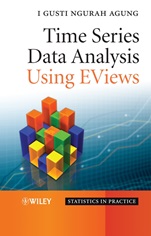
Time Series Data Analysis Using EViews
ISBN 9780470823675
Autor: I. Gusti Ngurah Agung
Wydawca: Wiley
Dostępność: 3-6 tygodni
Cena: 537,60 zł
Przed złożeniem zamówienia prosimy o kontakt mailowy celem potwierdzenia ceny.
ISBN13: |
9780470823675 |
ISBN10: |
0470823674 |
Autor: |
I. Gusti Ngurah Agung |
Oprawa: |
Hardback |
Rok Wydania: |
2009-02-17 |
Ilość stron: |
632 |
Wymiary: |
243x154 |
Tematy: |
KC |
Do you want to recognize the most suitable models for analysis of statistical data sets?
This book provides a hands–on practical guide to using the most suitable models for analysis of statistical data sets using EViews – an interactive Windows–based computer software program for sophisticated data analysis, regression, and forecasting – to define and test statistical hypotheses. Rich in examples and with an emphasis on how to develop acceptable statistical models, Time Series Data Analysis Using EViews is a perfect complement to theoretical books presenting statistical or econometric models for time series data. The procedures introduced are easily extendible to cross–section data sets.
The author:
Provides step–by–step directions on how to apply EViews software to
time series data analysis
Offers guidance on how to develop and evaluate alternative empirical models, permitting the most appropriate to be selected without the need for computational formulae
Examines a variety of times series models, including continuous growth, discontinuous growth, seemingly causal, regression, ARCH, and GARCH as well as a general form of nonlinear time series and nonparametric models
Gives over 250 illustrative examples and notes based on the author′s own empirical findings, allowing the advantages and limitations of each model to be understood
Describes the theory behind the models in comprehensive appendices
Provides supplementary information and data sets
An essential tool for advanced undergraduate and graduate students taking finance or econometrics courses. Statistics, life sciences, and social science students, as well as applied researchers, will also find this book an invaluable resource.
Spis treści:
Preface.
1 EViews workfile and descriptive data analysis.
1.1 What is the EViews workfile?
1.2 Basic options in EViews.
1.3 Cr
eating a workfile.
1.4 Illustrative data analysis.
1.5 Special notes and comments.
1.6 Statistics as a sample space.
2 Continuous growth models.
2.1 Introduction.
2.2 Classical growth models.
2.3 Autoregressive growth models.
2.4. Residual tests.
2.5 Bounded autoregressive growth models.
2.6 Lagged variables or autoregressive growth models.
2.7 Polynomial growth model.
2.8 Growth models with exogenous variables.
2.9 A Taylor series approximation model.
2.10 Alternative univariate growth models.
2.11 Multivariate growth models.
2.12 Multivariate AR(p) GLM with trend.
2.13 Generalized multivariate models with trend.
2.14 Special notes and comments.
2.15 Alternative multivariate models with trend.
2.16 Generalized multivariate models with time–related effects.
3 Discontinuous growth models.
3.1 Introduction.
3.2 Piecewise growth models.
3.3 Piecewise S–shape growth models.
3.4 Two–piece polynomial bounded growth models.
3.5 Discontinuous translog linear AR(1) growth models.
3.6 Alternative discontinuous growth models.
3.7 Stability test.
3.8 Generalized discontinuous models with trend.
3.9 General two–piece models with time–related effects.
3.10 Multivariate models by states and time periods.
4 Seemingly causal models.
4.1 Introduction.
4.2 Statistical analysis based on a single time series.
4.3 Bivariate seemingly causal models.
4.4 Trivariate seemingly causal models.
4.5 System equations based on trivariate time series.
4.6 General system of equations.
4.7 Seemingly causal models with dummy variables.
4.8 General discontinuous seemingly causal models.
4.9 Additional selected seemingly causal models.
4.10 Final notes in developing models.
5 Special cases of regression models.
5.1 Introduction.
5.2 Specific cases of growth curve models.
5.3 Seemingly causal models.
5.4 Lag
ged variable models.
5.5 Cases based on the US domestic price of copper.
5.6 Return rate models.
5.7 Cases based on the BASICS workfile.
6 VAR and system estimation methods.
6.1 Introduction.
6.2 The VAR models.
6.3 The vector error correction models.
6.4 Special notes and comments.
7 Instrumental variables models.
7.1 Introduction.
7.2 Should we apply instrumental models?
7.3 Residual analysis in developing instrumental models.
7.4 System equation with instrumental variables.
7.5 Selected cases based on the US—DPOC data.
7.6 Instrumental models with time–related effects.
7.7 Instrumental seemingly causal models.
7.8 Multivariate instrumental models based on the US—DPOC.
7.9 Further extension of the instrumental models.
8 ARCH models.
8.1 Introduction.
8.2 Options of ARCH models.
8.3 Simple ARCH models.
8.4 ARCH models with exogenous variables.
8.5 Alternative GARCH variance series.
9 Additional testing hypotheses.
9.1 Introduction.
9.2 The unit root tests.
9.3 The omitted variables tests.
9.4 Redundant variables test (RV–test).
9.5 Nonnested test (NN–test).
9.6 The Ramsey RESET test.
9.7 Illustrative examples based on the Demo.wf1.
10 Nonlinear least squares models.
10.1 Introduction.
10.2 Classical growth models.
10.3 Generalized Cobb–Douglas models.
10.4 Generalized CES models.
10.5 Special notes and comments.
10.6 Other NLS models.
11 Nonparametric estimation methods.
11.1 What is the nonparametric data analysis.
11.2 Basic moving average estimates.
11.3 Measuring the best fit model.
11.4 Advanced moving average models.
11.5 Nonparametric regression based on a time series.
11.6 The local polynomial Kernel fit regression.
11.7 Nonparametric growth models.
Appendix A: Models for a single time series.
A.1 The simplest model.
A.2 Firs
t–order autoregressive models.
A.3 Second–order autoregressive model.
A.4 First–order moving average model.
A.5 Second–order moving average model.
A.6 The simplest ARMA model.
A.7 General ARMA model.
Appendix B: Simple linear models.
B.1 The simplest linear model.
B.2 Linear model with basic assumptions.
B.3 Maximum likelihood estimation method.
B.4 First–order autoregressive linear model.
B.5 AR(p) linear model.
B.6 Alternative models.
B.7 Lagged–variable model.
B.8 Lagged–variable autoregressive models.
B.9 Special notes and comments.
Appendix C: General linear models.
C.1 General linear model with i.i.d. Gaussian disturbances.
C.2 AR(1) general linear model.
C.3 AR(p) general linear model.
C.4 General lagged–variable autoregressive model.
C.5 General models with Gaussian errors.
Appendix D: Multivariate general linear models.
D.1 Multivariate general linear models.
D.2 Moments of an endogenous multivariate.
D.3 Vector autoregressive model.
D.4 Vector moving average model.
D.5 Vector autoregressive moving average model.
D.6 Simple multivariate models with exogenous variables.
D.7 General estimation methods.
D.8 Maximum likelihood estimation for an MGLM.
D.9 MGLM with autoregressive errors.
References.
Index.
Okładka tylna:
Do you want to recognize the most suitable models for analysis of statistical data sets?
This book provides a hands–on practical guide to using the most suitable models for analysis of statistical data sets using EViews – an interactive Windows–based computer software program for sophisticated data analysis, regression, and forecasting – to define and test statistical hypotheses. Rich in examples and with an emphasis on how to develop acceptable statistical models, Time Series Data Analysis Using EViews is a perfect complement to t
heoretical books presenting statistical or econometric models for time series data. The procedures introduced are easily extendible to cross–section data sets.
The author:
Provides step–by–step directions on how to apply EViews software to
time series data analysis
Offers guidance on how to develop and evaluate alternative empirical models, permitting the most appropriate to be selected without the need for computational formulae
Examines a variety of times series models, including continuous growth, discontinuous growth, seemingly causal, regression, ARCH, and GARCH as well as a general form of nonlinear time series and nonparametric models
Gives over 250 illustrative examples and notes based on the author′s own empirical findings, allowing the advantages and limitations of each model to be understood
Describes the theory behind the models in comprehensive appendices
Provides supplementary information and data sets
An essential tool for advanced undergraduate and graduate students taking finance or econometrics courses. Statistics, life sciences, and social science students, as well as applied researchers, will also find this book an invaluable resource.
Koszyk
Książek w koszyku: 0 szt.
Wartość zakupów: 0,00 zł
Informacje


Kontakt
Gambit
Centrum Oprogramowania
i Szkoleń Sp. z o.o.
Al. Pokoju 29b/22-24
31-564 Kraków
Siedziba Księgarni
ul. Kordylewskiego 1
31-542 Kraków
+48 12 410 5991
+48 12 410 5987
+48 12 410 5989
Subskrypcje
Administratorem danych osobowych jest firma Gambit COiS Sp. z o.o. Na podany adres będzie wysyłany wyłącznie biuletyn informacyjny.
Autoryzacja płatności

Informacje na temat autoryzacji płatności poprzez PayU.

© Copyright 2012: GAMBIT COiS Sp. z o.o. Wszelkie prawa zastrzeżone.
Projekt i wykonanie: Alchemia Studio Reklamy