


Wydawcy
Katalog tematyczny
- Archeologia (109)
- Ekonomia, finanse, business (13704)
- Filozofia (1445)
- Historia (3040)
- Języki i językoznawstwo (2356)
- Lifestyle, hobby i rozrywka (475)
- Medycyna (9704)
- Nauki humanistyczne (4)
- Nauki o Ziemi i środowisku (2638)
- Nauki ścisłe (20412)
- Nauki społeczne (8486)
- Nauki techniczne (13450)
- Budownictwo lądowe (1045)
- Chemia przemysłowa (2258)
- Elektronika i telekomunikacja (3287)
- Energetyka (1122)
- Inne nauki stosowane (363)
- Inżynieria biochemiczna (507)
- Inżynieria transportu (232)
- Mechanika i materiały (3316)
- Nauka o środowisku (321)
- Rolnictwo (507)
- Technika, ogólnie (475)
- Prawo (1696)
- Publikacje informacyjne i interdyscyplinarne (1288)
- Religia i wierzenia (917)
- Technika komputerowa (4067)
- Zdrowie, relacje międzyludzkie i rozwój osobisty (657)





Informacje szczegółowe o książce
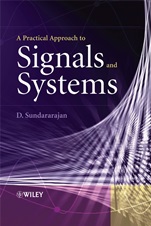
A Practical Approach to Signals and Systems
ISBN 9780470823538
Autor: D. Sundararajan
Wydawca: Wiley
Dostępność: 3-6 tygodni
Cena: 449,40 zł
Przed złożeniem zamówienia prosimy o kontakt mailowy celem potwierdzenia ceny.
ISBN13: |
9780470823538 |
ISBN10: |
0470823534 |
Autor: |
D. Sundararajan |
Oprawa: |
Hardback |
Rok Wydania: |
2008-07-22 |
Ilość stron: |
400 |
Wymiary: |
253x180 |
Tematy: |
TJ |
A Practical Approach to Signals and Systems is an excellent resource for the electrical engineering student or professional to quickly gain an understanding of signal analysis concepts –– concepts all electrical engineers will eventually encounter no matter what their specialization. For aspiring engineers in signal processing, communication, and control, the topics presented will form a sound foundation to their future study, while allowing them to quickly move on to more advanced topics in the area.
Sundararajan presents an easier path to understanding signals and systems analysis by using simultaneous study of both continuous and discrete signals. As discrete signals and systems are more often used in practice, and their concepts are relatively easy to understand, the author details discrete versions first followed by the corresponding continuous version for each topic. In addition to examples of typical applications of analysis techniques, Sundararajan gives comprehensive coverage of transform methods, emphasizing a practical approach to analysis and physical interpretations of concepts.Gives equal emphasis to theory and practicePresents methods that can be immediately appliedComplete treatment of transform methodsExpanded coverage of Fourier analysisSelf–contained: starts from the basics and discusses applicationsVisual aids and examples make the subject easier to understandEnd–of–chapter exercises, with an extensive solutions manual for instructorsMATLAB software for readers to download and practice on their own
Scientists in chemical, mechanical, and biomedical areas will also benefit from this book, as increasing overlap with electrical engineering solutions and applications will require a working understanding of signals. Compact and self contained, A Practical Approach to Signals and Systems can be used for courses or self–study, or as a refe
rence book.
Access the solutions manual to this text at the companion website –
http://www.wiley.com/go/sundararajan
Spis treści:
Preface.
Abbreviations.
1 Introduction.
1.1 The Organization of this Book.
2 Discrete Signals.
2.1 Classification of Signals.
2.1.1 Continuous, Discrete, and Digital Signals.
2.1.2 Periodic and Aperiodic Signals.
2.1.3 Energy and Power Signals.
2.1.4 Even– and Odd–Symmetric Signals.
2.1.5 Causal and Noncausal Signals.
2.1.6 Deterministic and Random Signals.
2.2 Basic Signals.
2.2.1 Unit–Impulse Signal.
2.2.2 Unit–Step Signal.
2.2.3 Unit–Ramp Signal.
2.2.4 Sinusoids and Exponentials.
2.3 Signal Operations.
2.3.1 Time Shifting.
2.3.2 Time Reversal.
2.3.3 Time Scaling.
2.4 Summary.
References.
Exercises.
3 Continuous Signals.
3.1 Classification of Signals.
3.1.1 Continuous Signals.
3.1.2 Periodic and Aperiodic Signals.
3.1.3 Energy and Power Signals.
3.1.4 Even– and Odd–Symmetric Signals.
3.1.5 Causal and Noncausal Signals.
3.2 Basic Signals.
3.2.1 The Unit–Step Signal.
3.2.2 The Unit–Impulse Signal.
3.2.3 The Unit–Ramp Signal.
3.2.4 Sinusoids.
3.3 Signal Operations.
3.3.1 Time Shifting.
3.3.2 Time Reversal.
3.3.3 Time Scaling.
3.4 Summary.
Reference.
Exercises.
4 Time–Domain Analysis of Discrete Systems.
4.1 Difference Equation Model.
4.1.1 System Response.
4.1.2 Impulse Response.
4.1.3 Characterization of Systems by their Responses to Impulse and Unit–Step Signals.
4.2 Classification of Systems.
4.2.1 Linear and Nonlinear Systems.
4.2.2 Time–Invariant and Time–Varying Systems.
4.2.3 Causal and Noncausal Systems.
4.2.4 Instantaneous and Dynamic Systems.
4.2.5 Inverse System
s.
4.2.6 Continuous and Discrete Systems.
4.3 Convolution–Summation Model.
4.3.1 Properties of Convolution–Summation.
4.3.2 The Difference Equation and the Convolution–Summation.
4.3.3 Response to Complex Exponential Input.
4.4 System Stability.
4.5 Realization of Discrete Systems.
4.5.1 Decomposition of Higher–Order Systems.
4.5.2 Feedback Systems.
4.6 Summary.
References.
Exercises.
5 Time–Domain Analysis of Continuous Systems.
5.1 Classification of Systems.
5.1.1 Linear and Nonlinear Systems.
5.1.2 Time–Invariant and Time–Varying Systems.
5.1.3 Causal and Noncausal Systems.
5.1.4 Instantaneous and Dynamic Systems.
5.1.5 Lumped–Parameter and Distributed–Parameter Systems.
5.1.6 Inverse Systems.
5.2 Difference Equation Model.
5.3 Convolution–Integral Model.
5.3.1 Properties of Convolution–Integral.
5.4 System Response.
5.4.1 Impulse Response.
5.4.2 Response to Unit–Step Input.
5.4.3 Characterization of Systems by their Responses to Impulse and Unit–Step Signals.
5.4.4 Response to Complex Exponential Input.
5.5 System Stability.
5.6 Realization of Continuous Systems.
5.6.1 Decomposition of Higher–Order Systems.
5.6.2 Feedback Systems.
5.7 Summary.
Reference.
Exercises.
6 The Discrete Fourier Transform.
6.1 The Time–Domain and Frequency–Domain.
6.2 The Fourier Analysis.
6.2.1 Versions of Fourier Analysis.
6.3 The Discrete Fourier Transform.
6.3.1 The Approximation of Arbitrary Waveforms with Finite Number Samples.
6.3.2 The DFT and the IDFT.
6.3.3 DFT of Some Basic Signals.
6.4 Properties of the Discrete Fourier Transform.
6.4.1 Linearity.
6.4.2 Periodicity.
6.4.3 Circular Shift of a Sequence.
6.4.4 Circular Shift of a Spectrum.
6.4.5 Symmetry.
6.4.6 Circular Convolution of Time–Domain Sequences.
6.4.7
Circular Convolution of Frequency–Domain Sequences.
6.4.8 Parseval′s Theorem.
6.5 Applications of the Discrete Fourier Transform.
6.5.1 Computation of the Linear Convolution Using the DFT.
6.5.2 Interpolation and Decimation.
6.6. Summary.
References.
Exercises.
7 Fourier Series.
7.1 Fourier Series.
7.1.1 FS as the Limiting Case of the DFT.
7.1.2 The Compact Trigonometric Form of the FS.
7.1.3 The Trigonometric Form of the FS.
7.1.4 Periodicity of the FS.
7.1.5 Existence of the FS.
7.1.6 Gibbs Phenomenon.
7.2 Properties of the Fourier Series.
7.2.1 Linearity.
7.2.2 Symmetry.
7.2.3 Time–Shifting.
7.2.4 Frequency–Shifting.
7.2.5 Convolution in the Time–Domain.
7.2.6 Convolution in the Frequency–Domain.
7.2.7 Duality.
7.2.8 Time–Scaling.
7.2.9 Time–Differentiation.
7.2.10 Time–Integration.
7.2.11 Parseval′s Theorem.
7.3 Approximation of the Fourier Series.
7.3.1 Aliasing Effect.
7.4 Applications of the Fourier Series.
7.5 Summary.
References.
Exercises.
8 The Discrete–Time Fourier Transform.
8.1 The Discrete–Time Fourier Transform.
8.1.1 The DTFT as the Limiting Case of the DFT.
8.1.2 The Dual Relationship Between the DTFT and the FS.
8.1.3 The DTFT of a Discrete Periodic Signal.
8.1.4 Determination of the DFT from the DTFT.
8.2 Properties of the Discrete–Time Fourier Transform.
8.2.1 Linearity.
8.2.2 Time–Shifting.
8.2.3 Frequency–Shifting.
8.2.4 Convolution in the Time–Domain.
8.2.5 Convolution in the Frequency–Domain.
8.2.6 Symmetry.
8.2.7 Time–Reversal.
8.2.8 Time–Expansion.
8.2.9 Frequency–Differentiation.
8.2.10 Difference.
8.2.11 Summation.
8.2.12 Parseval′s Theorem and the Energy Transfer Function.
8.3 Approximation of the Discrete–Time Fourier Transform.
8.
Koszyk
Książek w koszyku: 0 szt.
Wartość zakupów: 0,00 zł
Informacje


Kontakt
Gambit
Centrum Oprogramowania
i Szkoleń Sp. z o.o.
Al. Pokoju 29b/22-24
31-564 Kraków
Siedziba Księgarni
ul. Kordylewskiego 1
31-542 Kraków
+48 12 410 5991
+48 12 410 5987
+48 12 410 5989
Subskrypcje
Administratorem danych osobowych jest firma Gambit COiS Sp. z o.o. Na podany adres będzie wysyłany wyłącznie biuletyn informacyjny.
Autoryzacja płatności

Informacje na temat autoryzacji płatności poprzez PayU.

© Copyright 2012: GAMBIT COiS Sp. z o.o. Wszelkie prawa zastrzeżone.
Projekt i wykonanie: Alchemia Studio Reklamy