


Wydawcy
Katalog tematyczny
- Archeologia (109)
- Ekonomia, finanse, business (13704)
- Filozofia (1445)
- Historia (3040)
- Języki i językoznawstwo (2356)
- Lifestyle, hobby i rozrywka (475)
- Medycyna (9704)
- Nauki humanistyczne (4)
- Nauki o Ziemi i środowisku (2638)
- Nauki ścisłe (20412)
- Astronomia (294)
- Biologia (5119)
- Chemia (6540)
- Chemia analityczna (361)
- Chemia fizyczna (346)
- Chemia nieorganiczna (137)
- Chemia organiczna (535)
- Krystalografia (27)
- Minerologia (46)
- Fizyka (3309)
- Matematyka (4574)
- Nauki ścisłe, ogólnie (503)
- Nauki społeczne (8486)
- Nauki techniczne (13450)
- Prawo (1696)
- Publikacje informacyjne i interdyscyplinarne (1288)
- Religia i wierzenia (917)
- Technika komputerowa (4067)
- Zdrowie, relacje międzyludzkie i rozwój osobisty (657)





Informacje szczegółowe o książce
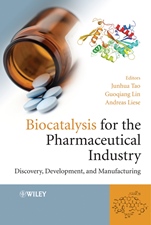
Biocatalysis for the Pharmaceutical Industry: Discovery, Development, and Manufacturing
ISBN 9780470823149
Autor: Junhua (Alex) Tao, Guo–Qiang Lin, Andreas Liese
Wydawca: Wiley
Dostępność: 3-6 tygodni
Cena: 638,40 zł
Przed złożeniem zamówienia prosimy o kontakt mailowy celem potwierdzenia ceny.
ISBN13: |
9780470823149 |
ISBN10: |
0470823143 |
Autor: |
Junhua (Alex) Tao, Guo–Qiang Lin, Andreas Liese |
Oprawa: |
Hardback |
Rok Wydania: |
2009-05-15 |
Ilość stron: |
336 |
Wymiary: |
250x173 |
Tematy: |
PN |
Biocatalysis is rapidly evolving into a key technology for the discovery and production of chemicals, especially in the pharmaceutical industry, where high yielding chemo–, regio–, and enantioselective reactions are critical. Taking the latest breakthroughs in genomics and proteomics into consideration, Biocatalysis for the Pharmaceutical Industry concisely yet comprehensively discusses the modern application of biocatalysis to drug discovery, development, and manufacturing. Written by a team of leading experts, the book offers deep insight into this cutting edge field.
Covers a wide range of topics in a systematic manner with an emphasis on industrial applications
Provides a thorough introduction to the latest biocatalysts, modern expression hosts, state–of–the–art directed evolution, high throughput screening, and bioprocess engineering
Addresses frontier subjects such as emerging enzymes, metabolite profiling, combinatorial biosynthesis, metabolic engineering, and autonomous enzymes for the synthesis and development of chiral molecules, drug metabolites, and semi–synthetic medicinal compounds and natural product analogs
Highlights the impact of biocatalysis on green chemistry
Contains numerous graphics to illustrate concepts and techniques
Biocatalysis for the Pharmaceutical Industry is an essential resource for scientists, engineers, and R&D policy makers in the fine chemical, pharmaceutical, and biotech industries. It is also an invaluable tool for academic researchers and advanced students of organic and materials synthesis, chemical biology, and medicinal chemistry.
Spis treści:
Preface.
1 Enzymes and Their Synthetic Applications: An Overview.
1.1 Introduction.
1.2 Enzyme Families.
1.3 Enzyme Discovery and Optimization.
1.4 Enzyme Production.
1.5 Enzymes and Synthetic Applications.
1.5.1 Ketoreductases (EC 1.1.1.2).
1.5.
2 Enoate Reductases or Ene Reductases (EC 1.3.1.16).
1.5.3 Oxygenases (EC. xxxx).
1.5.4 Alcohol Oxidases (EC 1.1.3.X).
1.5.5 Peroxidases (EC 1.11.1.X).
1.5.6 Halogenases (EC. xxxx).
1.5.7 Nitrilases (EC 3.5.5.1).
1.5.8 Nitrile Hydratases (EC 4.2.1.84).
1.5.9 Epoxide Hydrolases (EC 3.3.2.X).
1.5.10 !–Transaminases (EC 2.6.1.X).
1.5.11 Hydroxynitrile Lyases (EC 4.1.2.X).
1.5.12 Aldolases (EC. xxxx).
1.5.13 Glycosidases (EC. xxxx).
1.5.14 Glycosyltransferase (EC. xxxx).
1.6 Conclusions.
2 Expression Hosts for Enzyme Discovery and Production.
2.1 Introduction.
2.2 How to Choose an Expression System.
2.3 Prokaryotic Expression Systems.
2.3.1 Posttranslational Modification in Prokaryotes.
2.3.2 Escherichia coli.
2.3.3 Bacilli.
2.3.4 Pseudomonas fluorescens.
2.3.5 Other Prokaryotic Expression Systems.
2.4 Eukaryotic Expression Systems.
2.4.1 Yeasts.
2.4.2 Filamentous Fungi.
2.4.3 Insect/Baculovirus System.
2.4.4 Mammalian Cell Cultures.
2.4.5 Other Expression Systems.
2.5 Cell–Free Expression Systems.
2.6 Conclusions.
3 Directed Enzyme Evolution and High–Throughput Screening.
3.1 Introduction.
3.2 Directed Evolution Library Creation Strategies.
3.2.1 Random and Semi–Rational Mutagenesis.
3.2.2 Gene Shuffling.
3.3 Directed Evolution Library Screening/Selection Methods.
3.3.1 In Vivo Methods: Genetic Complementation.
3.3.2 In Vivo Methods: Chemical Complementation.
3.3.3 In Vivo Methods: Surface Display.
3.3.4 In Vitro Methods: Lysate Assay.
3.3.5 In Vitro Methods: Ribosome Display.
3.3.6 In Vitro Methods: In Vitro Compartmentalization.
3.3.7 Equipment/Automation.
3.4 Selected Industrial Examples.
3.4.1 Activity.
3.4.2 Thermostability.
3.4.3 Substrate Specificity.
3.4.4 Product Specificity.
3.4.5 Enantioselectivity.
3.5 Conclusions and Future Directions.
4 Applications of Reaction En
gineering to Industrial Biotransformations.
4.1 Introduction.
4.2 Metabolic Bioconversion.
4.3 Enzymatic Biotransformations.
4.3.1 Cofactor Regeneration.
4.3.2 Racemic Mixtures.
4.3.3 Equilibrium Conversion.
4.3.4 By–Product Formation.
4.3.5 Substrate Inhibition.
4.3.6 Low Solubility.
4.4 Conclusions.
5 Chiral Synthesis of Pharmaceutical Intermediates Using Oxynitrilases.
5.1 Introduction.
5.2 HNL.
5.2.1 The Natural Function and Distribution of HNLs.
5.2.2 Classification of HNLs.
5.2.3 New HNLs and High–Throughput Screening.
5.3. Reaction of HNLs.
5.3.1 Reaction System.
5.3.2 Immobilization of Enzyme.
5.3.3 Continuous Reactors.
5.3.4 Henry Reaction.
5.4 Transformation of Cyanohydrins.
5.4.1 Transformation of Hydroxyl Group.
5.4.2 Transformation of Nitrile Group.
5.4.3 Intramolecular Reaction.
5.5 Summary.
6 Expanding the Scope of Aldolases as Tools for Organic Synthesis.
6.1 Directed Evolution and Rational Mutagenesis.
6.2 Reaction Engineering.
6.3 Broad Substrate Tolerance of Wild–Type Aldolases.
6.4 Conclusions.
7 Synthetic Applications of Ketoreductases and Alcohol Oxidases.
7.1 Ketoreductases.
7.1.1 Wild–Type Whole–Cell Biocatalysts.
7.1.2 Recombinant Whole–Cell Biocatalysts Overexpressing Catalytic Enzymes.
7.1.3 Isolated Enzyme.
7.2 Alcohol Oxidases.
7.2.1 Primary Alcohol Oxidases.
7.2.2 Secondary Alcohol Oxidases.
8 Applications of Nitrile Hydratases and Nitrilases.
8.1 Introduction.
8.2 NHase.
8.2.1 New NHases.
8.2.2 Applications.
8.3 Nitrilase.
8.3.1 New Nitrilases.
8.3.2 Applications.
8.4 Conclusions.
9 Biosynthesis of Drug Metabolites.
9.1 Introduction.
9.2 Metabolite Synthesis Using Mammalian Bioreactors.
9.2.1 Selection of In Vitro Systems.
9.2.2 Reaction Condition Optimization.
9.2.3 Large Scale Incubations.
9.2.4 E
xamples with Mammalian Bioreactors.
9.2.5 In Vivo Samples.
9.3 Metabolite Synthesis Using Microbial Bioreactors.
9.3.1 Microbial Bioreactors Used in Metabolite Structure Elucidation.
9.3.2 Microbial Bioreactors Used in Synthesis of Key Metabolites.
9.3.3 Strain Selection.
9.3.4 Microbial Glycoside Conjugation.
9.3.5 Large Scale Reactions.
9.3.6 Examples for Metabolite Synthesis with a Microbial Bioreactor.
9.4 Recombinant Enzyme Bioreactors.
9.4.1 Advantages of Using CYP Enzymes for Producing Drug Metabolites.
9.4.2 Human Cytochrome Biocatalysts.
9.4.3 Microbial CYP Enzymes.
9.5 Summary.
10 Application of Whole–Cell Biotransformation in the Pharmaceutical Industry.
10.1 Introduction.
10.1.1 Whole–Cell Biotransformation Processes Used in Commercial Production of Pharmaceuticals.
10.1.2 Application of Whole–Cell Biotransformation Process in the Synthesis of Chiral Pharmaceutical Intermediates.
10.2 Disadvantages of Whole–Cell Process Compared with the Isolated Enzyme Process.
10.2.1 Substrate Availability and Recovery of Products in Low Concentrations.
10.2.2 Undesirable Side Reactions.
10.2.3 Toxicity of Substrate and Product.
10.3 Advantages of Whole–Cell Process Compared with the Isolated Enzyme Process.
10.3.1 More Stable Sources than Isolated Enzymes.
10.3.2 Regeneration of Cofactors and Multi–Enzymes Reactions.
10.3.3 Diversity and Availability.
10.3.4 Reactions with Non–Commercially Available Isolated Enzymes for Preparative Scale Synthesis.
10.3.5 Cost Effectiveness and Ease of Operation.
10.4 Approaches to Address the Disadvantages of Whole–Cell Biotransformation.
10.4.1 Control of Substrate and Product Concentration by Absorbing Resins.
10.4.2 Immobilized–Cell Technology.
10.4.3 Aqueous–Organic Two–Phase System.
10.4.4 Genetic Engineering Approaches.
10.5 Conclusions.
11 Combinatori
Koszyk
Książek w koszyku: 0 szt.
Wartość zakupów: 0,00 zł
Informacje


Kontakt
Gambit
Centrum Oprogramowania
i Szkoleń Sp. z o.o.
Al. Pokoju 29b/22-24
31-564 Kraków
Siedziba Księgarni
ul. Kordylewskiego 1
31-542 Kraków
+48 12 410 5991
+48 12 410 5987
+48 12 410 5989
Subskrypcje
Administratorem danych osobowych jest firma Gambit COiS Sp. z o.o. Na podany adres będzie wysyłany wyłącznie biuletyn informacyjny.
Autoryzacja płatności

Informacje na temat autoryzacji płatności poprzez PayU.

© Copyright 2012: GAMBIT COiS Sp. z o.o. Wszelkie prawa zastrzeżone.
Projekt i wykonanie: Alchemia Studio Reklamy