


Wydawcy
Katalog tematyczny
- Archeologia (109)
- Ekonomia, finanse, business (13704)
- Filozofia (1445)
- Historia (3040)
- Języki i językoznawstwo (2356)
- Lifestyle, hobby i rozrywka (475)
- Medycyna (9704)
- Nauki humanistyczne (4)
- Nauki o Ziemi i środowisku (2638)
- Nauki ścisłe (20412)
- Astronomia (294)
- Biologia (5119)
- Chemia (6540)
- Chemia analityczna (361)
- Chemia fizyczna (346)
- Chemia nieorganiczna (137)
- Chemia organiczna (535)
- Krystalografia (27)
- Minerologia (46)
- Fizyka (3309)
- Matematyka (4574)
- Nauki ścisłe, ogólnie (503)
- Nauki społeczne (8486)
- Nauki techniczne (13450)
- Prawo (1696)
- Publikacje informacyjne i interdyscyplinarne (1288)
- Religia i wierzenia (917)
- Technika komputerowa (4067)
- Zdrowie, relacje międzyludzkie i rozwój osobisty (657)





Informacje szczegółowe o książce
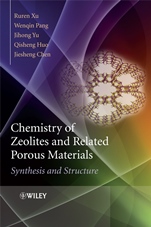
Chemistry of Zeolites and Related Porous Materials: Synthesis and Structure
ISBN 9780470822333
Autor: Ruren Xu, Wenqin Pang, Jihong Yu, Qisheng Huo, Jiesheng Chen
Wydawca: Wiley
Dostępność: 3-6 tygodni
Cena: 1 017,45 zł
Przed złożeniem zamówienia prosimy o kontakt mailowy celem potwierdzenia ceny.
ISBN13: |
9780470822333 |
ISBN10: |
0470822333 |
Autor: |
Ruren Xu, Wenqin Pang, Jihong Yu, Qisheng Huo, Jiesheng Chen |
Oprawa: |
Hardback |
Rok Wydania: |
2007-09-21 |
Ilość stron: |
694 |
Wymiary: |
244x173 |
Tematy: |
PN |
Widely used in adsorption, catalysis and ion exchange, the family of molecular sieves such as zeolites has been greatly extended and many advances have recently been achieved in the field of molecular sieves synthesis and related porous materials. Chemistry of Zeolites and Related Porous Materials focuses on the synthetic and structural chemistry of the major types of molecular sieves. It offers a systematic introduction to and an in–depth discussion of microporous, mesoporous, and macroporous materials and also includes metal–organic frameworks.Provides focused coverage of the key aspects of molecular sievesFeatures two frontier subjects: molecular engineering and host–guest advanced materialsComprehensively covers both theory and application with particular emphasis on industrial uses
This book is essential reading for researches in the chemical and materials industries and research institutions. The book is also indispensable for researches and engineers in R&D (for catalysis) divisions of companies in petroleum refining and the petrochemical and fine chemical industries.
Spis treści:
Preface.
1. Introduction.
1.1 The Evolution and Development of Porous Materials.
1.1.1 From Natural Zeolites to Synthesized Zeolites.
1.1.2 From Low–silica to High–silica Zeolites.
1.1.3 From Zeolites to Aluminophosphate Molecular Sieves and Other Microporous Phosphates.
1.1.4 From 12–Membered–ring Micropores to Extra–large Micropores.
1.1.5 From Extra–large Micropores to Mesopores.
1.1.6 Emergence of Macroporous Materials.
1.1.7 From Inorganic Porous Frameworks to Porous Metal–organic Frameworks (MOFs).
1.2 Main Applications and Prospects.
1.2.1 The Traditional Fields of Application and Prospects of Microporous Molecular Sieves.
1.2.2 Prospects in the Application Fields of Novel, High–tech, and Advanced Materials.
1.2
.3 The Main Application Fields and Prospects for Mesoporous Materials.
1.3 The Development of Chemistry for Molecular Sieves and Porous Materials.
1.3.1 The Development from Synthesis Chemistry to Molecular Engineering of Porous Materials.
1.3.2 Developments in the Catalysis Study of Porous Materials.
2. Structural Chemistry of Microporous Materials.
2.1 Introduction.
2.2 Structural Building Units of Zeolites.
2.2.1 Primary Building Units.
2.2.2 Secondary Building Units (SBUs).
2.2.3 Characteristic Cage–building Units.
2.2.4 Characteristic Chain– and Layer–building Units.
2.2.5 Periodic Building Units (PBUs).
2.3 Composition of Zeolites.
2.3.1 Framework Composition.
2.3.2 Distribution and Position of Cations in the Structure.
2.3.3 Organic Templates.
2.4 Framework Structures of Zeolites.
2.4.1 Loop Configuration and Coordination Sequences.
2.4.2 Ring Number of Pore Opening and Channel Dimension in Zeolites.
2.4.3 Framework Densities (FDs).
2.4.4 Selected Zeolite Framework Structures.
2.5 Zeolitic Open–framework Structures.
2.5.1 Anionic Framework Aluminophosphates with Al/P (less than or equal to) 1.
2.5.2 Open–framework Gallophosphates with Extra–large Pores.
2.5.3 Indium Phosphates with Extra–large Pores and Chiral Open Frameworks.
2.5.4 Zinc Phosphates with Extra–large Pores and Chiral Open Frameworks.
2.5.5 Iron and Nickel Phosphates with Extra–large Pores.
2.5.6 Vanadium Phosphates with Extra–large Pores and Chiral Open Frameworks.
2.5.7 Germanates with Extra–large Pores.
2.5.8 Indium Sulfides with Extra–large–pore Open Frameworks.
2.6 Summary.
3. Synthetic Chemistry of Microporous Compounds (I) – Fundamentals and Synthetic Routes.
3.1 Introduction to Hydro(solvo)thermal Synthesis.
3.1.1 Features of Hydro(solvo)thermal Synthetic Reactions.
3.1.2 Basic Types of Hyd
ro(solvo)thermal Reactions.
3.1.3 Properties of Reaction Media.
3.1.4 Hydro(solvo)thermal Synthesis Techniques.
3.1.5 Survey of the Applications of Hydro(solvo)thermal Synthetic Routes in the Synthesis of Microporous Crystals and the Preparation of Porous Materials.
3.2 Synthetic Approaches and Basic Synthetic Laws for Microporous Compounds.
3.2.1 Hydrothermal Synthesis Approach to Zeolites.
3.2.2 Solvothermal Synthesis Approach to Aluminophosphates.
3.2.3 Crystallization of Zeolites under Microwave Irradiation.
3.2.4 Hydrothermal Synthesis Approach in the Presence of Fluoride Source.
3.2.5 Special Synthesis Approaches and Recent Progresses.
3.2.6 Application of Combinatorial Synthesis Approach and Technology in the Preparation of Microporous Compounds.
3.3 Typical Synthetic Procedures for some Important Molecular Sieves.
3.3.1 Linde Type A (LTA).
3.3.2 Faujasite (FAU).
3.3.3 Mordenite (MOR).
3.3.4 ZSM–5 (MFI).
3.3.5 Zeolite Beta (BEA).
3.3.6 Linde Type L (LTL).
3.3.7 AlPO4–5 (AFI).
3.3.8 AlPO4–11 (AEL).
3.3.9 SAPO–31.
3.3.10 SAPO–34 (CHA).
3.3.11 TS–1 (Ti–ZSM–5).
4. Synthetic Chemistry of Microporous Compounds (II) – Special Compositions, Structures, and Morphologies.
4.1 Synthetic Chemistry of Microporous Compounds with Special Compositions and Structures.
4.1.1 M(III)X(V)O4–type Microporous Compounds.
4.1.2 Microporous Transition Metal Phosphates.
4.1.3 Microporous Aluminoborates.
4.1.4 Microporous Sulfides, Chlorides, and Nitrides.
4.1.5 Extra–large Microporous Compounds.
4.1.6 Zeolite–like Molecular Sieves with Intersecting (or Interconnected) Channels.
4.1.7 Pillared Layered Microporous Materials.
4.1.8 Microporous Chiral Catalytic Materials.
4.2 Synthetic Chemistry of Microporous Compounds with Special Morphologies.
4.2.1 Single Crystals and
Perfect Crystals.
4.2.2 Nanocrystals and Ultrafine Particles.
4.2.3 The Preparation of Zeolite Membranes and Coatings.
4.2.4 Synthesis of Microporous Material with Special Aggregation Morphology in the Presence of Templates.
4.2.5 Applications of Zeolite Membranes and Films.
5. Crystallization of Microporous Compounds.
5.1 Starting Materials of Zeolite Crystallization.
5.1.1 Structures and Preparation Methods for Commonly Used Silicon Sources.
5.1.2 Structure of Commonly Used Aluminum Sources.
5.2 Crystallization Process and Formation Mechanism of Zeolites.
5.2.1 Solid Hydrogel Transformation Mechanism.
5.2.2 Solution–mediated Transport Mechanism.
5.2.3 Important Issues Related to the Solution–mediated Transport Mechanism.
5.2.4 Dual–phase Transition Mechanism.
5.3 Structure–directing Effect and Templating in the Crystallization Process of Microporous Compounds.
5.3.1 Roles of Guest Molecules (Ions) in the Creation of Pores.
5.3.2 Studies on the Interaction between Inorganic Host and Guest Molecules via Molecular Simulation.
5.3.3 Conclusions and Prospects.
5.4 Crystallization Kinetics of Zeolites.
6. Preparation, Secondary Synthesis, and Modification of Zeolites.
6.1 Preparation of Zeolites – Detemplating of Microporous Compounds.
6.1.1 High–temperature Calcination.
6.1.2 Chemical Detemplating.
6.1.3 Solvent–extraction Method.
6.2 Outline of Secondary Synthesis.
6.3 Cation–exchange and Modification of Zeolites.
6.3.1 Ion–exchange Modification of Zeolite LTA.
6.3.2 Modification of FAU Zeolite through Ion–exchange.
6.4 Modification of Zeolites through Dealumination.
6.4.1 Dealumination Routes and Methods for Zeolites.
6.4.2 High–temperature Dealumination and Ultra–stabilization.
6.4.3 Chemical Dealumination and Silicon Enrichment of Zeolites.
6.5 Isomorphous Substitution of Heteroatoms
Koszyk
Książek w koszyku: 0 szt.
Wartość zakupów: 0,00 zł
Informacje


Kontakt
Gambit
Centrum Oprogramowania
i Szkoleń Sp. z o.o.
Al. Pokoju 29b/22-24
31-564 Kraków
Siedziba Księgarni
ul. Kordylewskiego 1
31-542 Kraków
+48 12 410 5991
+48 12 410 5987
+48 12 410 5989
Subskrypcje
Administratorem danych osobowych jest firma Gambit COiS Sp. z o.o. Na podany adres będzie wysyłany wyłącznie biuletyn informacyjny.
Autoryzacja płatności

Informacje na temat autoryzacji płatności poprzez PayU.

© Copyright 2012: GAMBIT COiS Sp. z o.o. Wszelkie prawa zastrzeżone.
Projekt i wykonanie: Alchemia Studio Reklamy