


Wydawcy
Katalog tematyczny
- Archeologia (109)
- Ekonomia, finanse, business (13704)
- Filozofia (1445)
- Historia (3040)
- Języki i językoznawstwo (2356)
- Lifestyle, hobby i rozrywka (475)
- Medycyna (9704)
- Nauki humanistyczne (4)
- Nauki o Ziemi i środowisku (2638)
- Nauki ścisłe (20412)
- Astronomia (294)
- Biologia (5119)
- Chemia (6540)
- Chemia analityczna (361)
- Chemia fizyczna (346)
- Chemia nieorganiczna (137)
- Chemia organiczna (535)
- Krystalografia (27)
- Minerologia (46)
- Fizyka (3309)
- Matematyka (4574)
- Nauki ścisłe, ogólnie (503)
- Nauki społeczne (8486)
- Nauki techniczne (13450)
- Prawo (1696)
- Publikacje informacyjne i interdyscyplinarne (1288)
- Religia i wierzenia (917)
- Technika komputerowa (4067)
- Zdrowie, relacje międzyludzkie i rozwój osobisty (657)





Informacje szczegółowe o książce
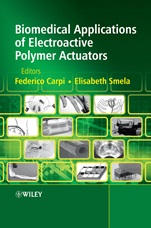
Biomedical Applications of Electroactive Polymer Actuators
ISBN 9780470773055
Autor: Federico Carpi, Elisabeth Smela
Wydawca: Wiley
Dostępność: 3-6 tygodni
Cena: 808,50 zł
Przed złożeniem zamówienia prosimy o kontakt mailowy celem potwierdzenia ceny.
ISBN13: |
9780470773055 |
ISBN10: |
0470773057 |
Autor: |
Federico Carpi, Elisabeth Smela |
Oprawa: |
Hardback |
Rok Wydania: |
2009-04-17 |
Ilość stron: |
496 |
Wymiary: |
252x174 |
Tematy: |
PN |
Giving fundamental information on one of the most promising families of smart materials, electroactive polymers (EAP) this exciting new titles focuses on the several biomedical applications made possible by these types of materials and their related actuation technologies. Each chapter provides a description of the specific EAP material and device configuration used, material processing, device assembling and testing, along with a description of the biomedical application.
Edited by well–respected academics in the field of electroactive polymers with contributions from renowned international experts, this is an excellent resource for industrial and academic research scientists, engineers, technicians and graduate students working with polymer actuators or in the fields of polymer science.
Spis treści:
Preface.
List of Contributors.
Introduction.
Polymer Gels.
1. Polymer Gel Actuators: Fundamentals (Paul Calvert).
1.1. Introduction and Historical Overview.
1.2. Properties of Gels.
1.3. Chemical and Physical Formation of Gels.
1.4. Actuation Methods.
1.5. Performance of Gels as Actuators.
1.6. Applications of Electroactive Gels.
1.7. Conclusions.
References.
2. Bioresponsive Hydrogels for Biomedical Applications (Tom McDonald, Alison Patrick, Richard Williams, Brian G. Cousins and Rein V. Ulijn).
2.1. Introduction.
2.2. Chemical Hydrogels.
2.3. Physical Hydrogels.
2.4. Defining Bioresponsive Hydrogels.
2.5. Bioresponsive Chemical Hydrogels.
2.6. Bioresponsive Physical Hydrogels.
2.7. Electroactive Chemical Hydrogels.
2.8. Conclusion.
References.
3. Stimuli–Responsive and ‘Active’ Polymers in Drug Delivery (Aram Omar Saeed, Jóhannes Páll Magn£sson, Beverley Twaites and Cameron Alexander).
3.1. Introduction.
3.2. Drug Delivery: Examples, Challenges and Opportunities for Polymers.
3.3. The eme
rging State of the Art Mechanisms In Polymer Controlled Release Systems.
3.4. Responsive or ‘Smart’ Polymers in Drug Delivery.
3.5. Recent Highlights of Actuated Polymers for Drug Delivery Applications.
3.6. Conclusions and Future Outlook.
References.
4. Thermally Driven Hydrogel Actuator for Controllable Flow Rate Pump in Long–Term Drug Delivery (Piero Chiarelli and Pietro Ragni).
4.1. Introduction.
4.2. Materials and Methods.
4.3. Hydrogel Actuator.
4.4. Pump Functioning.
4.5. Conclusion.
References.
Ionic Polymer–Metal Composites (IPMC).
5. IPMC actuators: Fundamentals (Kinji Asaka and Keisuke Oguro).
5.1. Introduction.
5.2. Fabrications.
5.3. Measurement.
5.4. Performance of the IPMC Actuator.
5.5. Model.
5.6. Recent Developments.
5.7. Conclusion.
References.
6. Active Micro–Catheter and Biomedical Soft Devices Based on IPMC Actuators (Kinji Asaka and Keisuke Oguro).
6.1. Introduction.
6.2. Fabrication of the IPMC Device.
6.3. Applications to Micro–Catheter.
6.4. Other Applications.
6.5. Conclusions.
References.
7. Implantable Heart–Assist and Compression Devices Employing Active Network of Electrically–Controllable Ionic Polymeric Metal Nanocomposites (Mohsen Shahinpoor).
7.1. Introduction.
7.2. Heart Failure.
7.3. Background of IPMNCs.
7.4. Three–Dimensional Fabrication of IPMNCs.
7.5. Electrically–Induced Robotic Actuation.
7.6. Distributed Nanosensing and Transduction.
7.7. Modeling and Simulation.
7.8. Application of IPMNCs to Heart Compression and Assist In General.
7.9. Manufacturing of Thick IPMC Fingers.
7.10. Conclusions.
References.
8. IPMC Based Tactile Displays for Pressure and Texture Presentation on a Human Finger (Masashi Konyo and Satoshi Tadokoro).
8.1. Introduction.
8.2. IPMC actuators as a Tactile Stimulator.
8.
3. Wearable Tactile Display.
8.4. Selective Stimulation Method for Tactile Synthesis.
8.5. Texture Synthesis Method.
8.6. Display Method for Pressure Sensation.
8.7. Display method for roughness sensation.
8.8. Display method for friction sensation.
8.9. Synthesis of total textural feeling.
8.10. Conclusions.
References.
9. IPMC Assisted Infusion Micropumps (Il–Seok Park, Sonia Vohnout, Mark Banister, Sangki Lee, Sang–Mun Kim and Kwang J. Kim).
9.1. Introduction.
9.2. Background of IPMC.
9.3. Miniature Disposable Infusion IPMC Micropumps.
9.4. Modeling for IPMC Micropumps.
9.5. Conclusions.
References.
Conjugated Polymers.
10. Conjugated Polymer Actuators: Fundamentals (Geoffrey M. Spinks, Gursel Alici, Scott McGovern, Binbin Xi and Gordon G. Wallace).
10.1. Introduction.
10.2. Molecular Mechanisms of Actuation in ICPs.
10.3. Comparison of Actuation Performance in Various ICPs.
10.4. Electrochemistry of ICPs.
10.5. Effect of Composition, Geometry and Electrolyte on Actuation of PPy.
10.6. Mechanical System Response.
10.7. Device Design and Optimization.
10.8. Future Prospects.
References.
11. Steerable Catheters (Tina Shoa, John D. Madden, Nigel R. Munce and Victor X. D. Yang).
11.1. Introduction.
11.2. Catheters: History And Current Applications.
11.3. Catheter Design Challenges.
11.4. Active Steerable Catheters.
11.5. Discussion and Conclusion.
References.
12. Microfabricated Conjugated Polymer Actuators for Microvalves, Cell Biology and Microrobotics (Elisabeth Smela).
12.1. Introduction.
12.2. Actuator Background.
12.3. Microfabrication.
12.4. Single Hinge Bilayer Devices: Flaps and Lids.
12.5. Multi–Bilayer Devices: Positioning Tools.
12.6. Swelling Film Devices: Valves.
12.7. Lifetime.
12.8. Integrated systems.
12.9. Conclusions.
References.
13. Actuated Pins for Braille
Displays (Geoffrey M. Spinks and Gordon G. Wallace).
13.1. Introduction.
13.2. Requirements for Electronic Braille screen.
13.3. Mechanical Analysis of Actuators Operating against Springs.
13.4. Polypyrrole Actuators for Electronic Braille Pins.
13.5. Other Polymer Actuation Systems for Electronic Braille Pins.
13.6. Summary.
Acknowledgements.
References.
14. Nanostructured Conducting Polymer Biomaterials and Their Applications in Controlled Drug Delivery (Mohammad Reza Abidian and David C. Martin).
14.1. Introduction.
14.2. Nanostructured Conducting Polymers.
14.3. Conducting Polymer Nanotubes for Controlled Drug Delivery.
14.4. Conclusions.
Acknowledgements.
References.
15. Integrated Oral Drug Delivery System with Valve Based on Polypyrrole (Thorsten Göttsche and Stefan Haeberle).
15.1. Introduction.
15.2. System Concept.
15.3. Osmotic Pressure Pump.
15.4. Polypyrrole in Actuator Applications.
15.5. Valve Concepts Evaluated in the Course of the Intellidrug Project.
15.6. Total assembly and Clinical Testing of the Intellidrug System.
Acknowledgements.
References.
Piezoelectric and Electrostrictive Polymers.
16. Piezoelectric and Electrostrictive Polymer Actuators: Fundamentals (Zhimin Li and Zhongyang Cheng).
16.1. Introduction.
16.2. Fundamentals of Electromechanical Materials.
16.3. Materials Properties related to Electromechanical Applications.
16.4. Typical Electromechanical Polymers and Their Properties.
16.5. Conclusion Remarks.
References.
17. Miniature High Frequency Focused Ultrasonic Transducers for Minimally Invasive Imaging Procedures (Aaron Fleischman, Sushma Srivanas, Chaitanya Chandrana and Shuvo Roy).
17.1. Introduction.
17.2. Coronary Imaging Needs.
17.3. High Resolution Ultrasonic Transducers.
17.4. Fabrication Techniques.
17.5. Testing Methods.
17.6. Results.
17.7. Conclusion.
Ref
Koszyk
Książek w koszyku: 0 szt.
Wartość zakupów: 0,00 zł
Informacje


Kontakt
Gambit
Centrum Oprogramowania
i Szkoleń Sp. z o.o.
Al. Pokoju 29b/22-24
31-564 Kraków
Siedziba Księgarni
ul. Kordylewskiego 1
31-542 Kraków
+48 12 410 5991
+48 12 410 5987
+48 12 410 5989
Subskrypcje
Administratorem danych osobowych jest firma Gambit COiS Sp. z o.o. Na podany adres będzie wysyłany wyłącznie biuletyn informacyjny.
Autoryzacja płatności

Informacje na temat autoryzacji płatności poprzez PayU.

© Copyright 2012: GAMBIT COiS Sp. z o.o. Wszelkie prawa zastrzeżone.
Projekt i wykonanie: Alchemia Studio Reklamy