


Wydawcy
Katalog tematyczny
- Archeologia (109)
- Ekonomia, finanse, business (13704)
- Filozofia (1445)
- Historia (3040)
- Języki i językoznawstwo (2356)
- Lifestyle, hobby i rozrywka (475)
- Medycyna (9704)
- Nauki humanistyczne (4)
- Nauki o Ziemi i środowisku (2638)
- Nauki ścisłe (20412)
- Nauki społeczne (8486)
- Nauki techniczne (13450)
- Prawo (1696)
- Publikacje informacyjne i interdyscyplinarne (1288)
- Religia i wierzenia (917)
- Technika komputerowa (4067)
- Zdrowie, relacje międzyludzkie i rozwój osobisty (657)





Informacje szczegółowe o książce
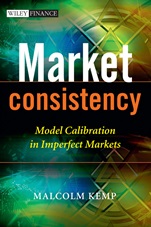
Market Consistency: Model Calibration in Imperfect Markets
ISBN 9780470770887
Autor: Malcolm Kemp
Wydawca: Wiley
Dostępność: 3-6 tygodni
Cena: 313,95 zł
Przed złożeniem zamówienia prosimy o kontakt mailowy celem potwierdzenia ceny.
ISBN13: |
9780470770887 |
ISBN10: |
0470770880 |
Autor: |
Malcolm Kemp |
Oprawa: |
Hardback |
Rok Wydania: |
2009-09-04 |
Ilość stron: |
376 |
Wymiary: |
249x175 |
Tematy: |
KF |
This excellent and very timely book might reasonably have been entitled How I Learned to have an Adult Relationship with Financial Markets. I heartily commend this valuable contribution to present global debates on regulation of banks and others. It should be on the bookshelves of regulators and accounting standard–setters as well as of general managers and non–executive directors of banks, insurers, and asset managers. It will be a valuable tool in support of the education of the actuaries, accountants, risk managers and asset managers of the future. It is very up to date and should stand the test of time in future. A very welcome addition to the literature."
—Seamus Creedon, Consultant, KPMG LLP
"In a period in which there is considerable confusion about ‘what the market has to say’ this work is a timely, comprehensive, up–to–date and lucid treatment of all the concepts and techniques needed for marking assets and liabilities to market across all financial service disciplines. With its unique all–inclusive scope it is sure to become a standard reference for bankers, insurers, fund managers and academics in finance."
—Professor Michael Dempster, Centre for Financial Research Statistical Laboratory, University of Cambridge
"Malcolm Kemp has written a very timely book on market–consistent valuation and model calibration. Given the recent market developments and the upcoming changes in regulation in the EU (Solvency II), the issue of market–consistent valuation has become a very hot topic. Kemp not only gives a review of the relevant literature and offers in–depth discussion of all the relevant issues surrounding market–consistent model calibration, but also offers a practioner′s perspective. I feel this gives the book great added value."
—Antoon Pelsser, Professor of Actuarial Science, University of Amsterdam
Achieving market consi
stency can be challenging, even for the most established finance practitioners. In Market Consistency: Model Calibration in Imperfect Markets, leading expert Malcolm Kemp shows readers how they can best incorporate market consistency across all disciplines. Building on the author′s experience as a practitioner, writer and speaker on the topic, the book explores how risk management and related disciplines might develop as fair valuation principles become more entrenched in finance and regulatory practice.
This is the only text that clearly illustrates how to calibrate risk, pricing and portfolio construction models to a market consistent level, carefully explaining in a logical sequence when and how market consistency should be used, what it means for different financial disciplines and how it can be achieved for both liquid and illiquid positions. It explains why market consistency is intrinsically difficult to achieve with certainty in some types of activities, including computation of hedging parameters, and provides solutions to even the most complex problems.
The book also shows how to best mark–to–market illiquid assets and liabilities and to incorporate these valuations into solvency and other types of financial analysis; it indicates how to define and identify risk–free interest rates, even when the creditworthiness of governments is no longer undoubted; and it explores when practitioners should focus most on market consistency and when their clients or employers might have less desire for such an emphasis.
Finally, the book analyses the intrinsic role of regulation and risk management within different parts of the financial services industry, identifying how and why market consistency is key to these topics, and highlights why ideal regulatory solvency approaches for long term investors like insurers and pension funds may not be the same as for other financial market participants such as banks and asset managers.
<
br>Spis treści:
Preface.
Acknowledgements.
Abbreviations.
Notation.
1 Introduction.
1.1 Market consistency.
1.2 The primacy of the ‘market.
1.3 Calibrating to the ‘market’.
1.4 Structure of the book.
1.5 Terminology.
2 When is and when isn’t Market Consistency Appropriate?
2.1 Introduction.
2.2 Drawing lessons from the characteristics of money itself.
2.3 Regulatory drivers favouring market consistent valuations.
2.4 Underlying theoretical attractions of market consistent valuations.
2.5 Reasons why some people reject market consistency.
2.6 Market making versus position–taking.
2.7 Contracts that include discretionary elements.
2.8 Valuation and regulation.
2.9 Marking–to–market versus marking–to–model.
2.10 Rational behaviour?
3 Different Meanings given to ‘Market Consistent Valuations’.
3.1 Introduction.
3.2 The underlying purpose of a valuation.
3.3 The importance of the ‘marginal’ trade.
3.4 Different definitions used by different standards setters.
3.5 Interpretations used by other commentators.
4 Derivative Pricing Theory.
4.1 Introduction.
4.2 The principle of no arbitrage.
4.3 Lattices, martingales and Îto calculus.
4.4 Calibration of pricing algorithms.
4.5 Jumps, stochastic volatility and market frictions.
4.6 Equity, commodity and currency derivatives.
4.7 Interest rate derivatives.
4.8 Credit derivatives.
4.9 Volatility derivatives.
4.10 Hybrid instruments.
4.11 Monte Carlo techniques.
4.12 Weighted Monte Carlo and analytical analogues.
4.13 Further comments on calibration.
5 The Risk–free Rate.
5.1 Introduction.
5.2 What do we mean by ‘risk–free’?
5.3 Choosing between possible meanings of ‘risk–free’.
6 Liquidity Theory.
6.1 Introduction
.
6.2 Market experience.
6.3 Lessons to draw from market experience.
6.4 General principles.
6.5 Exactly what is liquidity?
6.6 Liquidity of pooled funds.
6.7 Losing control.
7 Risk Measurement Theory.
7.1 Introduction.
7.2 Instrument–specific risk measures.
7.3 Portfolio risk measures.
7.4 Time series–based risk models.
7.5 Inherent data limitations applicable to time series–based risk models.
7.6 Credit risk modelling.
7.7 Risk attribution.
7.8 Stress testing.
8 Capital Adequacy.
8.1 Introduction.
8.2 Financial stability.
8.3 Banking.
8.4 Insurance.
8.5 Pension funds.
8.6 Different types of capital.
9 Calibrating Risk Statistics to Perceived ‘Real World’ Distributions.
9.1 Introduction.
9.2 Referring to market values.
9.3 Backtesting.
9.4 Fitting observed distributional forms.
9.5 Fat–tailed behaviour in individual return series.
9.6 Fat–tailed behaviour in multiple return series.
10 Calibrating Risk Statistics to ‘Market Implied’ Distributions.
10.1 Introduction.
10.2 Market implied risk modelling.
10.3 Fully market consistent risk measurement in practice.
11 Avoiding Undue Pro–cyclicality in Regulatory Frameworks.
11.1 Introduction.
11.2 The 2007–09 credit crisis.
11.3 Underwriting of failures.
11.4 Possible pro–cyclicality in regulatory frameworks.
11.5 Re–expressing capital adequacy in a market consistent framework.
11.6 Discount rates.
11.7 Pro–cyclicality in Solvency II.
11.8 Incentive arrangements.
11.9 Systemic impacts of pension fund valuations.
11.10 Sovereign default risk.
12 Portfolio Construction.
12.1 Introduction.
12.2 Risk–return optimisation.
12.3 Other portfolio construction styles.
12.4 Risk budgeting.
12.5 Reverse optimisation and implied view analysis.
12.6
Koszyk
Książek w koszyku: 0 szt.
Wartość zakupów: 0,00 zł
Informacje


Kontakt
Gambit
Centrum Oprogramowania
i Szkoleń Sp. z o.o.
Al. Pokoju 29b/22-24
31-564 Kraków
Siedziba Księgarni
ul. Kordylewskiego 1
31-542 Kraków
+48 12 410 5991
+48 12 410 5987
+48 12 410 5989
Subskrypcje
Administratorem danych osobowych jest firma Gambit COiS Sp. z o.o. Na podany adres będzie wysyłany wyłącznie biuletyn informacyjny.
Autoryzacja płatności

Informacje na temat autoryzacji płatności poprzez PayU.

© Copyright 2012: GAMBIT COiS Sp. z o.o. Wszelkie prawa zastrzeżone.
Projekt i wykonanie: Alchemia Studio Reklamy